


Basilica of Santa Maria Assunta known as the Tomb in Adria, Italy
Introduction
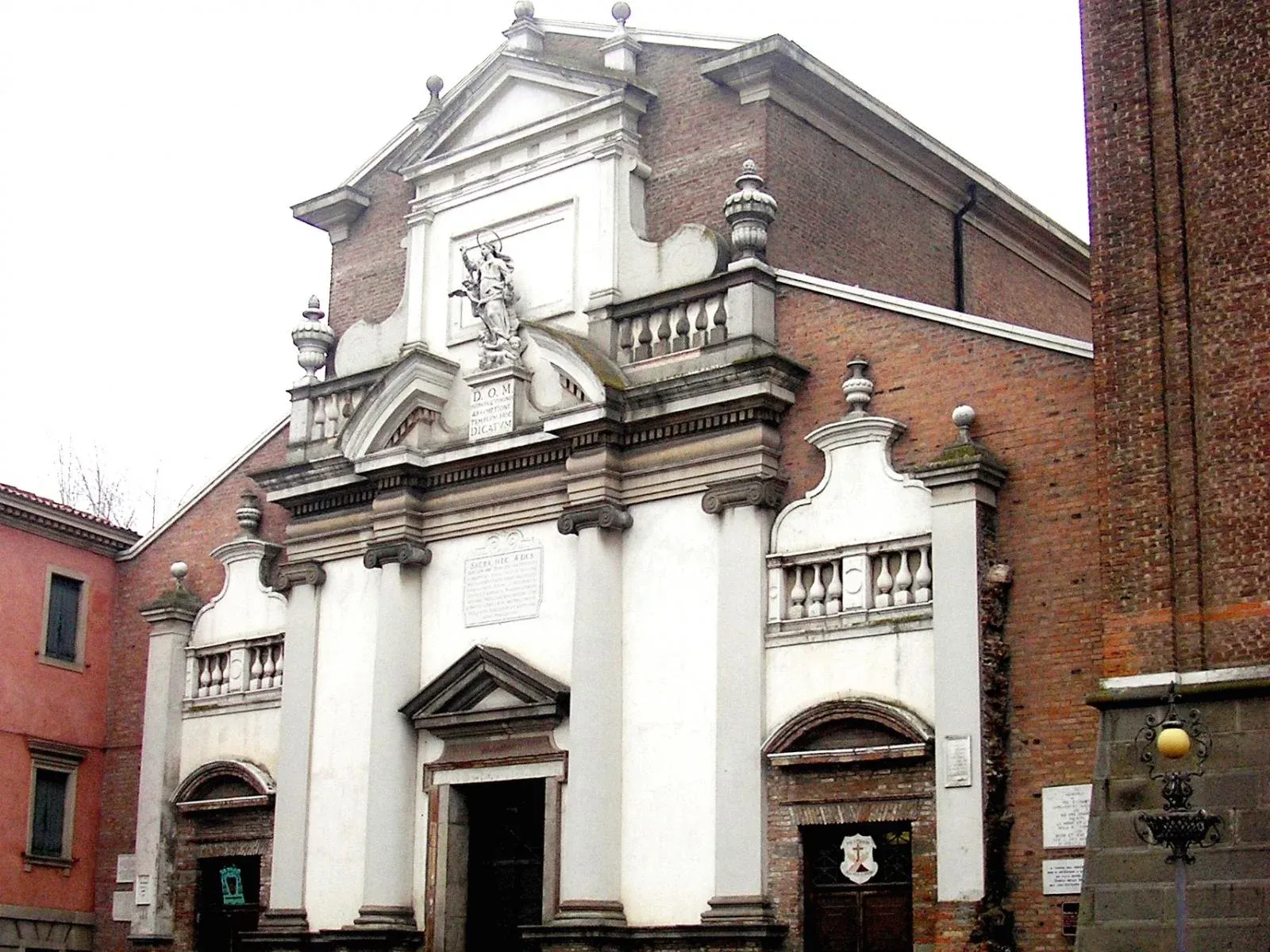
The Basilica of Santa Maria Assunta, also known as della Tomba, is a sacred building located on Via Francesco Bocchi in Adria. It has been elevated to the status of a minor basilica and remains the oldest existing religious structure in the town and surrounding area.
The basilica’s name, “della Tomba,” could refer to its proximity to a Roman tomb or its elevated position compared to the surrounding land. The church’s current appearance is mainly due to renovations carried out in 1718, when the façade was moved and reconstructed. Further minor changes were made between the 1930s and 1940s to ensure its preservation.
The basilica features several notable works of art, including the statue of the Assumption, created by Giacomo Contiero, which is positioned above the main portal. Inside, there are 15th and 16th-century paintings, and a terracotta high relief of the Dormitio Virginis in the chapel, attributed to Michele da Firenze. Another significant feature is the octagonal immersion baptismal font, dating back to the 7th or 8th century, which bears an inscription mentioning Bishop Bono, the second bishop of Adria.
History of Basilica of Santa Maria Assunta known as the Tomb in Adria, Italy
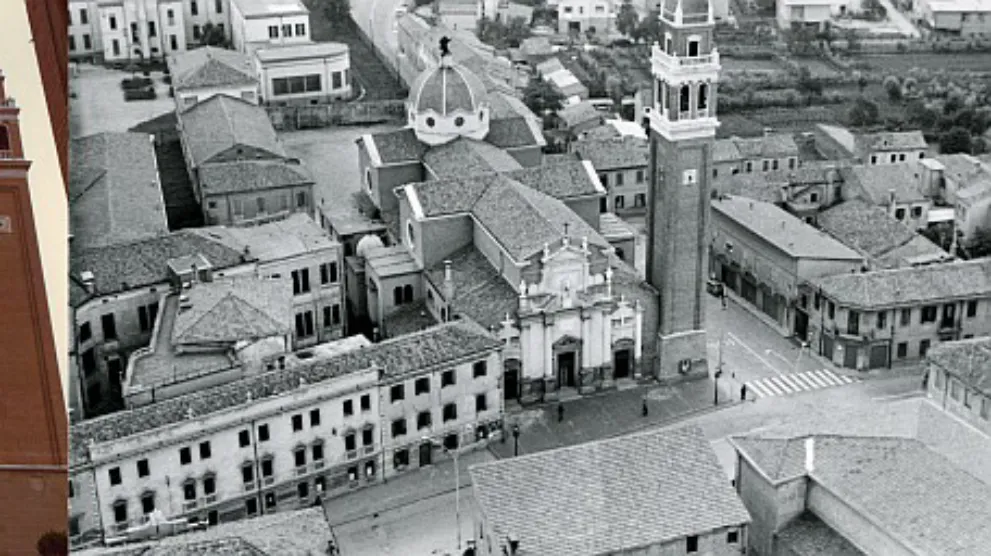
Historical Significance
The Basilica of Santa Maria Assunta, also known as della Tomba, holds the distinction of being the oldest existing sacred building in the Polesine region, despite undergoing multiple renovations and extensions over the centuries. It was built on the site of the earlier Basilica della Tomba, which dates back to the first centuries of the Christian era. The location is believed to have been chosen due to its association with an earlier pagan basilica, making the church a significant intersection of both Christian and pre-Christian history. As such, the basilica not only serves as a place of worship but also as an important historical and cultural landmark in the region.
The Meaning of “Tomba”
The nickname Tomba, meaning “tomb,” has sparked various interpretations over the years. One possible explanation is that it refers to the basilica’s proximity to a Roman tomb. Archaeological evidence suggests the presence of Roman-era burial sites in the vicinity, potentially leading to the association with the term “tomb.” Another interpretation is that the name could derive from the church’s elevated location—ad tumulum, meaning “at the tomb”—which places it higher than the surrounding area and other nearby buildings. This elevated position may have contributed to the name, emphasizing the church’s prominence in the landscape and its connection to the concept of a sacred resting place.
Renovations and Modifications
The church’s current appearance is largely due to significant renovations, with the most notable being in 1718. During this renovation, the façade was moved and rebuilt in a more advanced position, which altered the original design of the building. The new façade brought a more modern and refined architectural style to the church, while maintaining its historical essence. In addition to the 1718 renovation, the basilica underwent minor interventions between the 1930s and 1940s, during which further adjustments were made to preserve the structure and adapt it to modern requirements. These renovations helped maintain the basilica’s integrity while ensuring it continued to serve the spiritual needs of the community.
In summary, despite the church’s many changes, its deep historical roots and ongoing renovations ensure that it remains a crucial piece of Polesine’s heritage, serving as both a religious site and a monument to the area’s rich past.
Architecture of Basilica of Santa Maria Assunta known as the Tomb in Adria, Italy
Baptismal Font: A Historical Element
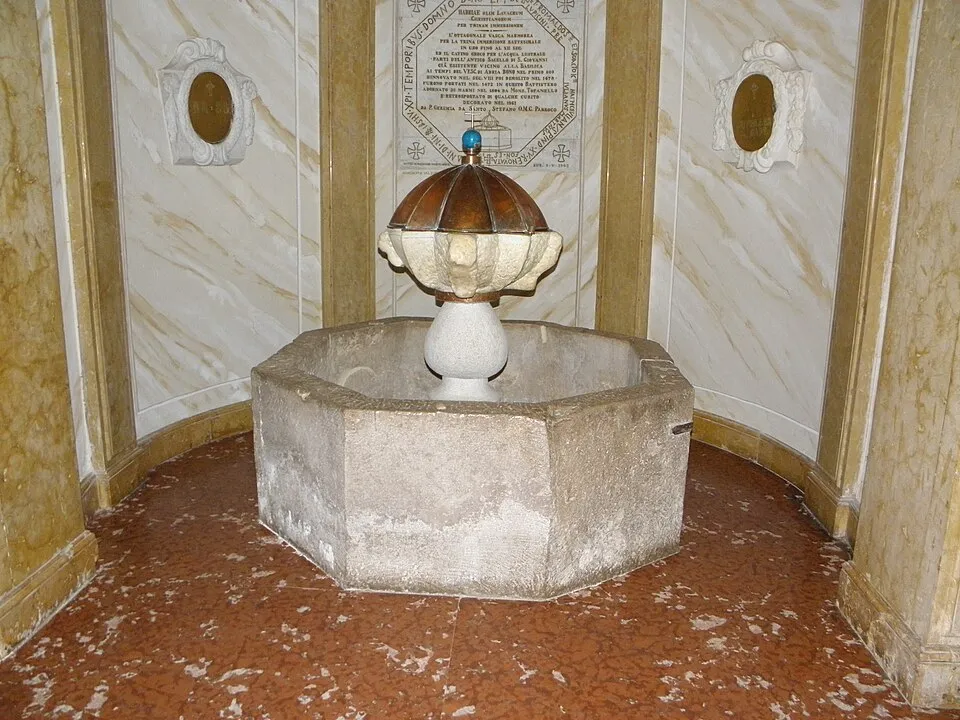
The baptismal font inside the Basilica of Santa Maria Assunta is one of the most significant and ancient features of the church. It stands as the oldest internal architectural element, reflecting both the historical and spiritual importance of the basilica. The baptismal font comprises two parts: the original basin, dating back to the 6th century, and a later additional basin, which was added in a subsequent period.
This large, octagonal-shaped basin was discovered during excavations near the Adria thermal baths, which are situated not far from the area believed to contain the tombs. The font was initially part of a broader complex of buildings that included a chapel dedicated to Saint Stephen and an octagonal baptistery. After the demolition of the chapel in 1478, the basin was repurposed as a holy water stoup, though it would later be placed back at the center of the basilica.
The baptismal font features a prominent lion’s head, which holds significant symbolism. The Lion of St. Mark is traditionally associated with the Evangelist Mark, and this iconography is the only remaining visible design on the lip of the font. Over the centuries, the rubbing of hands from the faithful has worn away much of the other iconography that originally decorated the font. On the lip of the font, there are also inscriptions that date back to the 8th century, with references to important church figures such as Bishop Bono and archpriests Romoaldo (740) and Lupicino (750).
In 1804, the font was relocated to a newly built baptistery, which was constructed using precious marbles. This new baptistery was placed a little further back from its original position, and in 1961, under the guidance of Father Geremia di Santo Stefano, the font was permanently placed in the first chapel on the left side of the basilica.
Sacred Art Inside the Basilica
16th-Century Sacred Art
The interior of the Basilica of Santa Maria Assunta contains a wealth of 16th-century sacred art, enriching the church’s spiritual atmosphere. Among the notable pieces is a fresco depicting the Madonna del Latte, which offers a glimpse into the religious themes of the era. In addition to this, the basilica houses a crucifix and a painted terracotta high relief that has been identified by various sources as part of a 15th-century altar.
The high relief originally depicted a Dormitio Virginis, surrounded by thirteen figures, which has caused some debate regarding its attribution. Initially linked to the Master of the Modena Statuettes, the work was later attributed to artists such as Niccolò Baroncelli, Jacopo della Quercia, and Michele da Firenze. Fragments of this altar, including pieces of the relief, are now part of the collection at the Bocchi Museum.
The Apse: 20th-Century Art
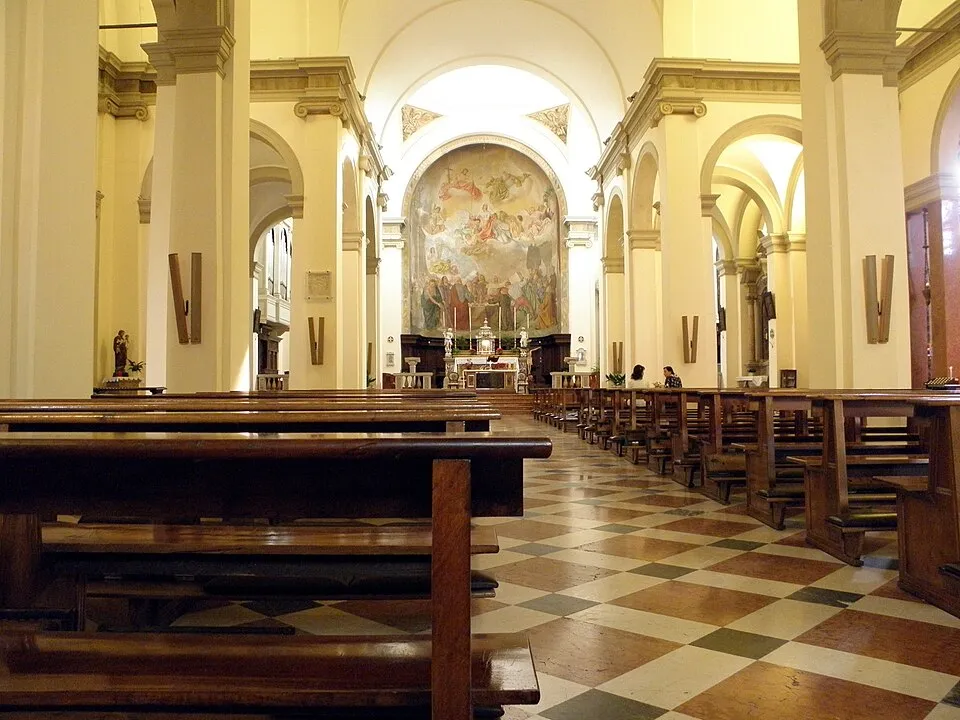
One of the most striking features of the basilica’s apse is the fresco of the Assumption of the Virgin, which covers the entire apse area. This monumental work was created in 1943 by Antonio Maria Nardi, a significant artist of the time. Nardi’s art brought a contemporary style to the basilica, while still maintaining the sacred themes associated with the church. In addition to the apse fresco, Nardi also created two altarpieces: “S. Cuore e S. Margherita Alacoque” and “S. Francesco ricevi le Stimmate”, both of which contribute to the church’s vibrant artistic legacy.
Via Crucis by Attilio Sacchetto
Another important piece of sacred art inside the basilica is the Via Crucis, a series of stations depicting the Passion of Christ. Created by Attilio Sacchetto, a local carver from Adria, the Via Crucis was donated to the basilica in 1955. The work is an excellent example of the region’s tradition of craftsmanship, and it enhances the church’s rich collection of religious art. The Via Crucis remains an essential part of the basilica’s interior, providing both spiritual and artistic value for visitors and worshippers alike.
Feast Day
Feast Day: 15th August
The Basilica of Santa Maria Assunta, also known as della Tomba, in Adria, Italy, celebrates the Feast of the Assumption of the Virgin Mary on August 15th each year. This feast is a significant event in the liturgical calendar of the Catholic Church, honoring the belief that the Virgin Mary was assumed into heaven, body and soul, at the end of her earthly life. The basilica, dedicated to the Assumption of the Virgin Mary, marks this occasion with special Masses, prayers.
Church Mass Timing
Monday : 6:30 PM
Tuesday : 6:30 PM
Wednesday : 6:30 PM
Thursday : 6:30 PM
Friday : 6:30 PM
Saturday : 5:00 PM
Sunday : 09:30 AM
Church Opening Time:
Monday : 7:00 am – 12:00 pm, 3:00 pm – 7:00 pm
Tuesday : 7:00 am – 12:00 pm, 3:00 pm – 7:00 pm
Wednesday : 7:00 am – 12:00 pm, 3:00 pm – 7:00 pm
Thursday : 7:00 am – 12:00 pm, 3:00 pm – 7:00 pm
Friday : 7:00 am – 12:00 pm, 3:00 pm – 7:00 pm
Saturday : 7:00 am – 12:00 pm, 3:00 pm – 7:00 pm
Sunday : 7:00 am – 12:00 pm, 3:00 pm – 7:00 pm
Contact Info
Address :
Via Francesco Bocchi, 45011 Adria RO, Italy
Phone : +39042621725
Accommodations
Connectivities
Airway
Venice (VCE) Airport to Basilica of Santa Maria Assunta (Adria)distance between 59 min (69.4 km) via SS 309 Romea.
Railway
Adria Railway Station to Basilica of Santa Maria Assunta (adria) distance between 5 min (1.9 km) via Via G. Badini.