


Basilica of Saint Euphemia in Grado, Italy
Introduction
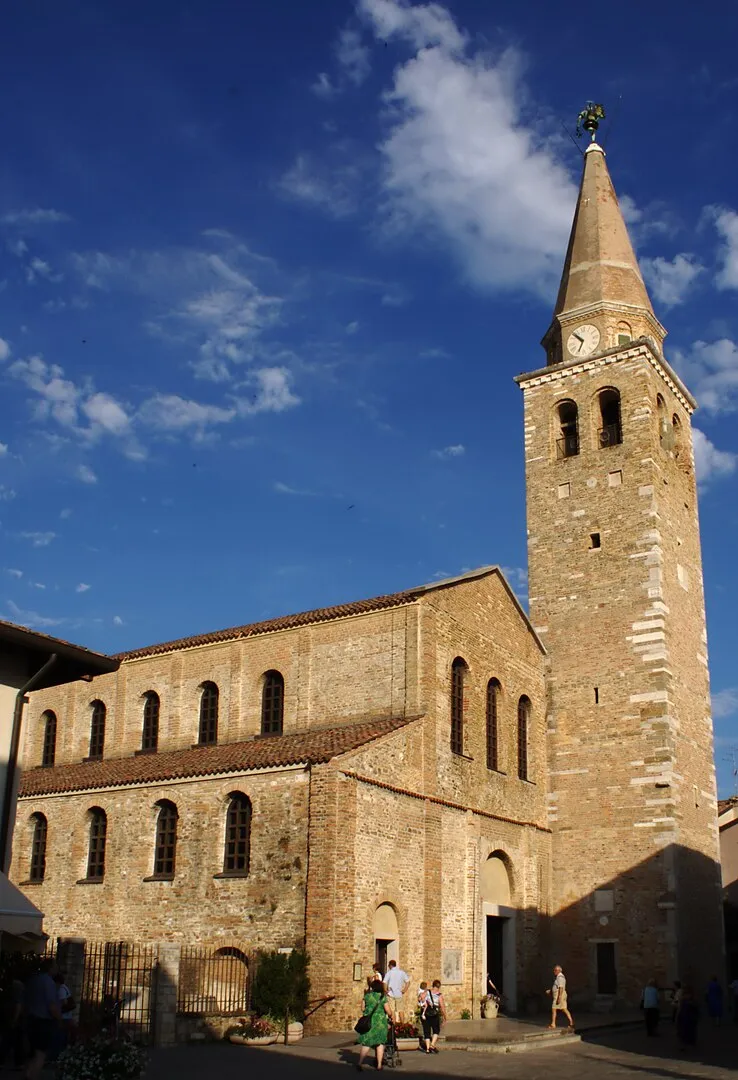
The Patriarchal Basilica of Sant’Eufemia serves as the primary religious structure in Grado, located within the province and archdiocese of Gorizia. This basilica, once the cathedral of the now-suppressed Patriarchate of Grado, holds great historical significance.
Dating back to the 6th century, it stands proudly in the central square of the ancient patriarchal city. The basilica is accompanied by a baptistery and is further highlighted by a 15th-century bell tower, which features a striking spire.
History of Basilica of Saint Euphemia in Grado, Italy
Foundation and Early History
The Patriarchal Basilica of Sant’Eufemia has its origins in the 5th century, with a previous basilica possibly commissioned by Nicetas, the metropolitan of Aquileia, during the invasion of Attila the Hun. The current structure was commissioned in the 6th century by Elia, the archbishop of Aquileia, who was fleeing the Lombard invasion. Elia proclaimed autocephaly, declaring himself patriarch in opposition to Pope Pelagius II and the condemnation of the Three Chapters. He dedicated the new church to Saint Euphemia of Chalcedon, the patron saint of the Council of Chalcedon, and likely consecrated it on November 3, 579. At the same time, the cult of Saint Euphemia spread through the Larian lands thanks to Agrippino, the bishop of Como, who also built a basilica dedicated to her on Comacina Island.
The Rise of the Patriarchate of Grado and Decline
By the 7th century, the basilica became the seat of the pro-Roman and pro-Byzantine faction in the Patriarchate of Aquileia. This led to the establishment of the Patriarchate of Grado between 717 and 739, with Grado becoming a counterpart to Aquileia. However, the basilica’s importance began to decline in 1105 when Giovanni Gradenigo, the patriarch of Aquileia, moved the patriarchal seat to Venice. Despite this, the basilica retained the title of patriarchal chair even after 1177, when Venice was officially recognized by the Pope as the seat of the patriarchs.
Transition to Venice and Modern Era
In 1451, the title of Patriarch of Grado was suppressed, and the patriarchate of Venice was established. As a result, the basilica lost its status as a cathedral, and the title was transferred to San Pietro di Castello in Venice. In 1455, the bell tower was constructed, topped by a weathervane statue of the Archangel Michael (though it is believed to represent the Archangel Gabriel). In 1818, the basilica became part of the Archdiocese of Gorizia, and in 1888, Luigi Mattia Zorn, Archbishop of Gorizia, consecrated the basilica, reaffirming its role as a parish. Despite its long history, it is unclear if the original dedication to Saint Euphemia has been preserved in modern times.
Architecture of Basilica of Saint Euphemia in Grado, Italy

Exterior and Architectural Design
The Patriarchal Basilica of Sant’Eufemia stands as a remarkable example of early Christian architecture, constructed primarily from exposed brick and sandstone. The basilica’s exterior has undergone several modifications over the centuries, particularly during the 17th and 19th centuries. These changes were largely reversed in the mid-20th century when significant restoration efforts took place to preserve the original structure. The basilica’s façade, facing the Piazza del Patriarcato, is divided into salients and pilaster strips, contributing to the symmetrical, formal appearance of the building. It features three prominent windows beneath which traces of the ancient narthex remain visible, although the narthex itself has since disappeared. The bell tower, attached to the right side of the basilica, adds to the grandeur of the structure. This Venetian-style tower, completed in the 15th century, is topped with a spire, enhancing the basilica’s visual appeal. The bell tower’s distinct design ties the structure to Venice’s architectural influences.
Interior Highlights
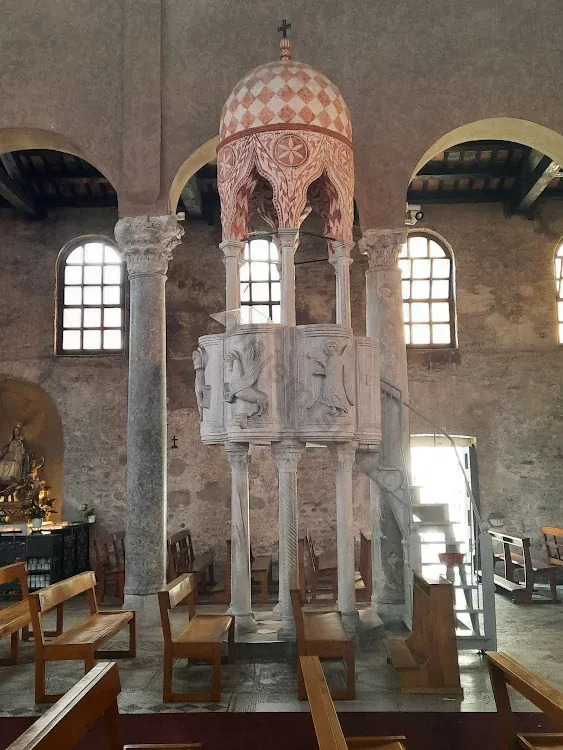
The interior of the basilica is vast and illuminated by natural light, with its layout consisting of three naves separated by polychrome marble columns. Many of these columns, along with their capitals, are remnants of the Roman era, contributing an ancient charm to the building. These columns support the arches that span the interior, leading to a trussed roof above. The ample windows along the perimeter walls allow sunlight to flood the space, enhancing the feeling of openness and serenity within the basilica.
One of the most striking features of the basilica is the floor mosaic, which dates back to the end of the 6th century. This intricate mosaic spans a significant area of the basilica’s floor, depicting biblical scenes and Christian symbols. On the left side of the central nave, visitors can find a tall hexagonal pulpit, an example of Moorish architecture that includes sculptural details from the 13th century. The pulpit serves as both a functional piece and a work of art, offering a glimpse into the stylistic evolution of the church.
In the presbytery, which is adorned with 15th-century frescoes, the golden altarpiece stands out as a major artistic and historical treasure. This altarpiece, donated by Venetian nobleman Donato Mazzalorsa in 1372, is a masterpiece of embossed and chiselled silver. It features religious scenes in three distinct registers: the Annunciation, images of Christ and the Evangelists, and a depiction of Christ on the throne with Saint Mark celebrating mass. This altarpiece is an important reminder of the basilica’s deep connections to Venice and its artistic traditions. Another important feature is the Madonna degli Angeli statue, which is venerated during the annual Perdon di Barbana festival, where it is carried in procession through the lagoon to the Sanctuary of Barbana.
Baptistery and its Historical Significance
The baptistery is located adjacent to the basilica on its left side, forming part of the complex. The baptistery, octagonal in shape, was originally constructed in the second half of the 5th century, though it has undergone several remodeling efforts over the centuries. One significant restoration took place in 1928, during which the Baroque floor was removed and the baptistery was lowered by approximately 2.20 meters to reveal its ancient mosaic floor, which dates back to the 6th century. This restoration also uncovered the small altar, which now sits in the apse at the end of the entrance. The baptismal font, crafted from green cipollino marble, is hexagonal in design, a characteristic feature that links it to the early Christian period. The windows in the baptistery were also reopened during the restoration, bringing in more light and offering views of the surroundings.
In front of the baptistery is a churchyard that houses ancient Roman sarcophagi found in the area around Grado. These artifacts provide a historical connection to the region’s past, highlighting the continuity of sacred spaces in the area from Roman to Christian times. The baptistery is a critical part of the basilica complex, reflecting both the early Christian roots of the site and the continuing reverence for the saints and sacred rituals that have taken place here over the centuries. The basilica’s rich historical layers, from its mosaics to its architectural details, tell the story of Grado’s importance as a religious center through the ages.
Feast Day
Feast Day: 16th September
The Feast Day of the Basilica di Sant’Eufemia in Grado, Italy, is celebrated on September 16th. This day honors Saint Euphemia, the patron saint of the basilica, whose relics are believed to have been brought to Grado during the early Christian period.
Church Mass Timing
Monday : 6:00 PM
Tuesday : 6:00 PM
Wednesday : 8:30AM and 6:00 PM
Thursday : 6:00 PM
Friday : 6:00 PM
Saturday : 6:00 PM
Sunday : 8:30AM And 10:00 AM
Church Opening Time:
Monday : 7:30 am – 6:30 pm
Tuesday : 7:30 am – 6:30 pm
Wednesday : 7:30 am – 6:30 pm
Thursday : 7:30 am – 6:30 pm
Friday : 7:30 am – 6:30 pm
Saturday : 7:30 am – 6:30 pm
Sunday : 7:30 am – 5:00 pm
Contact Info
Address :
Campo Patriarca Elia, 13, 34073 Grado GO, Italy
Phone : +39043180146
Accommodations
Connectivities
Airway
Trieste (TRS) Airport to Basilica of Saint Euphemia in Grado, Italy distance between 31 min (24.7 km) via SR352.
Railway
Monfalcone Railway Station to Basilica of Saint Euphemia in Grado, Italy distance between 36 min (27.3 km) via SP19.