


Cathedral Basilica of the Assumption of Our Lady, Guadalajara, Mexico
Introduction
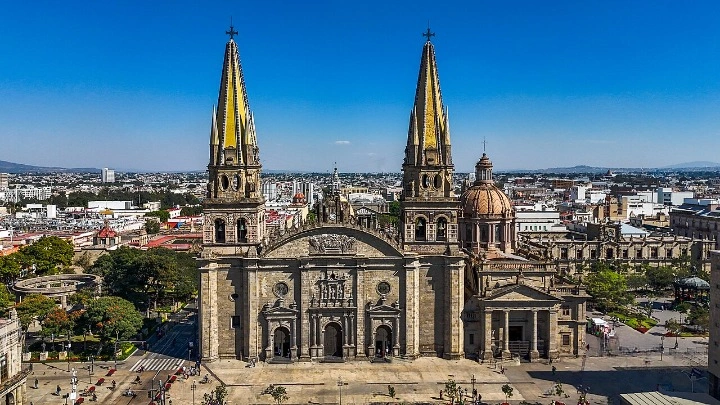
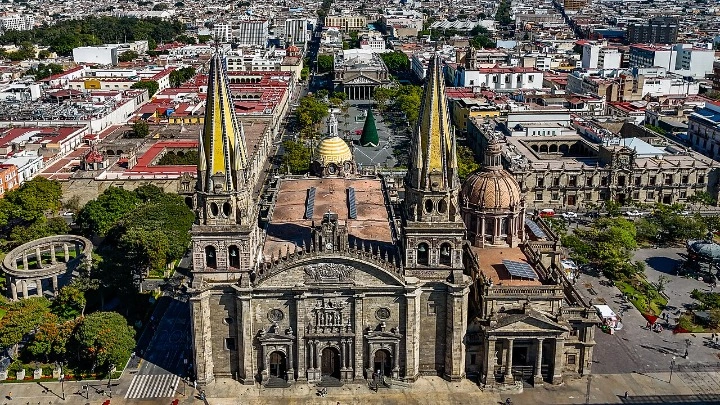
The Guadalajara Cathedral, also known as the Cathedral of the Assumption of Our Lady (in Spanish, Catedral de Guadalajara or Catedral de la Asunción de María Santísima), is one of the most iconic landmarks in the heart of Guadalajara, Jalisco. In addition to being the primary church of the Archdiocese of Guadalajara, it is also known as a minor basilica. The building itself is mostly done in the Spanish Renaissance style, but its tall, pointed spires stand out in a more neo-Gothic design, which gives the cathedral a unique look. This cathedral isn’t just a beautiful old church it’s also the official seat of the Archbishop of Guadalajara and is dedicated to the Assumption of the Virgin Mary. Back on December 21, 1938, Pope Pius XI officially gave it the title of minor basilica. You’ll find it right in the historic center of the city, along Paseo Alcalde, surrounded by four major plazas: Plaza de Armas, Plaza Guadalajara, Plaza de la Liberación, and the Rotunda of Illustrious Jaliscienses. Because of its cultural and historical importance, the National Institute of Anthropology and History (INAH) declared it a historical monument on April 20, 1943.
History of the Cathedral Basilica of the Assumption of Our Lady, Guadalajara, Mexico
In the space occupied by the temple of Santa María de Gracia was where the Church of San Miguel, the first cathedral of Guadalajara, was built, under the patronage of Saint Michael the Archangel. It is worth mentioning that this church was next to the first main square of the city and is now known as the Plaza Fundadores. The old cathedral was a fairly simple adobe temple. There was a fire on May 30, 1574 that severely damaged the church. Sometime later the center of Guadalajara moved to the new main square, where the new cathedral was built. On May 18, 1561, authorization was obtained from Philip II of Spain by royal decree to build the new cathedral church, the cost of which would be covered by the Treasury Council ; so on July 31, 1561, Pedro de Ayala , then the second bishop of New Galicia , laid and blessed the first stone of the temple. However, its construction did not begin until 1571. It was consecrated on October 22, 1618. In the 19th century, the architect José Gutiérrez replaced the gilded wooden baroque altarpieces with similar but now neoclassical ones. In 1818, a powerful earthquake struck the city, leaving a new tragedy in its aftermath: the towers and dome had collapsed. They were replaced by new ones, which also collapsed during a subsequent earthquake in 1849. Bishop Aranda commissioned the construction of the new ones to the architect Manuel Gómez Ibarra, whose works in Guadalajara include the dome of the Hospicio Cabañas, the portico of the Temple of Our Lady of Pilar , and the Sanctuary of San José de Gracia . It is said that after the Corpus Christi procession , around 1850-1851, the prelate mitigated the intense heat of June with pitayas , served on a platter adorned with figures and landscapes, which also illustrated pyramidal bell towers, just like the current ones with which the architect modeled this religious enclosure, who used pumice stone as construction material to lighten them in the face of the danger of seismic episodes . The investment from July 30, 1851 to June 15, 1854, was 33,521 pesos, plus 7,166 pesos in fees for the architect, at a rate of 2,000 pesos per year. In 1915 it was stripped of its atrium with wrought iron grille that adorned its front, which had been ordered to be built by the first archbishop of Guadalajara, Pedro Espinosa y Dávalos. Governor Manuel M. Diéguez ordered its destruction to widen the Avenida Alcalde. On December 21, 1938, Pope Pius XII elevated it to the rank of minor basilica, dedicated to the Assumption of Mary. In 1988, work began on the cathedral. In 1993, the towers were restored and the old high altar, which was made of Carrara marble and featured sculptures of the evangelists, was demolished. The cathedral church is currently in danger: it has been damaged by earthquakes in 1932, 1957, 1979, 1985, 1995 and 2003. Among the risks it presents are: the brief inclination of the north tower, its slight subsidence and the structural damage suffered by the dome, among others. Due to the constant vibrations generated by vehicles circulating in the tunnel under Hidalgo Avenue, the building and the north tower, which borders this road, are being damaged.
Architecture of Cathedral Basilica of the Assumption of Our Lady, Guadalajara, Mexico
Architects: Martín Casillas, Manuel Gomez Ibarra.
Architectural style: Gothic Revival architecture, Renaissance architecture.
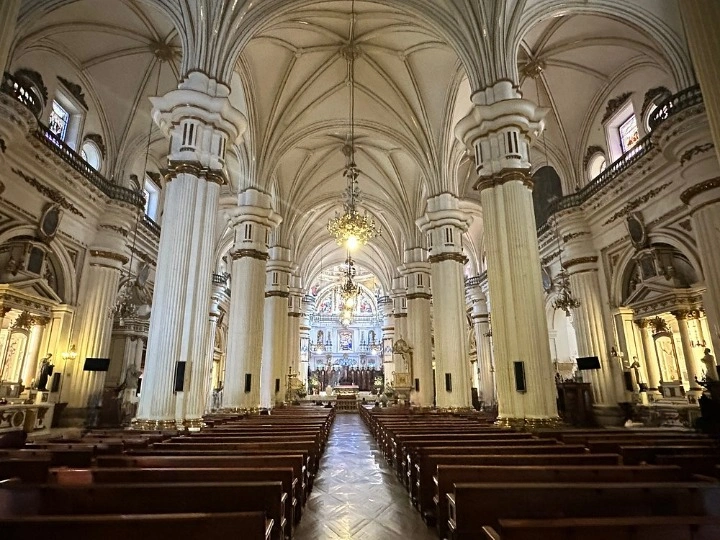
The Guadalajara Cathedral is quite large, covering an area of about 5,660 square meters. It measures roughly 77.8 meters long by 72.75 meters wide. The structure is laid out like a typical basilica, with three main naves divided into six sections by sturdy columns. The materials used in its construction are typical of the region a mix of adobe, yellow stone quarry, and tezontle, which is a reddish volcanic rock commonly found in Mexico. This combination gives the cathedral its distinctive look, blending earthy tones with the elegance of stone. Several altars dedicated to significant religious figures and local devotions can be found inside the cathedral. These include Our Lady of Zapopan, Guadalajara’s patron saint, Our Lady of the Assumption, Our Lady of Guadalupe, and Our Lady of Sorrows. Other altars honor saints like Saint Dominic, Saint Nicholas, Saint Thomas Aquinas, Saint Christopher, and Saint John of God. The main central nave features tierceron vaults a type of decorative vaulting and the presbytery area is crowned by a large dome. The side naves have cross vaults, which add to the architectural complexity and beauty of the space. Near the choir area (called the sotacoro), you’ll find side chapels dedicated to the Lord of the Waters and Our Lady of Solitude. The sacristy and an ante-sacristy surround the presbytery, where clergy prepare for services.
Exterior
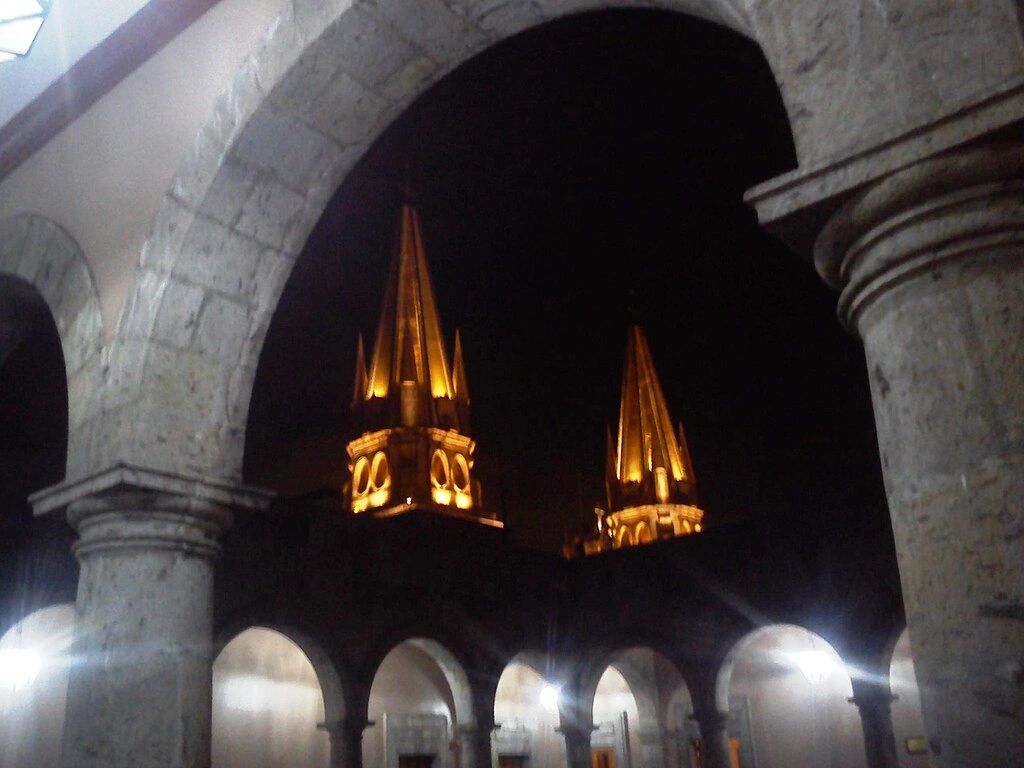
The exterior of the cathedral is influenced by Spanish Renaissance architecture, however, the two towers take influence from Neo-Gothic architecture. The main building is geometric and proportional, typical of a basilica plan. The front of the cathedral has pilasters in colossal order framing the largest entrance. The entrances at the front are semicircular arches with pilasters on either side. The base of the towers are square with four pinnacles that lead into conical towers topped with Greek crosses. The top of the towers are yellow with blue tile accents.
Central nave
The white marble and silver main altar in the center nave stands out against the background. It took the place of an old altar made of cypress that had been built during the Reform War. The canons’ choir, located at the back of the temple under the apse, has 52 finely carved wooden seats, which is a work of art made by the native artisans of Nayarit when Nayarit was part of the state of Jalisco, meaning that in addition to the intrinsic value of the stalls and the artistic value, it has a historical value. It was opened in 1832, and there are 22 chairs in the lower section and 31 in the upper section. In the center is the cardinal’s chair, made of cocobolo wood. The stained glass windows are imported from France. In contrast, Merklin-Schütze, a Belgian company, built the enormous neo-Gothic organ that is the second-largest in Mexico and can be found in the choir above the main door.
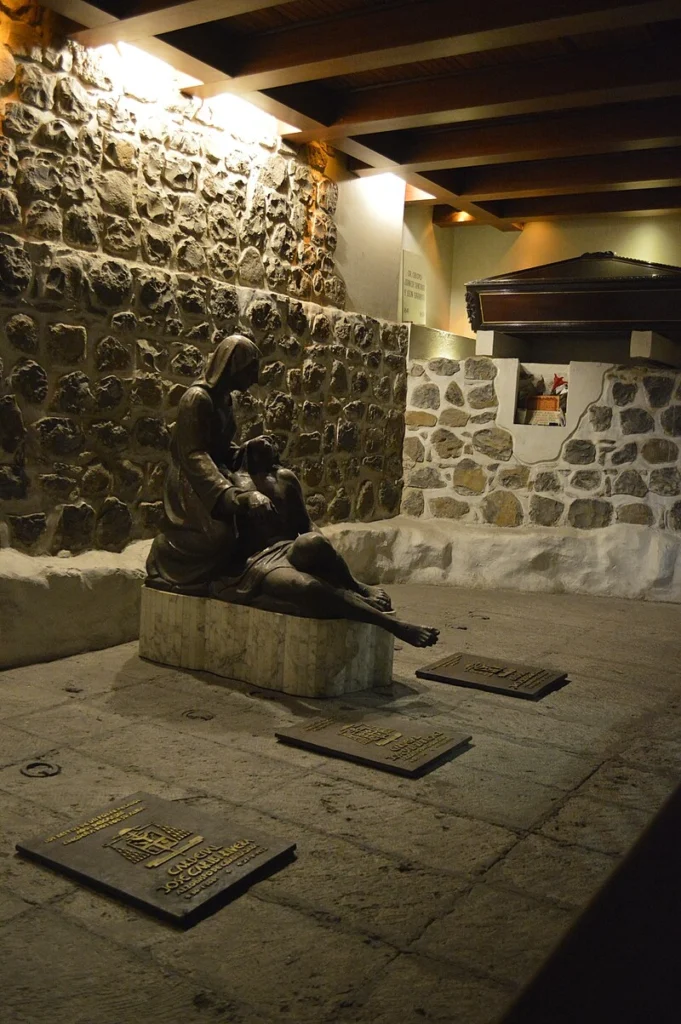
Archiepiscopal crypt
Among the crypts, beneath what was once the royal chapel, is that of the archbishops of Guadalajara , which contains burials dating back to the 16th century . The cathedral’s testero and foundations can be seen here, as well as the coffins containing the remains of bishops Juan de Santiago y León and Manuel Gómez de Mendiola y Solorzano. There are also the tombs of Cardinals José Garibi Rivera, José Salazar López and Juan Jesús Posadas Ocampo. In the other crypt are the remains of 23 martyrs of the Cristero War who were beatified by Pope John Paul II in 1992. The heart of a well-known prelate, Bishop Juan Cruz Ruiz de Cabañas, founder of the Cabañas Hospice that bears his name is also located in that crypt.
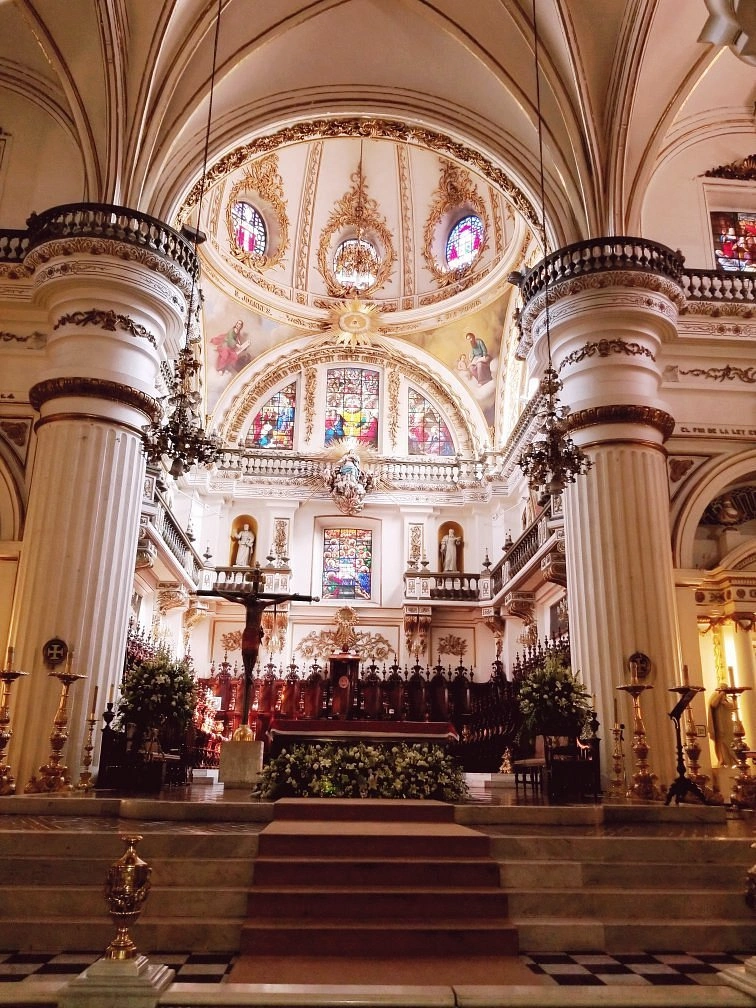
North nave
At the base of the nave, just beneath the north tower of the cathedral, you’ll find the Chapel of the Lord of the Waters. It’s a quiet, reflective space that holds deep meaning for many of the faithful, often visited by those seeking blessings or offering prayers related to drought and rainfall a devotion that goes back centuries. Along this section of the cathedral, there are five side altars, each dedicated to a different figure of importance in the Catholic faith. One is devoted to Our Lady of the Rose, which is said to have been given to Charles I of Spain as a gift. The others honor Archangel Michael, Our Lady of Guadalupe, Saint Joseph of Nazareth, and Saint Clement of Rome, whose altar even holds a relic of Saint Innocence. The cathedral’s spiritual richness and history are enhanced by the individual stories told by each altar.
South nave
At the foot of the south nave, right beneath the south tower, is the Chapel of Our Lady of Solitude, a space that was closed off for many years but still holds deep emotional and spiritual meaning for many who visit the cathedral. At the center of this same nave is the Chapel of the Immaculate Conception, which also serves as the final resting place of Bishop Francisco Orozco y Jiménez. Standing at the chapel’s entrance, you’ll see statues of Saint Jerome and Saint Augustine of Hippo that give the space a sense of solemnity and theological depth. Along this south nave, there are four altars, each with its own dedication and character. One is dedicated to Simon Peter, and it is made of beautiful alabaster. It is surrounded by statues of Paul of Tarsus and James the Greater, who was Guadalajara’s first patron saint. The other altars are dedicated to the Sacred Heart of Jesus, Saint John of Nepomuk, and Our Lady of Zapopan, a beloved figure throughout the region. The cathedral sacristy, which houses significant works of religious art, is located at the very end of the nave. The Church Militant and Triumphant by New Spanish painter Cristóbal de Villalpando, commissioned by Bishop Juan de Santiago y León Garabito, is one of the most well-known. Nearby, there’s also The Immaculate Conception by the renowned Spanish artist Bartolomé Esteban Murillo, adding to the cathedral’s rich artistic legacy.
Architectural complex
The architectural complex of the Metropolitan Cathedral of Guadalajara includes, in addition to the cathedral church, the archbishop’s palace, located at the corner of Morelos and Liceo Streets, and the parish church of the Metropolitan Tabernacle, located at the corner of Paseo Alcalde and Morelos Streets. The latter is accessed through a door near the main entrance. Both buildings were built after the cathedral.
Museum of Sacred Art
Inside the cathedral was the Museum of Sacred Art, a religious art museum that contained a large collection of religious images, vestments, artifacts, paintings, and important pieces used in ceremonies. Inaugurated in 2012, it was forced to close permanently due to the COVID-19 pandemic in Jalisco.
Feast Day
Feast Day : 15 August
The feast day of the Cathedral Basilica of the Assumption of Our Lady in Guadalajara, Mexico, is celebrated on August 15th. This date honors the Assumption of Mary, when, according to Catholic belief, the Virgin Mary was taken up into heaven. It’s a major religious celebration in Guadalajara and across many Catholic communities worldwide.
Church Mass Timing
Monday to Saturday : 8:00 AM , 9:30 AM , 12:00 PM , 6:00 PM
Sunday : 8:00 AM , 9:30 AM , 10:30 AM , 12:00 PM , 2:00 PM , 5:00 PM , 6:00 PM , 7:00 PM , 8:00 PM.
Church Opening Time:
Monday to Sunday : 8:00 AM, 8:00 PM
Contact Info
Address : Guadalajara Cathedral
Av. Fray Antonio Alcalde 10, Zona Centro, 44100 Guadalajara, Jal., Mexico
Phone : +52 33 3613 7168.
Accommodations
Connectivities
Airway
Cathedral Basilica of the Assumption of Our Lady, Guadalajara, Mexico, to Guadalajara International Airport distance between 27 min (20.6 km) via Carr. Guadalajara – Chapala/México 23.
Railway
Cathedral Basilica of the Assumption of Our Lady, Guadalajara, Mexico, to Guadalajara Central station distance between 3 min (1.5 km) via Av. Miguel Hidalgo y Costilla and Av Juárez.