


Basilica of Santa Maria dell’Elemosina, Biancavilla, Italy
Introduction
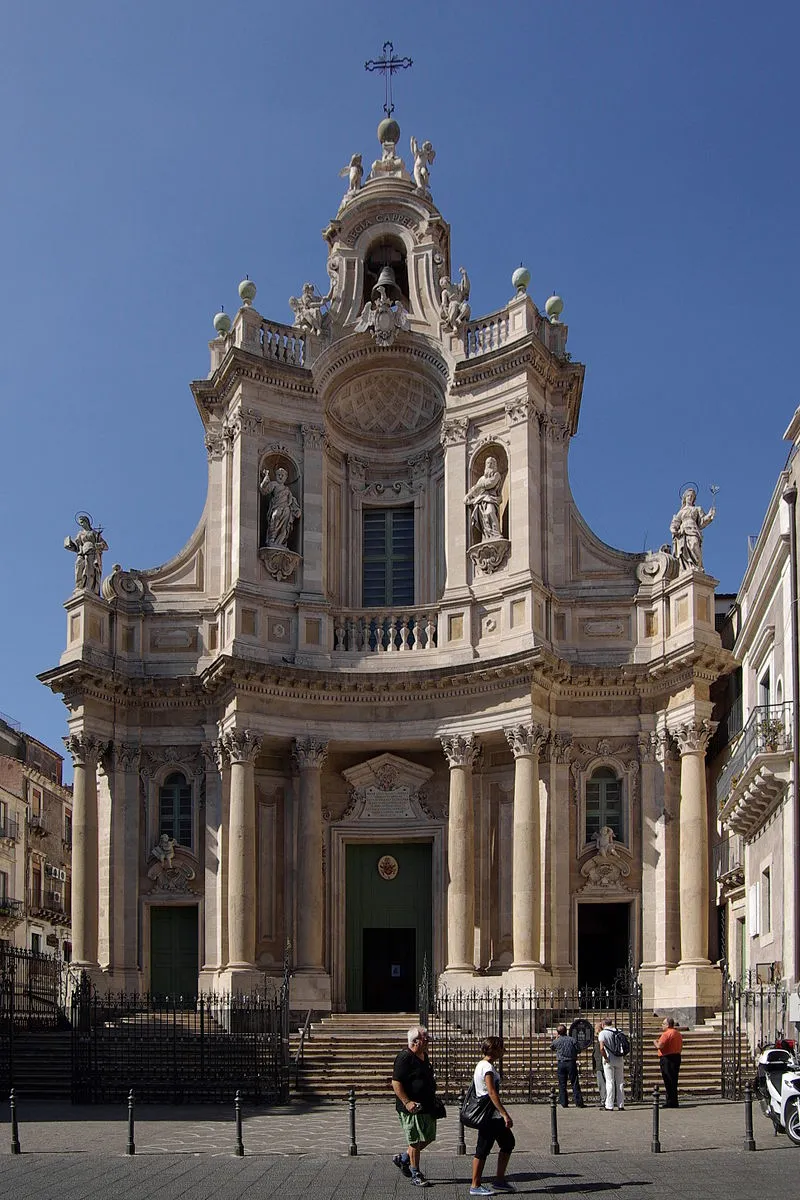
The Basilica della Collegiata, formally known as L’Antichissima Regia ed Insigne Basilica Collegiata di Maria Santissima dell’Elemosina, is a late Baroque church located in Catania, Italy. Situated along the western side of Via Etnea in the Basilica Collegiata district, it lies just north of the Palazzo dell’Università, which faces the adjacent square. The church is renowned for its historical and architectural significance. The Basilica della Collegiata (officially Antichissima Regia ed Insigne Basilica Collegiata di Maria Santissima dell’Elemosina) is a historic church in Catania, Sicily, completed in 1794. A prime example of Sicilian Baroque architecture, it stands as a significant cultural and religious landmark in the city.
History Basilica of Santa Maria dell’Elemosina, Biancavilla, Italy
Origins of the Basilica
The Basilica of Biancavilla, dedicated to Maria SS. dell’Elemosina, the protector of the city, was likely constructed between the late 15th century and early 16th century, soon after the foundation of the city in 1488. While the exact design of the original church remains uncertain, it is believed to have been dedicated to Saint Catherine of Alexandria. It is highly probable that the initial structure followed a Greek cross plan, with the apse facing east, in line with Byzantine traditions. Additionally, it is assumed that the Chapel of Saint Placido, the patron saint of the city, was an integral part of the original church. It is also likely that the transept (or part of it) existed before the 17th century.
Expansion in the 17th Century
During the 17th century, the church underwent significant expansion. The addition of three naves transformed the building, expanding its layout. In the 18th century, the church was further enlarged with the addition of three more bays, which led to the church adopting a Latin cross plan, a characteristic feature of many Baroque churches. Additionally, during this period, the wooden ceiling was replaced by a barrel vault with lunettes, contributing to the church’s grandeur.
Completion of the Façade and Bell Tower
The church’s façade was completed toward the end of the 19th century, marking the culmination of the long-term construction efforts. A monumental bell tower, designed by the Milanese architect Carlo Sada, was added during this time. At a height of 50 meters, this bell tower is the tallest in the province of Catania. The tower’s impressive stature adds to the church’s architectural prominence.
The Collapse of the Dome
In the first half of the 19th century, the church’s dome was constructed and frescoed. However, just three months after its inauguration, the dome tragically collapsed. The collapse is believed to have been caused by construction defects, which led to its ruinous fall. Since then, the dome has never been rebuilt, leaving the church with an unfinished architectural element that adds to its historical narrative.
Architectural Legacy
Despite the challenges faced during its construction, the Basilica of Biancavilla stands as a symbol of resilience and historical continuity. The church, with its Latin cross plan, barrel vault, and impressive bell tower, remains a testament to the rich cultural and architectural history of the region. The dedication to Maria SS. dell’Elemosina as the protector of the city further reinforces the basilica’s significance to the people of Biancavilla, who have long revered it as a central place of worship and cultural identity.
Archiecture of Basilica of Santa Maria dell’Elemosina, Biancavilla, Italy
Archiecture Style: Baroque
The church’s design is attributed to Angelo Italia (1628–1700), who reoriented the building after the original structure was destroyed by an earthquake, aligning it to face the Strada della Luminaria (later known as via Uzeda, now via Etnea), as outlined in the reconstruction plan. The façade, designed by the Polish architect Stefan Ittar (1724–1790), is a notable example of late international Baroque style, showcasing intricate detailing and grandeur.
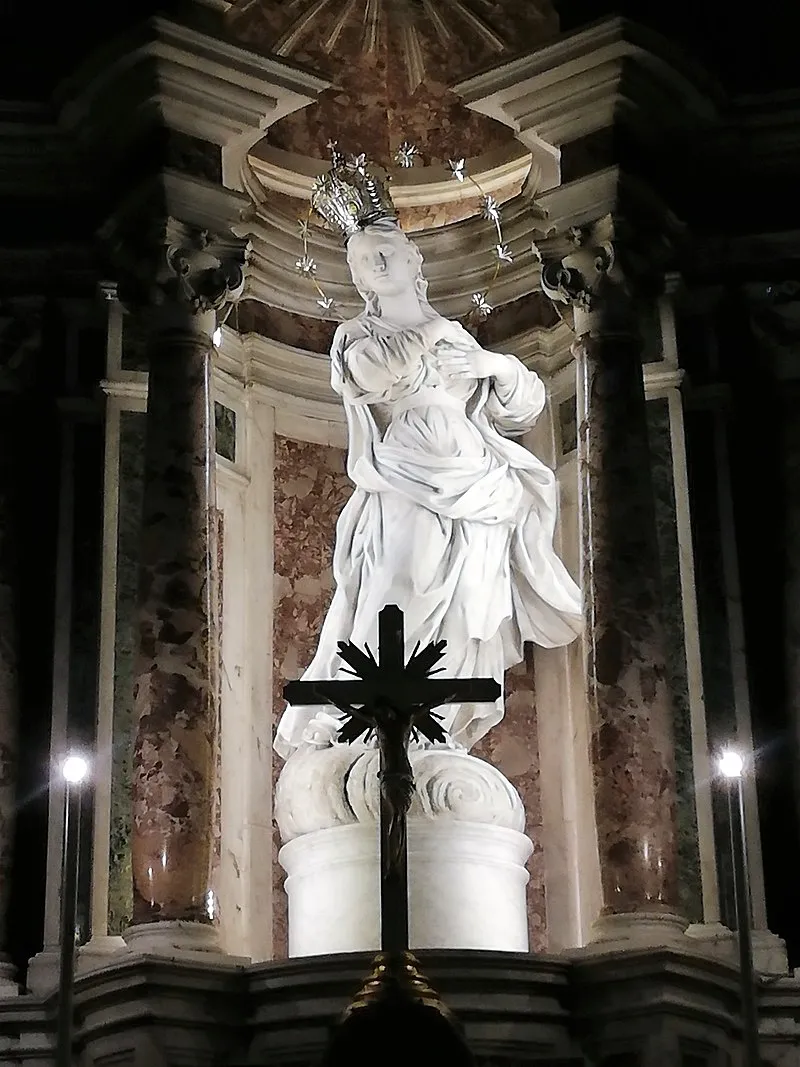
The temple once contained five chapels, each adorned with its own painting. The paintings depicted various religious figures, including Santa Maria della Grazia, the Madonna della Presentazione (also known as Candelora), Sant’Apollinare, the Madonna Santissima delle Grazie (also known as San Leonardo), and the Madonna Santissima dello Spasimo and degli Agonizzanti, the latter of which was placed on the main altar. The building features a limestone façade, with two orders and three naves inside, as well as marble floors, altars, and gates. Noteworthy elements include the minor apse to the south, supported by four columns of verde antico, Sozzi’s painting of Sant’Apollonia, a statue of the Conception, and a beautifully crafted marble Crucifix.
External Features
The exterior of the church is characterized by a limestone façade partitioned with Giurgiulena stone, designed in two orders. The first order features six limestone columns, topped with a balustrade, while the second order houses large curled volutes with statues of Saint Agatha and Saint Apollonia. The central loggia, framed by niches, holds statues of Saint Peter and Saint Paul. Above this, the dome is crowned with a balustrade and a central bell tower, which is ornately decorated with an eagle, a crowned coat of arms, musical angels, putti, and spheres, culminating in a wrought iron cross.
The church is accessed via a grand staircase, with a wrought iron gate that marks the boundary of the churchyard, adding to the monumental and impressive entrance.
Internal Features
Inside, the church follows a basilica plan with three naves, divided by eight pillars, and three apses. The central apse is notably elongated to accommodate the canons’ choir, second only in importance to the cathedral’s. In 1896, Giuseppe Sciuti frescoed the vault and dome with biblical scenes and characters, including the Passage from Darkness to Light, Madonna of Mercy, Pilgrimage, Deadly Sins, and the Assumption, along with portraits of the Evangelists—Saint Matthew, Saint Luke, Saint John, and Saint Mark.
The right aisle houses several chapels: the first spans the Baptistery Chapel with a baptismal font, the second contains the Chapel of Saint Apollonia with a painting by Olivio Sozzi, the third holds the Chapel of Sant’Euplio with another work by Sozzi, and the fourth features the Chapel of Saint Agatha with Francesco Gramignani Arezzi’s painting of the Martyrdom of Saint Agatha. The left aisle includes chapels dedicated to Saint John of Nepomuk, the Holy Family, Saint Francis de Sales, and the Holy Crucifix.
Apses and Altar
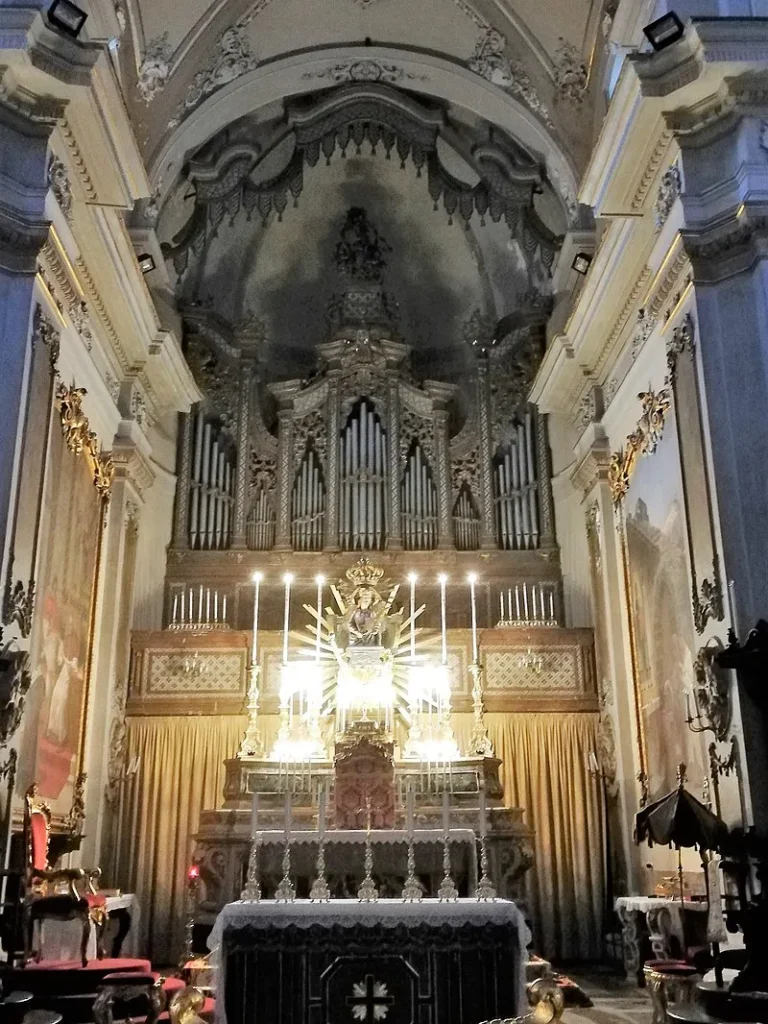
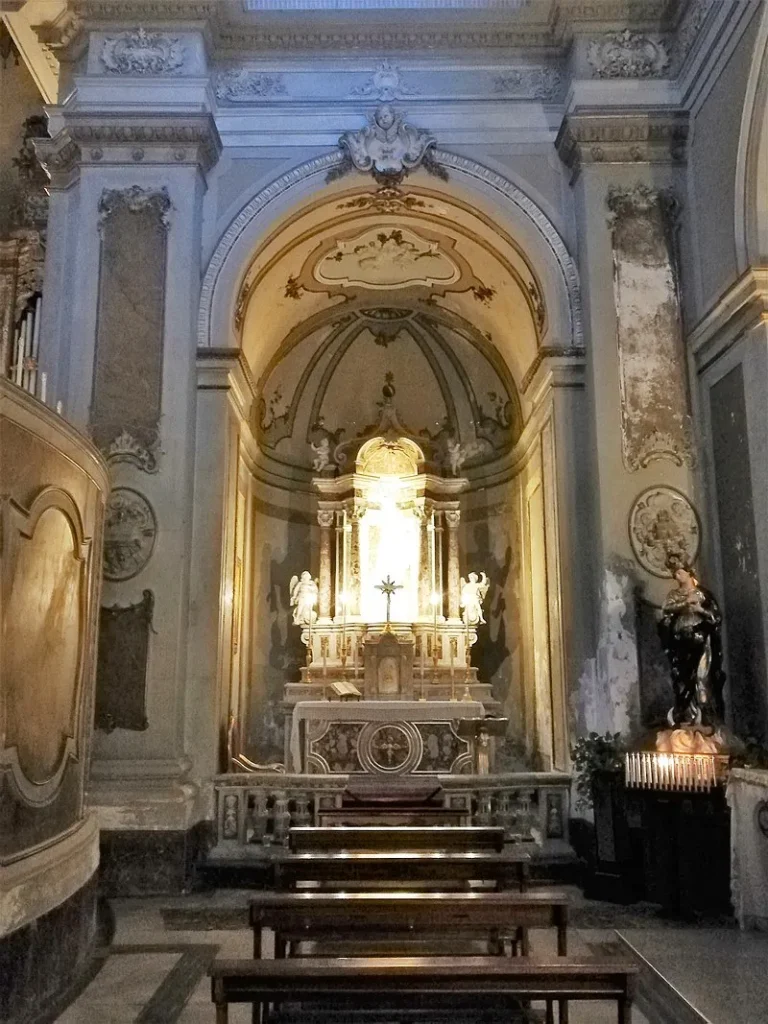
The right apse features the Chapel of the Immaculate Conception, enclosed by a marble balustrade, with a marble statue of the Immaculate Conception on the altar. The left apse is dedicated to the Chapel of the Blessed Sacrament. In the central apse, the main altar is adorned with a copy of the Byzantine icon of the Madonna with Child, known as the Madonna dell’Elemosina, a revered icon in the collegiate basilica sanctuary of Biancavilla. Behind the altar stands an 18th-century wooden organ, with a wooden choir of 36 stalls to the side. Two of Giuseppe Sciuti’s paintings, “Brother Geremia before Pope Eugene IV” and “Madonna dell’Elemosina,” are also displayed in this area.
Feast Day
Feast Day: 4th October
The Basilica of Santa Maria dell’Elemosina in Biancavilla, Italy, is dedicated to Our Lady of Alms (Santa Maria dell’Elemosina). This church celebrates its feast day annually on August 5th, honoring the Virgin Mary under her title of the Madonna dell’Elemosina, who is the patroness and protector of the town. The feast day includes religious processions, prayers, and festivities that reflect the town’s deep devotion to the Madonna. Additionally, a secondary feast is celebrated on October 4th in her honor, with significant cultural and religious activities taking place throughout Biancavilla.
Church Mass Timing
Monday : 6:30 PM
Tuesday : 6:30 PM
Wednesday : 6:30 PM
Thursday : 6:30 PM
Friday : 6:30 PM
Saturday : 6:30 PM
Sunday : 8:30 AM, 11:00 AM, 5:00 PM, and 6:30 PM
Church Opening Time:
Monday : Closed
Tuesday : 9:00 am – 12:00 pm4:00 pm – 8:00 pm
Wednesday : 9:00 am – 12:00 pm4:00 pm – 8:00 pm
Thursday : 9:00 am – 12:00 pm4:00 pm – 8:00 pm
Friday : 9:00 am – 12:00 pm4:00 pm – 8:00 pm
Saturday : 9:00 am – 12:00 pm4:00 pm – 8:00 pm
Sunday : 9:00 am – 12:00 pm4:00 pm – 8:00 pm
Contact Info
Address:
Piazza Roma, 6, 95033 Biancavilla CT, Italy.
Phone: +39095982401
Accommodations
Connectivities
Airway
Catania Fontanarossa Airport to Basilica of Santa Maria dell’Elemosina, Biancavilla, Italy distance between 39 min (37.9 km) via SS121 and SS284
Railway
Biancavilla Train Station to Basilica of Santa Maria dell’Elemosina, Biancavilla, Italy distance between 6 min (2.0 km) via Viale C. Colombo.