


Basilica of Santa Maria Assunta and San Giovanni Battista, Clusone, Italy
Introduction
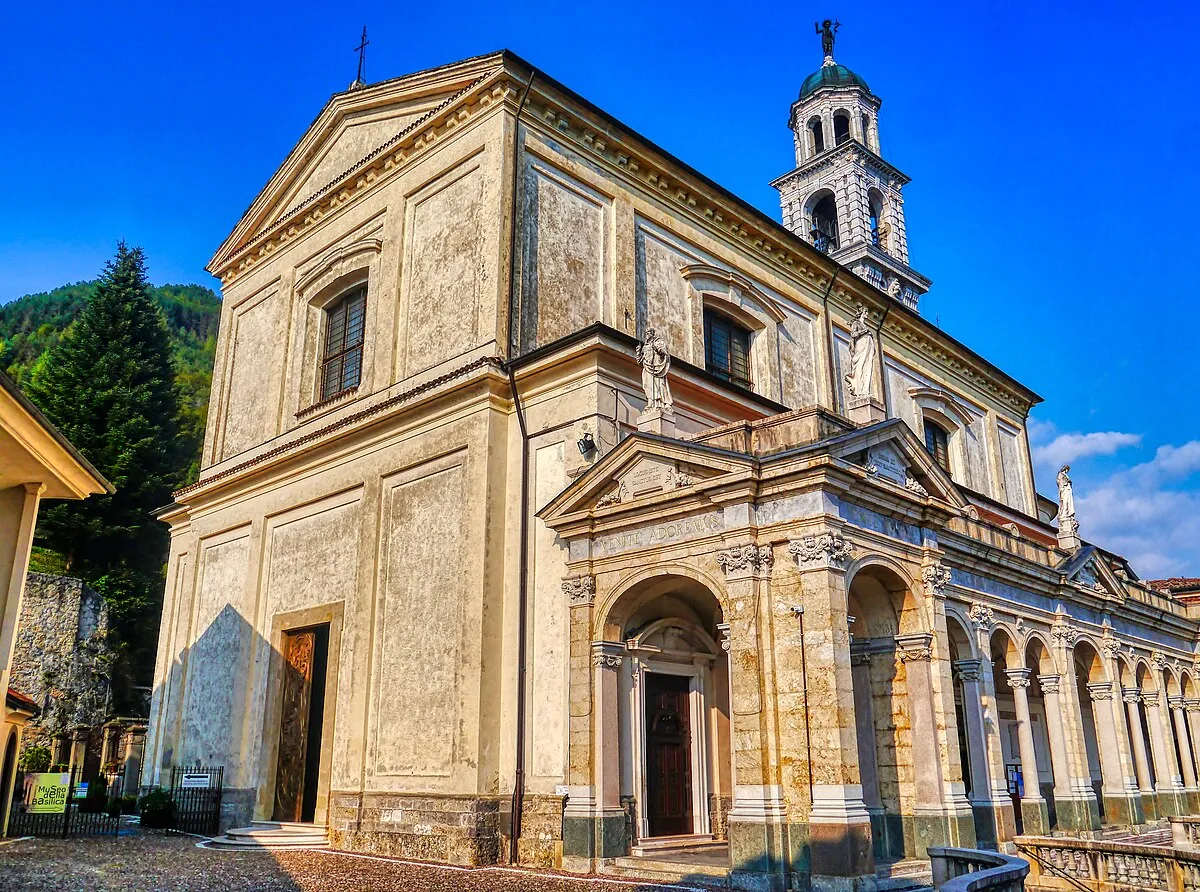
The Basilica of Santa Maria Assunta and San Giovanni Battista is the principal Catholic church in Clusone, a town in the province of Bergamo, Italy. It has served as the parish church and the central place of Catholic worship in the area since its establishment on July 6, 1711. Recognized for its historical and spiritual significance, the church was granted the title of a minor basilica on July 28, 1961. This distinction highlights its importance as a center of faith and its architectural and cultural value within the region.
History of the Basilica of Santa Maria Assunta and San Giovanni Battista
The Roman Origins
The Basilica of Santa Maria Assunta and San Giovanni Battista in Clusone is traditionally believed to have been constructed atop the ruins of an ancient Roman temple dedicated to the goddess Diana. This belief is primarily based on the writings of Bernardino Baldi, who claimed that a stone bearing the inscription “DIANAE C(…[M(…)S(…)” was walled up in the presbytery apse, suggesting the presence of a temple dedicated to Diana Clusonia. However, this stone was never recovered. Despite the absence of physical evidence, other findings lend weight to this theory, such as a stone dedicated to the spouses Marco Reburro and Pittiena Massima, which was discovered during the pastoral visit of Cardinal Borromeo in September 1575. These stones, along with others, were eventually relocated to the archaeological museum of Bergamo.
The Parish Church
The establishment of Clusone as a religious center began around the 8th century when it became the seat of a parish for the upper Seriana Valley. Until the 5th century, the only episcopal seat was in Bergamo, but with the growing population in the surrounding valleys, the bishop appointed presbyters to oversee the local churches, and Clusone became one such important parish. The first known document mentioning the church is a will from Aucunda, the daughter of Stabile, dating between 828 and 837, which mentions the church of Santa Maria in Clisione. An exchange from 909 further corroborates the presence of the “ecclesia” of Santa Maria in Clusone. Numerous other documents from the parish and episcopal archives attest to its ongoing importance, and by 1260, the church was included in the census of churches imposed by the church of Rome. This census referred to the church as “caput plebis,” indicating its status as the head of the parish.
Throughout the Middle Ages, the church faced numerous challenges, including internal conflicts between the parish’s clergy and the local families, as well as tensions between the Guelph and Ghibelline factions in the region. One notable conflict occurred on May 28, 1297, when an armed group led by the Clusone archpriest, Bonacore de Bunizonibus, a Ghibelline, attacked the bishop’s residence in Ardesio, destroying a small church. This act of aggression led to further tensions within the church, prompting intervention by the bishop of Bergamo, Giovanni da Scanzo, in 1304.
The church was included in the ecclesiastical census conducted by Bernabò Visconti in 1360, which documented the presence of six canons in the church, although four were typically listed in subsequent records. The original structure of the church, built in the 9th century and rebuilt in the 13th century, is difficult to ascertain. However, the diocesan pastoral visit of San Carlo Borromeo in 1575 described the church as “curatam, satis amplam et ornatam,” with a single nave, a wooden ceiling supported by three pointed arches, and 13 altars. There was also a cemetery space in front of the church for communal and private burials.
In 1495, the Congregation of the Blessed Sacrament was established, which would go on to become the most important and numerous group within the church.
The 17th Century Reconstruction and Current Structure
By the early 17th century, the old church was deemed unsuitable for the growing needs of the community. In 1613, the construction of a bell tower began, and by 1621, the work was completed. The dome, crowned by the statue of St. John the Baptist, was placed in 1624. However, the church’s physical condition led to the decision to build a new one. This project was initiated by Archpriest Alessandro Ghirardelli in 1659, with funds from his inheritance, following his death in 1686. The new church was designed by Giovanni Battista Quadrio, the son of Gerolamo Quadrio, who had been the architect of the Cathedral of Milan.
The building of the church took place over several years, with modifications to the original design by Gian Maria Terzini and Francesco Cifrondi between 1688 and 1698. By 1711, the new church was consecrated by Cardinal Pietro Priuli, Bishop of Bergamo, and was officially named the Basilica of Santa Maria Assunta and San Giovanni Battista. In 1961, the church was granted the title of Minor Basilica by Pope John XXIII, recognizing its historical and spiritual significance. Further renovations continued in the following decades, including the replacement of the old wooden portal with a bronze one in 2010, crafted by Mario Toffetti. This portal features scenes from the life of St. John the Baptist, including his preaching, the prophecy of the arrival of the Lamb of God, the visitation of the Virgin Mary to St. Elizabeth, the calling of the Baptist, the baptism of Jesus, his arrest, and his beheading.
Architecture of Basilica of Santa Maria Assunta and San Giovanni Battista, Clusone, Italy
Architect: Giovanni Battista Quadrio
Architectural Style : Baroque architecture.
External Description of the Basilica of Santa Maria Assunta and San Giovanni Battista
Churchyard and Portico
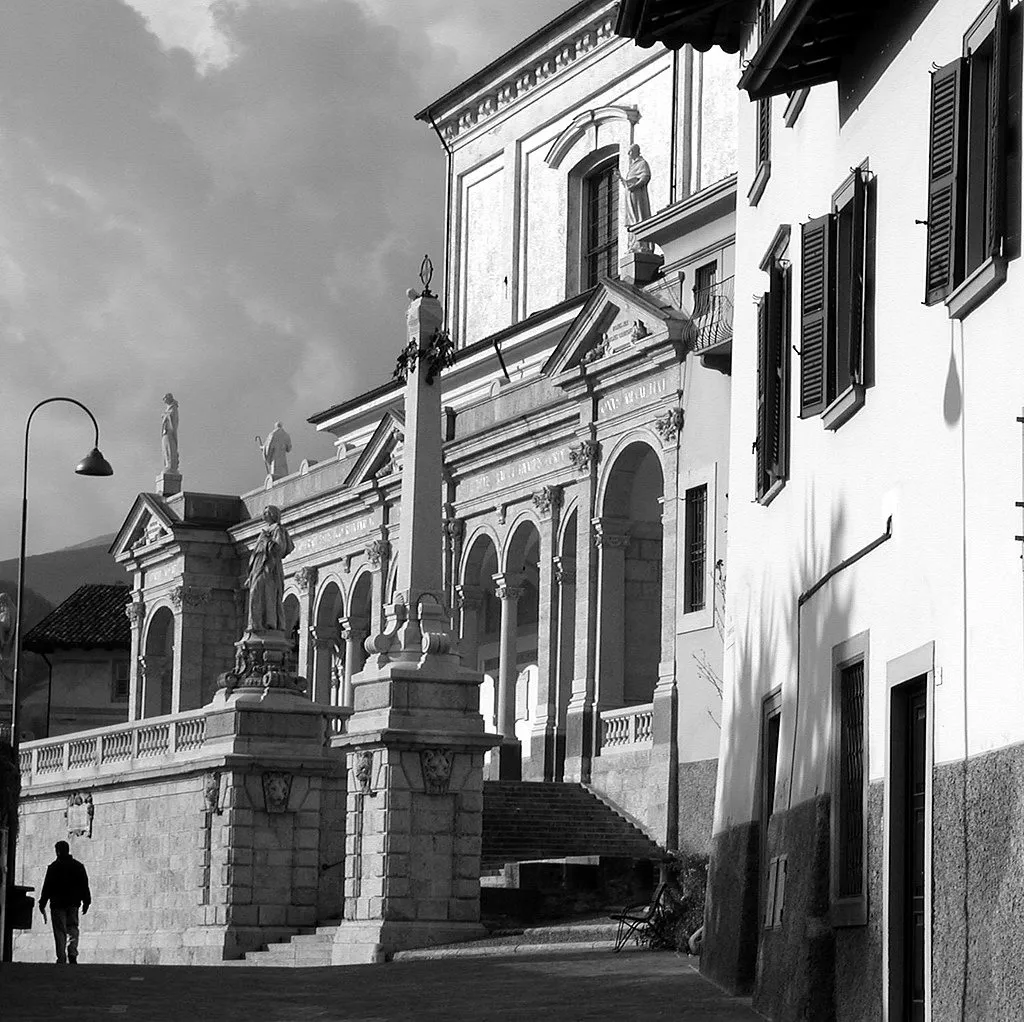
The Basilica of Santa Maria Assunta and San Giovanni Battista stands prominently in the heart of Clusone, surrounded by a large raised churchyard. This open space is enclosed by a balustrade adorned with tall marble statues of the four Evangelists, sculpted by Angelo Magnoni. These statues, based on a wooden model by Giuseppe Rovida and Giacomo Sozzi, were completed during the late 19th century. In 1938, additional statues were placed on the trabeation, including those of Blessed Alberto of Villa d’Ogna, Saint Gregorio Barbarigo, and the Assumption. However, the original statue of the Assumption was replaced in 1991 due to damage.
The churchyard is connected to Via Pier Antonio Brasi, located at a lower level, by three staircases—two frontal and one lateral. The lateral staircase is characterized by its curvilinear shape, adding a graceful element to the approach to the basilica. The portico, designed by Virginio Muzio in 1894, runs along the right side of the church, providing a sheltered space before entering the main building. The portico is supported by Ionic semi-pillars and flanked by composite pilasters. The center bay and the two end projections are topped with round arches, while the other four bays are framed with mullioned windows supported by smooth Ionic columns. Below the portico are three portals providing access to the basilica. The facade of the basilica is simple and slightly protruding, with minimal decorative elements. A large rectangular window sits prominently at the top of the facade, while the main entrance is framed by a plain portal at the bottom.
Bell Tower
The bell tower construction began on March 17, 1613, with the tower itself completed by 1621. The statue of St. John the Baptist was placed on the tower in 1624, though it was replaced in 1979. The bell tower stands at a height of 66.5 meters, reaching 70 meters when including the statue at its peak. It houses a concert of 12 bells, with a 13th bell in the lantern, all tuned to a low B♭2.
Internal Description of the Basilica of Santa Maria Assunta and San Giovanni Battista
Nave
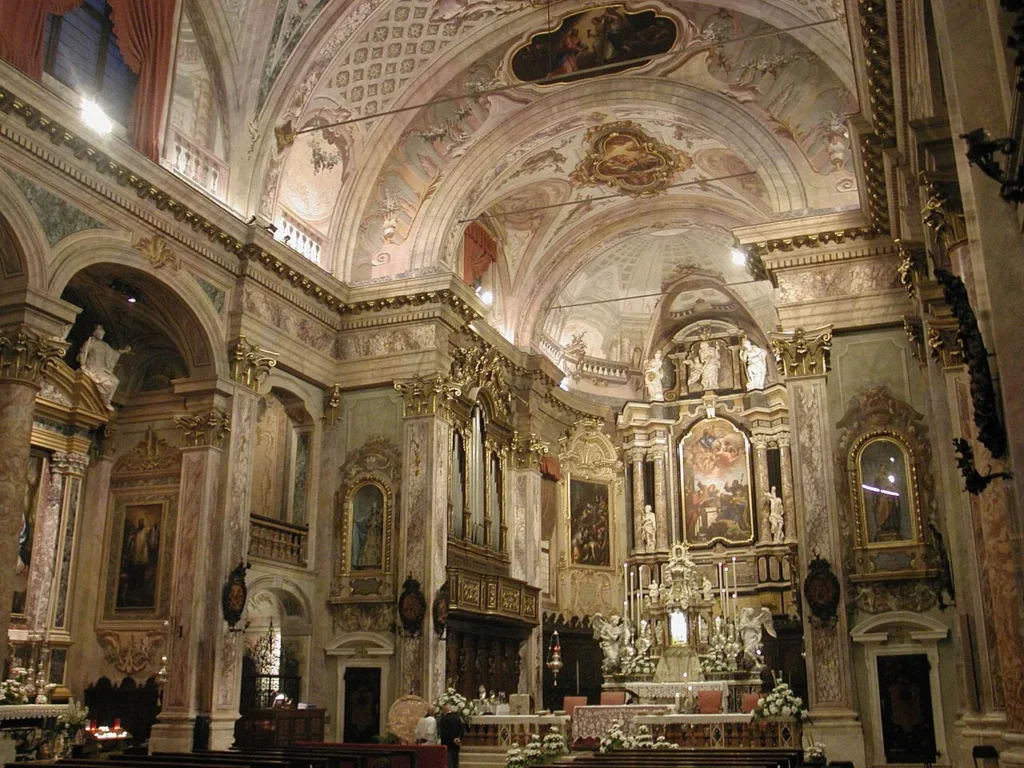
The interior of the basilica is laid out with a single nave, flanked by eight lateral chapels. These chapels are separated by lowered arches, supported by tall Corinthian columns, each standing 8.30 meters in height. The vault of the nave is cross-vaulted, and the apse is barrel-vaulted with lunettes. The frescoes in the nave, executed by Bernardo Brignoli, depict various biblical scenes, including the Last Judgment, the Coronation of the Virgin, angels making music, and Jesus in Gethsemane. The paintings of the medals in the nave, created by Antonio Cifrondi, are a significant feature, alongside the two counter-facade paintings: the Baptism of Jesus on the left and the Preaching of the Baptist on the right. The Via Crucis reliefs, created by Cesare Zonca in 1909, also enhance the interior, portraying the stations of Christ’s Passion.
Apse and Presbytery
The basilica’s high altar, built between 1702 and 1732, is one of its most striking features. Designed by Andrea Fantoni, the altar is richly decorated with marble inlays and quadratures by the Corbarelli workshop of Brescia. The altar is adorned with statues of Faith, Generosity, and Fortitude, while statues of St. John the Baptist and St. Sebastian stand on the lateral columns. Fantoni himself sculpted the two lateral angels and the antependium depicting the Transport of the Ark of the Covenant, a scene in which he depicted himself among the characters. Behind the altar is the altarpiece, painted by Sebastiano Ricci between 1711 and 1713, which portrays the Assumption of Mary. Flanking the altarpiece are two paintings: the Birth of St. John the Baptist by Domenico Carpinoni on the right and the Martyrdom of St. John the Baptist on the left. The wooden choir stalls, made from briarwood, were crafted by Domenico Visinoni and completed in 1699 by the Fantoni workshop.
Side Chapels of the Basilica of Santa Maria Assunta and San Giovanni Battista
The basilica features several side chapels, each dedicated to a specific religious theme or figure. On the right side of the church, the first chapel is dedicated to the Nativity of Jesus, with an altar created by Grazioso Fantoni in 1754. It is accompanied by an altarpiece painted by Gaspare Diziani and statues of Saint Stephen (1702) and Saint Anthony of Padua (1732), both from the Fantoni workshop. On the right wall, there is also a painting of Saint Valentine by Antonio Cifrondi, and the chapel houses a relic of the True Cross. The second chapel on the right is dedicated to the deceased. Its altar, designed by Domenico Corbarelli in 1720, is adorned with statues by Andrea Fantoni. The altarpiece, painted by Domenico Carpinoni, portrays the Holy Trinity, with the Madonna, Saint Joseph, and Saint Gregory interceding for the deceased. A painting by Carpinoni on the right wall depicts Saint Charles and Saint Ambrose praying before the Madonna of Loreto.
The third chapel on the right is dedicated to the Guardian Angel. The altar, created in 1759 by Grazioso Fantoni, replaced an earlier altar from 1711. The altarpiece, painted in 1659 by Pietro Ricchi, depicts the Virgin appearing to Saint Ursula and the Angel with the Child. A painting by Antonio Cifrondi on the left wall portrays the Madonna and Saint Anthony of Padua. The fourth chapel on the right is dedicated to the Crucifix. The altar, built in 1698 by Andrea Fantoni and his workshop, features a wooden sculpture group of Saint Gaetano and Saint Charles in adoration of the Crucifix, with an angel holding episcopal insignia above. To the right of the altar is an 18th-century painting by Domenico Caretti, depicting Our Lady of Sorrows with seven swords piercing her heart, and to the left is a painting of Saints Filippo Benzi and Giuliana Falconieri.
The chapel dedicated to Saint Anthony of Padua was created by the workshop of Carlo Carra in 1667. The altar is adorned with allegorical figures of Prudence and Justice, alongside the coat of arms of the Fogaccia family. The altarpiece, depicting Saint Anthony with the Child and the Madonna, was painted by Giambettino Cignaroli. The chapel dedicated to the Rosary features an altar created by Manni of Desenzano in the Fantoni workshop. It is flanked by statues of Judith, holding a sword and the head of Holofernes, and Esther, holding a royal scepter. On the left side of the church, the second chapel is dedicated to San Lorenzo. Its altar, created in 1629 by the workshop of Giovanni Antonio Carra for the Gromelli family, is flanked by wooden statues of Saint Rocco and Saint Anthony Abate, both crafted by Giovanni Battista Torcelli in the 17th century.
The first chapel on the left is dedicated to the Deposition of Jesus and was once the seat of the Disciplini. The altar, made from marbles salvaged from an earlier altar, features statues of Saint Christopher and Saint Rocco, along with a depiction of the Redeemer between Prayer and Penitence, created between 1725 and 1730. The altarpiece, painted by Domenico Carpinoni, shows the Deposition of Jesus from the Cross, flanked by statues of Saint George and the Blessed Alberto da Villa d’Ogna. Additionally, there is a canvas by an unknown artist depicting Mary Magdalene witnessing the resurrection of Lazarus.
Baptismal Font
The baptismal font, located at the end of the left nave, dates back to the 15th century and is the oldest remaining piece from the original Plebana church. It features an octagonal basin supported by a chalice-shaped stem, intricately decorated with foliage and images of Saint Stephen, the Risen Christ, the Crucifixion, the Baptism of Jesus, Saint John, Saint Peter, Saint Alexander, and the Virgin Mary. The font was financed by the Confraternity of the Conception.
Confessional Pulpit
The confessional pulpit, located in the middle of the left nave, is a work of the Fantoni school. Made from polychrome marble, it is surmounted by an inlaid and gilded wooden canopy. The four telamons, which support the pulpit, were crafted by Andrea Fantoni just two years before his death.
Pipe Organ
The pipe organ, constructed in 1960 by the Ruffatti Brothers and restored in 1994, is housed in two wooden cases in the apse with a three-bay facade and a display of the main pipes. The organ features three keyboards of 61 notes each and a concave-radial pedalboard with 32 notes. It has a total of 65 registers and is controlled from a console located along the left wall of the nave.
Feast Day
Feast Day : Santa Maria Assunta 15th August.
Saint John the Baptist 24th June.
The feast day of the Basilica of Santa Maria Assunta and San Giovanni Battista in Clusone, Italy, celebrates the Assumption of the Virgin Mary, as the church is dedicated to both Santa Maria Assunta (the Assumption of the Virgin Mary) and San Giovanni Battista (Saint John the Baptist). The feast of the Assumption is observed on August 15th, while the feast of Saint John the Baptist is celebrated on June 24th. These feast days are significant for the basilica and its community, with special masses and religious events held to honor both the Virgin Mary and Saint John the Baptist.
Church Mass Timing
Saturday : 6:00 pm.
Sunday : 8:30 am, 10:30 am and 6:00 pm.
Church Opening Time:
Monday : 7:30 am – 6:00 pm.
Tuesday : 7:30 am – 6:00 pm.
Wednesday : 7:30 am – 6:00 pm.
Thursday : 7:30 am – 6:00 pm.
Friday : 7:30 am – 6:00 pm.
Saturday : 7:30 am – 6:00 pm.
Sunday : 7:30 am – 6:00 pm.
Contact Info
Address :
Via S. Narno, 1, 24023 Clusone BG, Italy.
Phone : +390346 21073
Accommodations
Connectivities
Airway
Basilica of Santa Maria Assunta and San Giovanni Battista, Clusone, Italy, to Il Caravaggio Int’l Airport (BGY), Via Aeroporto, distance between 43 min (41.5 km) via SS671.
Railway
Basilica of Santa Maria Assunta and San Giovanni Battista, Clusone, Italy, to Sulzano 25058, Sulzano BS, Italy, distance between 49 min (44.0 km) via SP 53.