


Cathedral Basilica of St. Pamphilus of Sulmona, Italy
Introduction
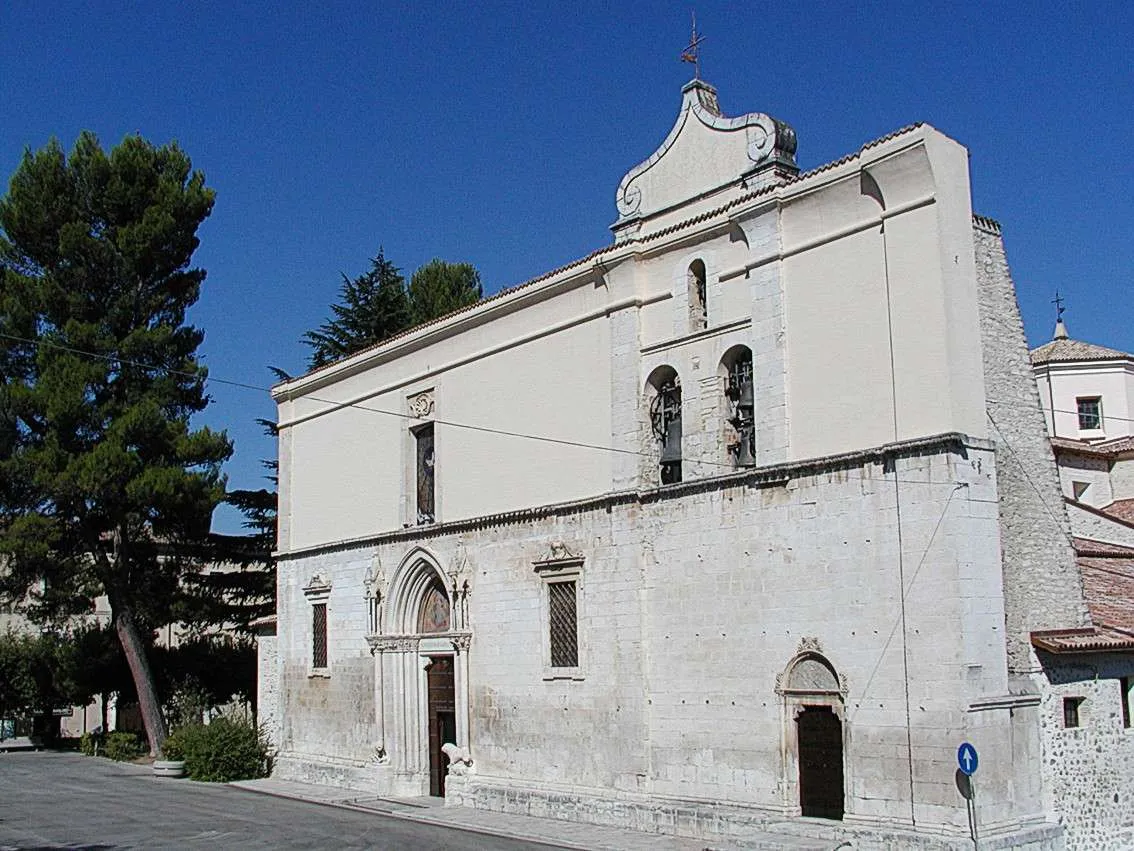
The Sulmona Cathedral (Italian: Duomo di Sulmona, Basilica Cattedrale di San Panfilo) is a prominent Catholic cathedral located in the historic town of Sulmona, in the province of L’Aquila, Italy. This cathedral serves as the seat of the Bishop of Sulmona-Valva, a position that was formerly held by the Bishop of Sulmona before the diocese’s reorganization. Dedicated to Saint Panfilo, the cathedral is the principal site of Catholic worship in Sulmona and holds significant religious, cultural, and architectural importance in the region.
The cathedral’s rich history dates back to the early centuries of Christianity, though the structure as it stands today was built and modified over time, particularly during the Romanesque and Renaissance periods. Its artistic and architectural features reflect various styles, showcasing the evolution of religious and cultural influences in the area. In 1902, Sulmona Cathedral was declared a national monument, recognizing its historical and architectural significance. Today, it remains a symbol of Sulmona’s religious heritage and continues to attract visitors and pilgrims alike.
History of Sulmona Cathedral
Early Origins and Roman Influence
The history of Sulmona Cathedral dates back to the 8th century, though the site itself has an even earlier history. It is believed that a Roman temple originally stood where the cathedral now stands. The construction of the present building, in the Romanesque style, began in 1075, though many layers of architectural transformation have occurred over the centuries, shaping the cathedral as it appears today.
Early Dedications and Transformation
The cathedral was originally dedicated to the Virgin Mary, but by the 12th century, it underwent significant changes. During this period, the cathedral’s dedication was altered to Saint Panfilo, the patron saint of Sulmona. This transformation was part of a broader renovation process that aimed to enhance the church’s structure and align it more closely with the region’s religious identity. The first official records of these changes appear in the Chronicon Casauriense, a historical document from the abbey of San Clemente in Casauria, dated to the 12th century. According to this document, Bishop Trasmondo of Sulmona commissioned substantial renovations in 1075, which were completed in 1119 by Gualtiero. This work marked the beginning of the cathedral’s enduring architectural development, which over time became a blend of various styles.
Earthquake Damage and Baroque Reconstruction
Sulmona Cathedral faced significant damage from earthquakes throughout its history. The first major event occurred in 1456, when the church was seriously harmed. The cathedral was struck again in 1706 by a devastating earthquake that caused even greater destruction. In the wake of this disaster, the church was rebuilt in the Baroque style, a transformation that brought changes to the interior design, including the introduction of stucco work, paintings, and vaulted ceilings. Some of these Baroque elements remain visible in the cathedral today, despite more recent restorations.
During the 1706 earthquake, the sacristies of the cathedral collapsed, and the bell tower, along with the adjacent bishop’s palace, was severely damaged. Unfortunately, these elements were never rebuilt. However, the lower part of the cathedral’s façade and the Gothic crypt were preserved, maintaining a connection to the building’s earlier architectural phases. The restoration work primarily focused on the upper portions of the church, including the vaults of the three naves.
Elevation to Minor Basilica
In recognition of its historical and religious significance, Sulmona Cathedral was granted the honorary title of “minor basilica” by Pope Pius VII on September 25, 1818. This elevation further affirmed the cathedral’s importance as a center of worship and cultural heritage in the region.
Architecture of Sulmona Cathedral
Architectural Styles: Romanesque architecture
Exterior Features and Façade
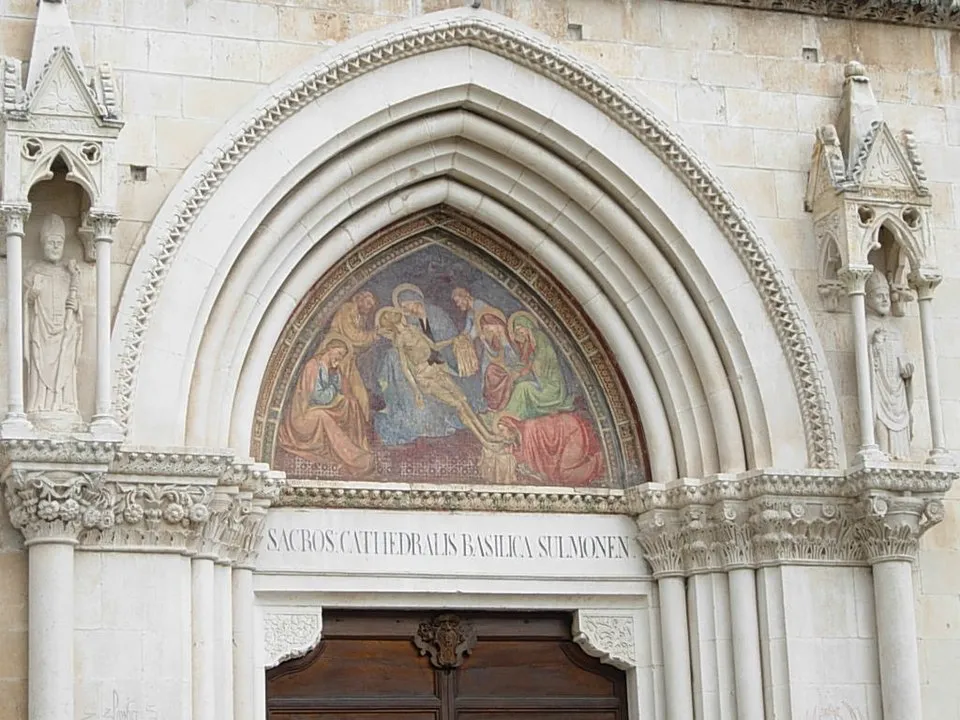
The façade of Sulmona Cathedral showcases a blend of architectural styles, reflecting the many transformations the building has undergone over the centuries. The lower part of the façade features a Gothic-style frame, which includes a continuation along the right side of an ogival (pointed) portal. This portal is flanked by columns that support aedicules, which house statues of San Panfilo and San Pelino, created by the artist Nicola Salvitti in 1391. Above the portal, the lunette displays a fresco from the end of the 14th century, attributed to Leonardo da Teramo.
The cathedral also features several notable access points. A small lateral portal, constructed in the 17th century, provides access to the sacristy. On the left side, another portal features beautiful inscriptions in Lombard characters, along with a fragment of a Roman tombstone. The three apses on this side of the building are adorned with anthropomorphic motifs, signaling the church’s Romanesque origins. In the center of the decoration, the famous quote from the poet Ovid, “Sulmo mihi patria est,” is proudly displayed, referencing the city of Sulmona as Ovid’s birthplace.
Layout and Interior Design
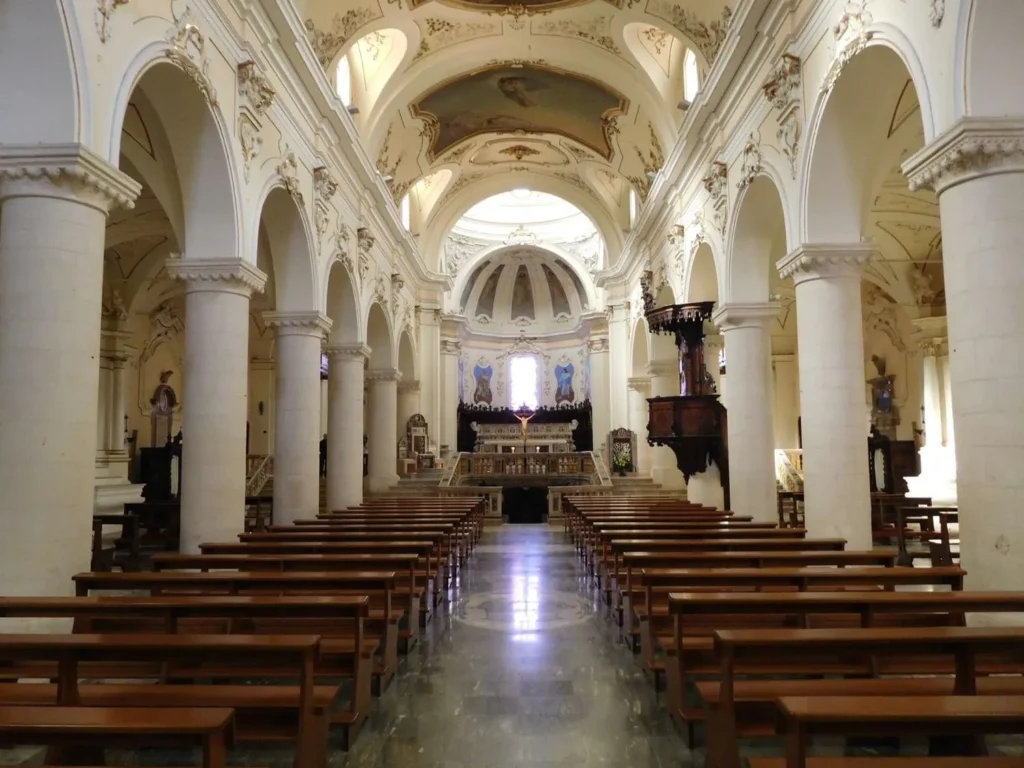
The cathedral is designed with a basilica plan, which has been preserved despite the many alterations over time. The interior is divided into three naves, supported by Romanesque columns. On the wall of the counter-façade, two funerary monuments can be found: one dedicated to Bishop Bartolomeo De Petrinis (1422) and the other, possibly commemorating his sister. Behind these monuments are two 15th-century frescoes depicting the Crucifixion and the Redeemer between two saints.
The organ, located beneath the entrance, is a fine example of 18th-century craftsmanship, made of gilded wood. Above, the vault of the main nave is adorned with frescoes depicting stories from the lives of Saint Panfilo and Saint Pietro Celestino, created by Amedeo Tedeschi in 1906. The presbytery is dominated by a wooden choir from 1751, designed by Ferdinando Mosca, and a stunning polychrome marble high altar dating to the 18th century.
In the side aisles, several noteworthy features can be found, including marble altars, a baptismal font of the Neapolitan school (1757), and a 14th-century Crucifix. In the chapel to the right of the presbytery, visitors can admire a beautiful wooden sculpture titled The Ecstasy of Saint Teresa, created by Giacomo Colombo in 1707.
The Crypt
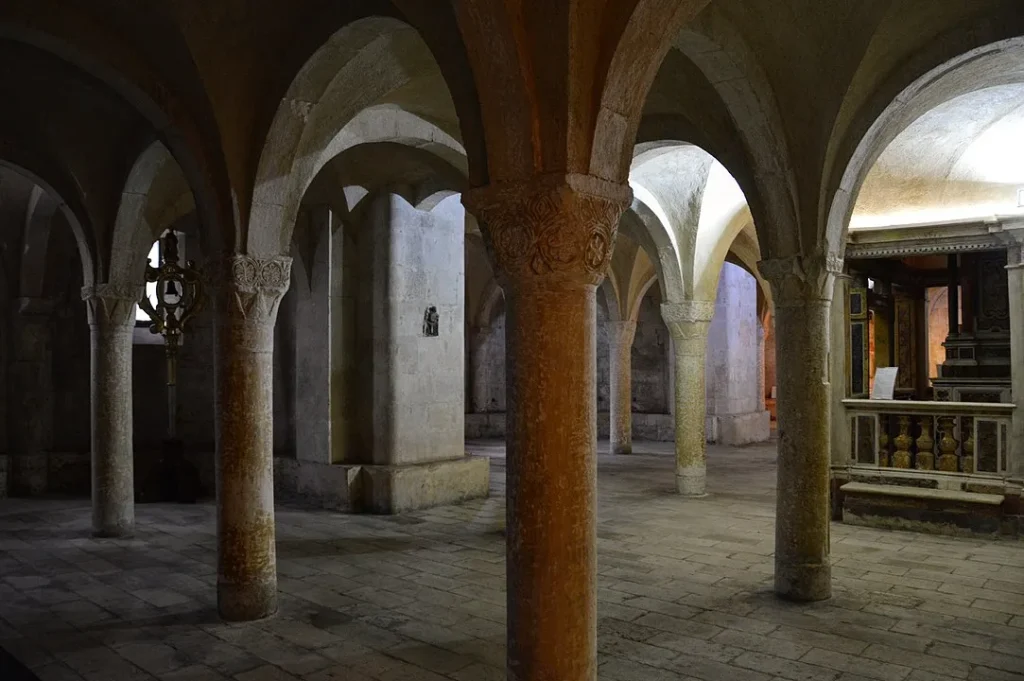
The crypt, the oldest part of the cathedral, dates back to the restoration carried out by Bishop Trasmondo. It is believed that the lateral columns, with their monolithic limestone shafts, date back to the 10th century. The crypt consists of three semicircular apses, and the perimeter structure differs from the internal core. The space occupies the area beneath the upper presbytery, which is divided into three naves supported by 16 columns, later reduced to 14 to accommodate the 17th-century altar dedicated to Saint Panfilo. The three rows of columns are irregularly spaced and not perfectly aligned, which results in an irregular squaring of the cross vaults. At the foot of the central staircase, the Chapel of the Saint contains an altar made of local stone and inlaid with polychrome marble, erected in 1662 to honor Saint Panfilo for his miracle during the 1656 plague.
Inside the chapel, a reliquary bust of Saint Panfilo, crafted from gilded copper, silver, and enamel by Giovanni di Marino di Cicco in 1458, is displayed. Other notable works in the crypt include a 12th-century bas-relief of the Madonna with Child, known as the “Madonna delle Fronaci,” and two side slabs from the 13th century, made of marble and decorated with rosettes in relief. On the right wall of the crypt, a sepulchral monument from the late 14th century features a cuspidate and tympanum arcosolium with a depiction of Agnus Dei at the top. The fresco within this monument shows the Madonna and Child between Saint Michael the Archangel and Saint John the Baptist, with Christ depicted on the intrados of the arch. The sarcophagus front bears traces of a sinopia (preliminary sketch) showing a knight.
Along the side walls of the crypt are rows of 16th-century wooden seats from a choir commissioned by Bartolomeo Balcone. These seats were restored after the earthquake of 1706. An adjacent room is dedicated to Celestine V, featuring relics such as a portion of his heart, sacred clothing, a bust, a wooden crucifix from the hermitage of Sant’Onofrio al Morrone, and documents written by the saint.
The Pipe Organ
The cathedral’s pipe organ is located in a gallery on the back wall of the left transept. Built in 1953 by the organ builder Remo Zarantonello, it was later restored in 2011 by Eligio Bevilacqua of Torre del Greco. The organ features digital transmission and includes two keyboards with 61 notes each, along with a concave-radial pedalboard of 32 notes. An independent mobile console is placed in the nave, allowing for flexibility during services and concerts.
The Chapter Archive
Sulmona Cathedral is home to one of the most important archives in the Abruzzo region, preserving a vast array of documents dating from the 11th century onwards. This includes parchments, codes, diplomas, and baptismal books. Many sacred furnishings and documents that were once housed in the cathedral are now exhibited at the civic museum of Sulmona, offering further insight into the cathedral’s rich history.
Feast Day
Feast Day: 28th April
The feast day of the Cathedral Basilica of St. Pamphilus of Sulmona is celebrated on April 28, in honor of Saint Pamphilus, the patron saint of Sulmona. This day commemorates the life and martyrdom of Saint Pamphilus, and is marked by special religious services and celebrations at the cathedral.
Church Mass Timing
Monday : 6.30pm.
Tuesday : 6.30pm.
Wednesday : 6.30pm.
Thursday : 6.30pm.
Friday : 6.30pm.
Saturday : 6.30pm.
Sunday : 9.30am., 11.30am., 6.30pm.
Church Opening Time:
Monday : 8:15 am–12:30 pm, 4:00 pm –7:30 pm
Tuesday : 8:15 am–12:30 pm, 4:00 pm –7:30 pm
Wednesday : 8:15 am–12:30 pm, 4:00 pm –7:30 pm
Thursday : 8:15 am–12:30 pm, 4:00 pm –7:30 pm
Friday : 8:15 am–12:30 pm, 4:00 pm –7:30 pm
Saturday : 8:15 am–12:30 pm, 4:00 pm –7:30 pm
Sunday : 8:15 am–12:30 pm, 4:00 pm –7:30 pm
Contact Info
Address :
Viale Giacomo Matteotti, 67039 Sulmona AQ, Italy.
Phone : +39 0864 34065
Accommodations
Connectivities
Airway
Cathedral Basilica of St. Pamphilus of Sulmona, Italy, to Abruzzo Airport, Italy distance between 49 min (65.3 km) via A25/E80.
Railway
Cathedral Basilica of St. Pamphilus of Sulmona, Italy, to Sulmona 67039, Sulmona Railway station distance between 4 min (1.8 km) via Via Pescara.