


Basilica of St. Ursula, Cologne, Germany
Introduction
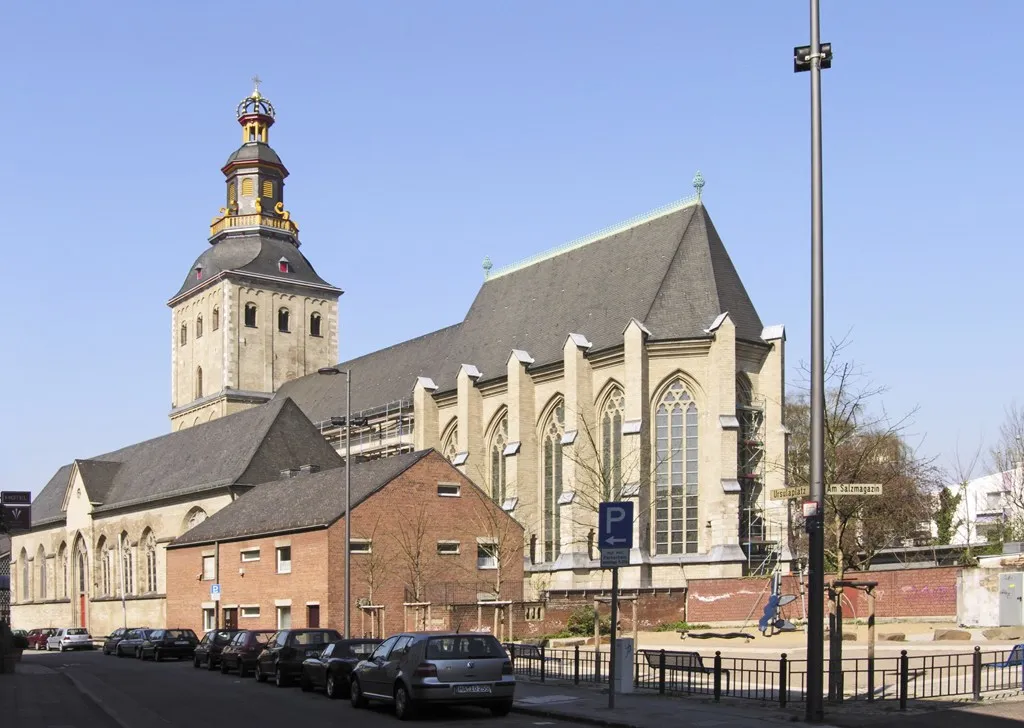
The Basilica church of St. Ursula (German: [ˌzaŋt ˈʔʊʁzula], Colognian: [ˌtsɪnt ˈʔoʒəla]) is located in Cologne, North Rhine-Westphalia, Germany. It is built upon the ancient ruins of a Roman cemetery, where the 11,000 virgins associated with the legend of Saint Ursula are said to have been buried. The church has an impressive reliquary created from the bones of the former occupants of the cemetery. It is one of the twelve Romanesque churches of Cologne and was designated a Minor Basilica on 25 June 1920. While the nave and main tower are Romanesque, the choir has been rebuilt in the Gothic style.
The Golden Chamber
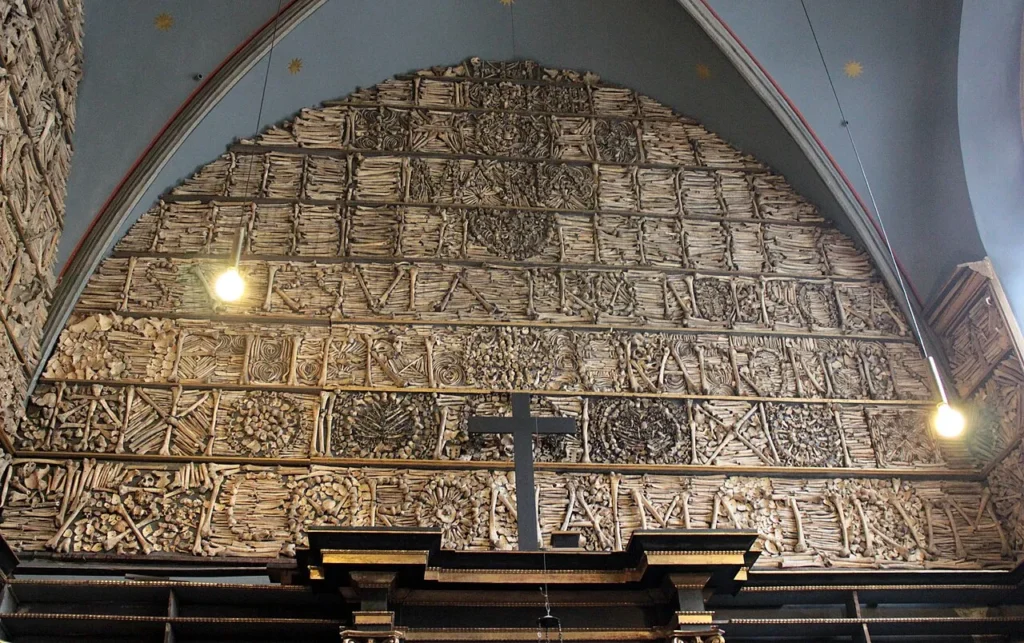
The Golden Chamber, or Goldene Kammer, of the church contains the alleged remains of St. Ursula and her 11,000 virgins who are said to have been killed by the Huns, possibly around the time of the Battle of the Catalaunian Plains. There are various theories relating to the origin of the legend of the 11,000 virgins – one is that the original legend said 11 virgins accompanied St. Ursula, but later readings misread the abbreviation “M” for martyrs as Latin numeral “M” for 1000, which over time lead to 11,000.
The walls of the Golden Chamber are covered in bones arranged in designs and/or letters along with relic skulls. The exact number of people whose remains are in the Golden Chamber remains ambiguous but the number of skulls in the reliquary is greater than 11 and less than 11,000. These remains were found in 1106 in a mass grave and were assumed to be those of the legend of St. Ursula and the 11,000 virgins. Therefore, the church constructed the Golden Chamber to house the bones. The bones themselves are neatly arranged in “zigzags and swirls and even in the shapes of Latin words.
Saint Ursula
Ursula (Latin for ‘little she-bear’) was a Romano-British virgin and martyr possibly of royal origin. She is venerated as a saint in the Roman Catholic Church, Eastern Orthodox Church and the Anglican Communion. Her feast day in the pre-1970 General Roman Calendar and in some regional calendars of the ordinary form of the Roman Rite is 21 October.
History Basilica of St. Ursula, Cologne, Germany
There is little information about Ursula or the anonymous group of holy virgins who accompanied her and, on an uncertain date, were killed along with her at Cologne. They remain in the Roman Martyrology, although their commemoration does not appear in the simplified General Roman Calendar of the 1970 Missale Romanum.
The earliest evidence of a cult of martyred virgins at Cologne is an inscription from. 400 in the Church of St. Ursula, located on Ursulaplatz in Cologne; it states that the ancient basilica had been restored on the site where some holy virgins were killed. The earliest source to name one of these virgins as “Ursula” dates from the 10th century. The Catholic Encyclopedia (1912) article on Ursula states that “this legend, with its countless variants and increasingly fabulous developments, would fill more than a hundred pages. Various characteristics of it were already regarded with suspicion by certain medieval writers, and since [Caesar] Baronius have been universally rejected”. Neither Jerome nor Gregory of Tours refers to Ursula in his writings. Gregory of Tours mentions the legend of the Theban Legion, to whom a church that once stood in Cologne was dedicated. The most important hagiographers (Bede, Ado, Usuard, Notker the Stammerer, Hrabanus Maurus) of the early Middle Ages also do not enter Ursula under 21 October, her feast day.
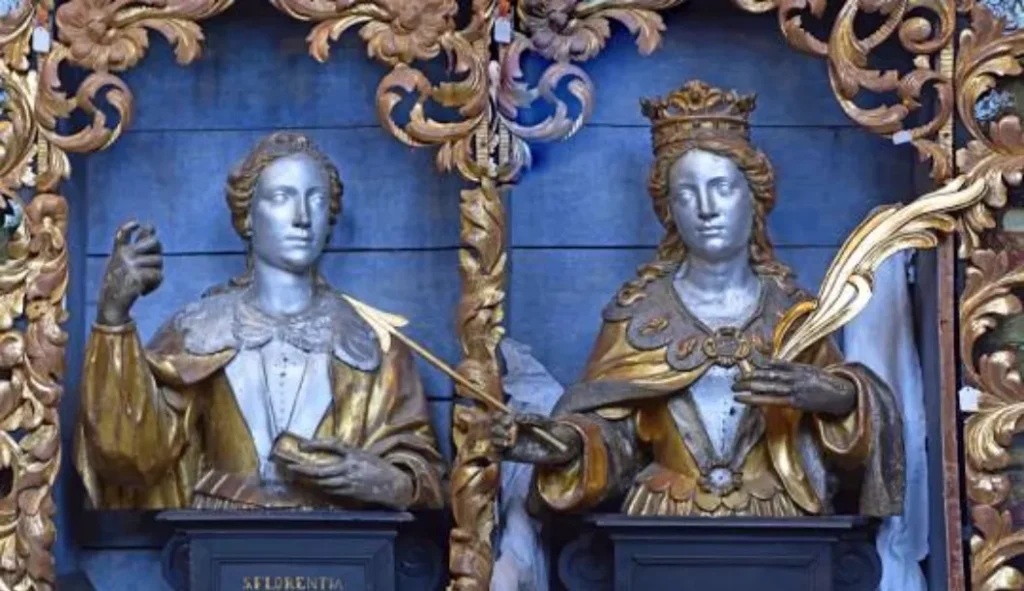
The Basilica of St. Ursula in Cologne holds the alleged relics of Ursula and her 11,000 companions. It contains what has been described as a “veritable tsunami of ribs, shoulder blades, and femurs … arranged in zigzags and swirls and even in the shapes of Latin words”. The Goldene Kammer (Golden Chamber), a 17th-century chapel attached to the Basilica of St. Ursula, contains sculptures of their heads and torsos, “some of the heads encased in silver, others covered with stuff of gold and caps of cloth of gold and velvet; loose bones thickly texture the upper walls”. The peculiarities of the relics themselves have thrown doubt upon the historicity of Ursula and her 11,000 maidens.
Architecture Basilica of St. Ursula, Cologne, Germany
The Roman cemetery, containing hundreds of graves and thousands of bones, was discovered in 1106 when a project was begun to expand the city’s fortifications. This discovery led also to the expansion of the Saints’ legend to include a number of impossible events and fictious personages, and provided the impetus to the building of an impressive new church to house the huge number of new-found relics. The new church was begun in the second quarter of the 12th century, following the orientation of its predecessor, but also including a large, vaulted crypt chamber to house the many new relics.
The church was severely damaged during the many bombing raids that struck Cologne, and by the end of the war, had been largely reduced to a ruin. Restoration on the main building was completed in 1972, and the Golden Chamber finished in 1978. The church’s belltower is believed to have been completed around 1230…
while the large Gothic choir on the east side was begun around 1255, and finished by the end of the century. In the same period, a second aisle was added to the church’s south side as a Lady Chapel.
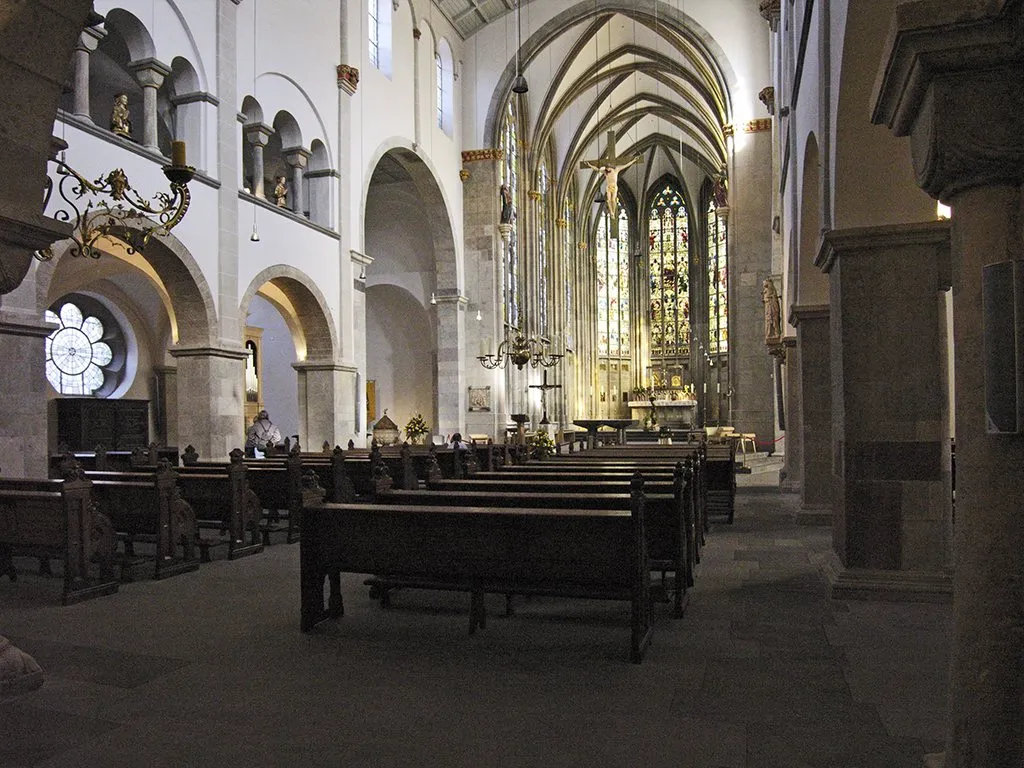
The main sanctuary seen from the choir gallery. As with many other churches throughout Germany, the modern restorers took advantage of the destruction inflicted on the church during the Second World War to “restore” the sanctuary to a primitive state that has nothing to do with its original form. The choir has 11 bays of stained-glass windows with innumerable representations of the 11,000 virgins. Some of the relics are kept on the main altar in the choir. A column in the north aisle of the church, decorated with an elaborate sculpture of the Passion of Our Lord.
Feast Day
Feast Day : 21 October
Saint Ursula (flourished 4th century, Rome; feast day October 21) was a legendary leader of 11 or 11,000 virgins reputedly martyred at Cologne, now in Germany, by the Huns, 4th-century nomadic invaders of southeastern Europe. The story is based on a 4th- or 5th-century inscription from St. Ursula’s Church, Cologne, stating that an ancient basilica had been restored on the site where some holy virgins were killed. Mentioned again in an 8th- or 9th-century sermon, the number of maidens increased to several thousand, reportedly martyred under the Roman emperor Maximian. In Jacobus de Voragine’s Legenda Aurea (1265–66; Golden Legend) Ursula is a British princess who went to Rome accompanied by 11,000 virgins and was killed with them by the Huns on the return from the pilgrimage. The discovery at Cologne in 1155 of an ancient Roman burial ground believed to contain these martyrs’ relics inspired additional legends. Ursula is the patron of the Order of St. Ursula (Ursulines), a congregation of nuns dedicated to educating girls. In the 1969 reform of the Roman Catholic church calendar her feast day was reduced to observances in certain localities.
Church Mass Timing
Thursday : 06.00 PM
Sunday : 10.15 AM
Church Opening Time:
Monday : 10 am – 12 pm, 3pm – 5 pm
Tuesday : 10 am – 12 pm, 3pm – 5 pm
Wednesday : 10 am – 12 pm, 3pm – 5 pm
Thursday : 10 am – 12 pm, 3pm – 5 pm
Friday : 10 am – 12 pm, 3pm – 5 pm
Saturday : 10 am – 12 pm, 3pm – 5 pm
Sunday : 3pm – 5 pm
Contact Info
Address :
Ursulapl. 24, 50668 Köln, Germany
Phone : +49 221 7880750
Accommodations
Connectivities
Airway
Cologne Bonn Airport (CGN), to Basilica of St. Ursula, Cologne Distance 22 min (17.2 km) via A559.
Railway
Cologne Central Station to Basilica of St. Ursula, Cologne Distance 5 min (1.1 km) via Ursulastraße.