


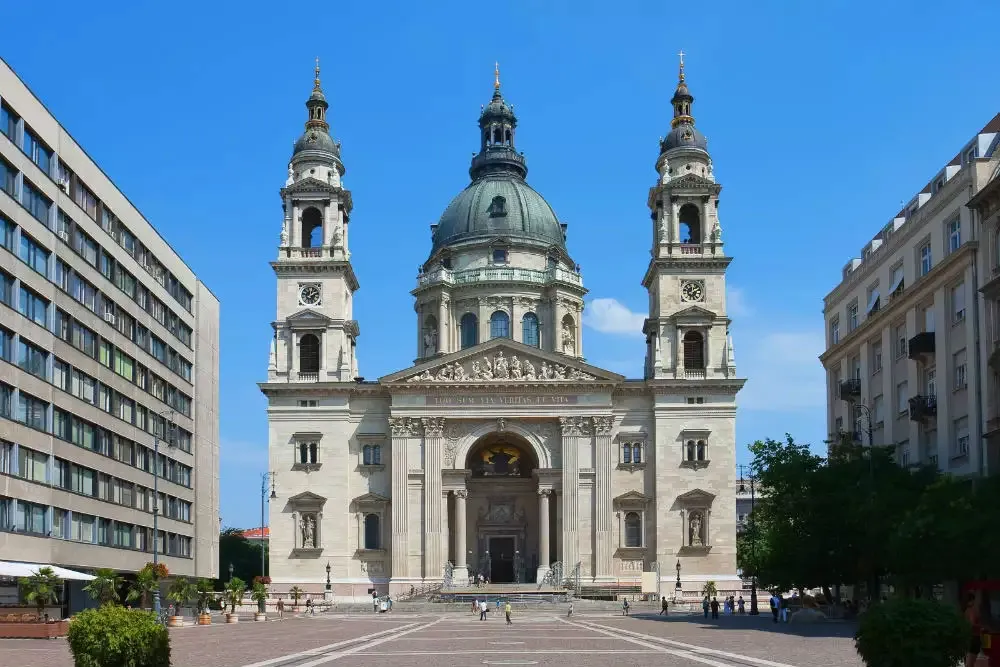
St. Stephen’s Basilica, Budapest, Hungary

Introduction
St. Stephen’s Basilica (Hungarian: Szent István-bazilika [sɛnt ˈiʃtvaːn ˈbɒzilikɒ]) is a Roman Catholic basilica in Budapest, Hungary. It is named in honour of Stephen, the first King of Hungary (c. 975–1038), whose right hand is housed in the reliquary. Since the renaming of the primatial see, it has been the co-cathedral of the Roman Catholic Archdiocese of Esztergom-Budapest. Today, it is the third largest church building in present-day Hungary. It is the largest church in Budapest and a World Heritage Site. St. Stephen’s Basilica, the largest church of Budapest is located in the heart of the city It is dedicated to Hungary’s first king, St. Stephen. About 8 500 people can get in the beautiful Neoclassical cathedral at the same time. Apart from its vastness, the Basilica offers some unique attractions and programs:
It houses Hungary’s most sacred treasure, St. Stephen’s mummified right hand, the Szent Jobb (Holy Right Hand), The Panorama Terrace up in the cupola and offers a birds’ eye view of the wholecity Several musical programs are organised in the church throughout the year. The spacious St. Stephen Square offers plenty of terraced cafes and bistros to people watch by a cup of coffee.
History of St. Stephen’s Basilica Budapest
St Stephen’s Basilica of Budapest is one of the most beautiful and significant churches and touristic attractions of the country. This is partly due to its historical heritage, of being dedicated to the holy king St Stephen who was also the founder of the Hungarian state, and partly to the architectural and artistic value of the building itself. A campaign to raise funds for the construction of the church commenced in the 1810-es, however, construction works did not start until August 14, 1851, based on the drawings of József Hild, a leading citizen and architect of Pest, who also designed the cathedrals in Esztergom and Eger. József Hild supervised the works until his death as of March 6, 1867. The Council of the City of Pest appointed Miklós Ybl, an acknowledged master at the time and designer of numerous public buildings in the capital city including the Opera House, to continue to supervise the design and construction of this prominent building.
After his death, the interior of the building and the fine artistic and decorative works were completed by 1905 under the supervision of József Kauser. January 22, 1868 was an important date in the history of the Basilica. It was on this day that the cupola and the cupola drum constructed according to the designs of Hild collapsed due to defects in materials and craftmanship. The pillars holding the arches of the cupola were constructed with donated stones of assorted quality and solidity. The cupola drum was built on the inner rim of the arches underpinning it, resulting in a precariously balanced structure which distributed the load unevenly on the pillars. The imbalance of the structure in turn gave rise to the collapse, after which works paused for more than a year, when the removal of the debris and the demolition of the poorly constructed parts commenced and continued until 1871. Miklós Ybl prepared new designs for continuing the construction works or revised the previous ones in terms of the structure and the appearance alike. From 1875, the Hellenistic forms and Classicist style were replaced by Neo-Renaissance elements applied by Ybl, and works continued, even after his death of 1891, according to his sketches and ideas until the long-last dedication of the church in 1905.
At first, the building was supposed to be named after Saint Leopold, the patron saint of Austria, but was later changed to honor Saint Stephen I of Hungary, the first King of Hungary (c. 975–1038), whose mummified right hand is housed in a reliquary. In 1931, Pope Pius XI awarded it the title of basilica minor; and served as the main venue for the 34th International Eucharistic Congress in May 1938. Although the church suffered serious damage during World War II the cellar provided shelter for many refugees and a valuable collection of the Hungarian National Archives.
The basilica is rather dark and gloomy inside. To the right as you enter the basilica is a lift to the 2nd-floor treasury of ecclesiastical objects. Behind the main altar and to the left is the basilica’s main attraction: the holy right Chapel, containing what is also called the Holy Dexter – the mummified right hand of St Stephen and an object of great devotion. It was restored to Hungary by Habsburg empress Maria Theresa in 1771 after being discovered in a Bosnian monastery. The chapel was being extensively renovated at the time of research and was not due reopen before 2020.
Architecture of St. Stephen’s Basilica Budapest

The church was designed in neo-classical style by József Hild. In 1858 the dome collapsed, which required complete demolition of the completed works and rebuilding from the ground up. Upon Hild’s death in 1867, the project passed to Miklós Ybl, who modified Hild’s initial plan to a more neo-Renaissance style. Construction commenced in 1851 and continued for fifty-four years. Work was completed in 1905 by József Kauser. The keystone was placed in the presence of the Emperor Franz Joseph I.
Equal with the Hungarian Parliament Building, it is one of the two tallest buildings in Budapest at 96 metres (315 ft) – this equation symbolises that worldly and spiritual thinking have the same importance. Regulations prohibited for a long period the construction of any building taller than 96 metres (315 ft) in Budapest. It has a width of 55 metres (180 ft), and length of 87.4 metres (287 ft). The tympanum over the main entrance holds an 1893 mosaic designed by Mór Than, Our Lord on the Throne with Angels by Salviati of Venice. On the main facade, below the tympanum, is an inscription of Christ’s words: “Ego Sum Via, Veritas et Vita” (I am the way the truth and the life).
St. Stephen Basilica was built in Neo-Classical style, and the church has a Greek cross ground plan. The facade is characterized by its two large bell towers. In the southern tower there is the largest bell of Hungary. The two towers feature six bells all together: five are located on the north side bell, while the largest bell is located in the southern tower. This bell is used about twice a year: on August 20th, on the church consecration day, and on December 31st. Visitors can access the dome by elevators or by climbing 364 steps and enjoy a wonderful view of Budapest . The façade is anchored by two large bell towers. In the southern tower is Hungary’s biggest bell, weighing over 9 tonnes (8.9 long tons; 9.9 short tons). Its predecessor had a weight of almost 8 tonnes (7.9 long tons; 8.8 short tons), but it was used for military purposes during World War II.
The two towers have six bells altogether: five small bells in the north tower and a single bourdon in the south tower. The bourdon called the Great St. Stephan bell is the biggest bell in Hungary with its 9250 kilograms and its diameter of 252 centimeters. Usually it is used twice a year, at 5pm on August 20, which is the date it was consecrated while the four smaller bells were consecrated three years later on the same day. It also tolls at midnight on New Year’s Eve and some special events when it tolls like the death of a Prime Minister or tragic events like the 9/11, but it is quite rare. The four smallest bells are founded in Passau in 1993.
The Bells
Great St. Stephan bell The largest bell in the church and in Hungary. Located in the south tower, it weighs 9250 kg and has a diameter of 240 cm. It was made by the Perner bell foundry in Passau, Germany in 1990, this bell chimes the hour. Blessed Virgin Mary bell The 2nd largest and oldest bell in the church, founded by Ferenc Walser in 1863 in Pest. It weighs 3100 kg and has a diameter of 178,5 cm, this bell chimes the quarter hours and has a unique looking clapper. St. Henry II. Bell It weighs 2150 kg and has a diameter of 150 cm. Blessed Gizella bell It weighs 1250 kg and has a diameter of 117,8 cm. Saint Emeric bell The 2nd smallest bell in the church, weighing 750 kg. Saint Erzsébet (Elizabeth) from the House of Árpád bell The smallest bell in the church, weighing 500 kg.

Interior
In the lobby of the main entrance you can see the Saint Stephen’s relief of Károly Senyei, and mosaics by Bertalan Székely. The dome above the sanctuary shows the representation of the Lord God, and the tambourine shows Christ as well as the prophets and evangelists (built by Károly Lotz). The sanctuary vault features allegories of the Holy Mass on mosaics by Gyula Benczúr and highlights the important stages of St. Stephen’s life in the bronze relief series by Ede Mayer. The canopy altarpiece designed by József Kauser is decorated with the statue of St. Stephen by Alajos Stróbl. The pulpit is also work of József Kauser. The glass painting works were made by Miksa Róth, and the pipe organ of the church is the product of the factory of Pécs and József Angster recognized in the era. He carried out the painting and, in particular, the gilding of the interior decoration.

Feast Day
Feast Day: August 20
Each year, Christians in Hungary celebrate St. Stephen Day on August 20
Mass Timing
08:30 – Mass
10:00 – Great Mass
12:00 – Holy Mass
05:00 – Pm Holy Mass in English in the Chapel of the Holy Right
06:00 – Pm
Weekdays:
07:00 – Holy Mass (Chapel of the Holy Right)
08:00 – Holy Mass (Chapel of the Holy Right)
06:00 – Pm Holy Mass
Contact Info
St. Stephen’s Basilica,
Budapest,
Szent István tér 1,
1051 Hungary
Phone No.
Tel :+36-13110839
Accommodations
Connectivities
Airway
Stephen’s Basilica to Budapest Airport (BUD) is 22 km. It takes approximately 24 min to drive from St. Stephen’s Basilica to Budapest Airport
Railway
Stephen’s Basilica to Budapest Keleti 13 min (2.7 km) via Rákóczi út
