


Our Lady of Awaiting Lebanon

Introduction
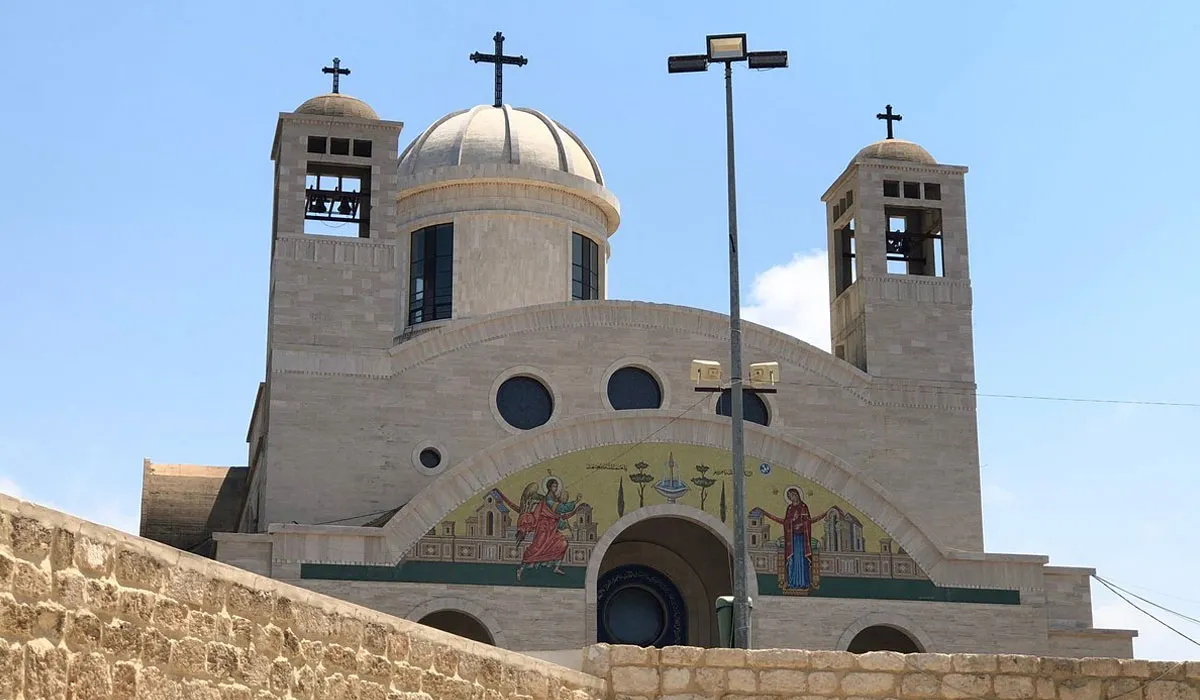
Our Lady of Mantara, a Melkite Greek Catholic Marian shrine located in Maghdouché, Lebanon, was first uncovered on September 8, 1721, by a young shepherd. Legend suggests that the grotto, with roots tracing back to ancient times, was entrusted to the care of Monsignor Eftemios Saïfi, the Melkite Catholic bishop of the Melkite Greek Catholic Archeparchy of Sidon. This sacred site comprises a tower adorned with a statue of the Virgin and Child, alongside a cathedral, a cemetery, and a revered cave believed to be where the Virgin Mary sought refuge while awaiting Jesus during his time in Tyre and Sidon, cities where women were not permitted entry. Since its initial discovery, families have made regular visits, particularly during the annual celebration of the Nativity of Mary on September 8th.
History of Our Lady of Awaiting

Numerous historians concur that the reverence for the Virgin Mary in Lebanon supplanted the Phoenician veneration of Astarte. Former temples and shrines dedicated to Astarte underwent conversion into Christian places of devotion, paying homage to the Virgin Mary. This transition is evident in Maghdouché, where remnants of a shrine dedicated to Astarte lie in close proximity to Our Lady of Awaiting.
Middle Ages
During Emperor Constantine’s reign in 324, Saint Helena of Constantinople, his mother, urged the destruction of all pagan temples and idols devoted to Astarte. The Astarte shrine in Maghdouché likely met its demise during this period and was repurposed as a site of reverence for the Holy Mother.
Since the early days of Christianity, the people of Maghdouché have held the cave where the Virgin Mary rested while awaiting her son Jesus’ preaching in Sidon in high esteem. Saint Helena tasked the Bishop of Tyre with consecrating a small chapel at the cave in Maghdouché. She also sent an icon of the mother and child along with some altar furnishings to the people. Historians suggest that Saint Helena invited the people to name the chapel, and they chose “Our Lady of Awaiting” to signify the spot where the holy mother awaited her son. The term “Mantara” is derived from the Semitic root “ntr,” which means “to wait.”
Saint Helena allocated funds from the imperial treasury to maintain the chapel, a practice that continued for three centuries during Byzantine rule in Phoenicia until Khalid ibn al-Walid’s victory over Emperor Heraclius at the Battle of the Yarmuk. Although Caliph Omar, who ascended to power in Jerusalem, demonstrated piety and humility by sparing Christendom’s holiest sites and showing tolerance toward Christian subjects, Arab rulers in other parts of Byzantium were less accommodating toward Christians, particularly in coastal cities like Tyre, Sidon, Beirut, Byblos, and Tripoli. After the majority of Sidonians converted to Islam in exchange for promised privileges and immunities, the residents of Maghdouché retreated to higher elevations in Mount Lebanon. Recognizing the Christians of Mount Lebanon as autonomous communities, the caliphate imposed a fixed tax on them. Before departing from their village, they concealed the entrance to the cave of Our Lady of Awaiting with stones, earth, and vines. Using obscure mountain paths, they left the village for the fortresses of Christian Lebanon. The legend of Our Lady of Awaiting endured through generations of Maghdouché’s exiled populace for a millennium.
Despite the arrival of the Crusaders in Sidon, the people of Maghdouché chose not to return to their ancestral home. The Crusaders spent much of the 12th and 13th centuries in the vicinity of Maghdouché without ever uncovering the existence of the sacred cave, even though they erected a small fort called La Franche Garde just meters from the hidden entrance.

Modern Era
The people of Maghdouché only returned to their ancestral village during the reign of the Druze Prince Fakhreddin II (1572-1635). Known for his tolerance and progressive mindset, Prince Fakhreddin II advocated for equality among Lebanon’s diverse religious communities. As a testament to this principle, he appointed a Maronite Catholic as Prime Minister, a Muslim as Minister of the Interior, a Druze as Army Commander, and a Jew as Finance Minister. His reign exemplified non-sectarianism and led to the principality becoming the most prosperous in the Ottoman Empire.
Despite centuries of labor near the grotto, where the men of Maghdouché dismantled the stones of the Crusader fort for construction material, relocating the sacred cave proved challenging. It was not until 8 September 1721 that the cave was rediscovered by a young shepherd. While attempting to rescue his goat, which had fallen into a well-like opening in the porous limestone, the shepherd fashioned a rope from vine twigs and descended into the hole. However, the rope broke, causing him to fall. As his eyes adjusted to the darkness of the grotto, the boy noticed a faint glimmer emanating from a golden object, later revealed to be Saint Helena’s icon of the Mother and Child. Climbing the stone walls, the boy hurried back to the village to share news of his discovery.
Pilgrimage Site
Ever since the rediscovery, the cave of Our Lady of Awaiting has been open to the public. It has become a major pilgrimage site in the Lebanon. The adjacent hilltop where Jesus and Mary had once stood is now Sidon’s Greek Catholic cemetery. Grand festivities are held each year on September 8 to commemorate the rediscovery of the sacred cave.
Near the sacred cave, the people of Magdhdouché built a cathedral and a modern tower crowned with a bronze statue of the Virgin and Child. The tower offers pilgrims panoramic views of Sidon, the Mediterranean, and the lush hills, valleys and citrus groves of Lebanon.
Annual Feast Day
Feast Date : September 8
The annual feast day of Our Lady of Awaiting Lebanon, is celebrated on September 8 every year.
Church Visiting Hours
-
Monday to Sunday : Open 24 hours
Contact Info
Basilica of Our Lady of Mantara,
G9GJ+VCX,
Maghdoucheh,
Lebanon.
Phone No.
Phone: +961 7 200 434
Accomodations
Connectivities
Airway
The nearest airport to the Our Lady of Awaiting Lebanon is Beirut-Rafic Al Hariri International Air. which is 44.4 km away from the Shrine.
Railway
The nearest Railway to the Our Lady of Awaiting Lebanon is Mar Mikhail Train Station. which is 55 km away from the Shrine.
