


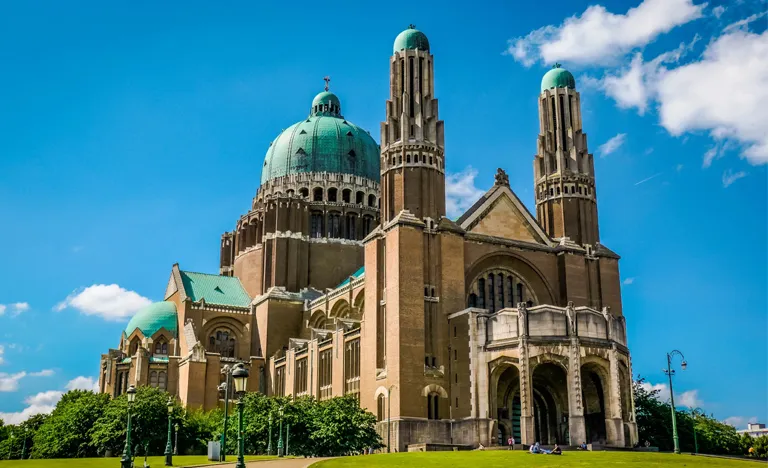
National Basilica of the Sacred Heart in Koekelberg, Belgium
Introduction

The National Basilica of the Sacred Heart (French: Basilique nationale du Sacré-Coeur, Dutch: Nationale Basiliek van het Heilig-Hart) is a Roman Catholic minor basilica and parish church in Brussels, Belgium. It is dedicated to the Sacred Heart, inspired by the Basilique du Sacré-Coeur in Paris. Symbolically, King Leopold II laid the first stone in 1905 during the celebrations of the 75th anniversary of Belgian independence. The construction was halted by the two World Wars and finished only in 1970. Belonging to the Metropolitan Archdiocese of Mechelen–Brussels, it is one of the largest churches by area in the world.
Located at the head of Elisabeth Park atop the Koekelberg hill, between the municipalities of Koekelberg and Ganshoren, the church is popularly known as the Koekelberg Basilica (French: Basilique de Koekelberg, Dutch: Basiliek van Koekelberg). The massive brick and reinforced concrete structure, in Art Deco style of neo-Byzantine inspiration, features two thinner towers and a nearly as high green copper dome that rises 89 metres (292 feet) above ground, dominating Brussels’ north-western skyline. On a clear day, the basilica can be recognised with the naked eye from dozens of kilometres away outside Brussels.
The Basilica of the Sacred Heart in Koekelberg is an Art Deco masterpiece. Almost an entire century passes from the first designs, dating from the end of the 19th century, to the final completion of the monument. The building that can now be admired bears witness to a contemporary art expression, streamlined by the mental structures of the time, with the desire to approach eternal beauty, as in the Renaissance.
History of Koekelberg Basilica

In 1902, Leopold II visited the Basilique du Sacré-Coeur of Paris, and inspired by it, decided to build a pilgrimage church back home, a national sanctuary dedicated to the Sacred Heart of Jesus. While he saw the opportunity to build his national Panthéon at the Namur Gate in Ixelles, Leopold II accepted that the land of Koekelberg be ceded by the Compagnie immobilière de Belgique to the Catholic Church with a view to building instead the national basilica there. The deed of donation of the 3.32 ha (8.2 acres) of land was signed on 12 December and confirmed on 31 December through a royal decree.
The initial project of the Leuven-based architect Pierre Langerock was a sumptuous neo-Gothic basilica inspired by the “ideal cathedral” of the French architectural theorist Eugène Viollet-le-Duc. Langerock envisaged an edifice bristling with six towers of a hundred metres or more, the highest of which would have culminated at 146 metres (479 ft) above the crossing.
Leopold II laid the first stone on 12 October 1905 during the celebrations commemorating the 75th anniversary of Belgian independence. The foundation works started in 1909, but the project was delayed due to the king’s death on 17 December 1909. Financing the basilica’s construction also soon became a problem, so only the foundations had been finished when World War I broke out. In his pastoral letter for Christmas 1914, Cardinal Mercier gave the basilica a new meaning:
“As soon as Peace shines on our country, we will rebuild on our ruins, and we hope to put the crowning touch on this work of reconstruction by building, on the heights of the capital of free and catholic Belgium, the National Basilica of the Sacred Heart”.
On 29 June 1919, King Albert I and a large crowd associated themselves with this promise in a ceremony on the Koekelberg hill. However, it was impossible to resume Langerock’s plan due to the state of public finances. A new project, in Art Deco style of neo-Byzantine inspiration, by the Ghent architect Albert Van Huffel , was thus adopted. In 1925, a 1/40 scale model of this final design won the great architectural prize at the International Exhibition of Modern Decorative and Industrial Arts in Paris. This model, produced with the greatest care, still stands today in the basilica.
The adaptation and extension of the existing foundations were undertaken from January 1926, and the building the apse began in August 1930.After Van Huffel’s death on 16 March 1935, the construction was taken over by his assistant, the architect-engineer Paul Rome. Cardinal Jozef-Ernest van Roey consecrated the unfinished basilica and opened it for worship on 14 October 1935, after obtaining a special authorisation from Pope Pius XI. The base of the cupola was finished in 1940 when World War II brought a new halt to the works. Building resumed in September 1944 and the main nave was completed in 1951.
The basilica was consecrated by Cardinal Van Roey on 13 and 14 October 1951, and Pope Pius XII assigned it the title of Minor Basilica on 28 January 1952. In 1953, the two towers were completed. The south transept opened in 1958 and the north transept in 1962. The cupola and thus the external structure was finished in 1969, and on 11 November 1970, the ceremony for the 25th anniversary of the episcopate of Archbishop of Mechelen–Brussels, Cardinal Leo Joseph Suenens, marked the completion of the basilica’s construction. On 4 June 1995, Father Damien was beatified in the basilica by Pope John Paul II.
Architecture of Basilique nationale du Sacré-Coeur

The National Basilica of the Sacred Heart, a paragon of architectural magnificence, stands as an active testament to its functional purpose. This grand basilica, designed by the collaborative genius of Pierre Lange rock, Albert Van Huffel, and Paul Rome, epitomizes the Art Deco style. Its ground-breaking ceremony on 12 October 1905, now 118 years past, marked the commencement of a monumental undertaking that reached its completion on 11 November 1970, culminating in 53 years of awe-inspiring existence.
Crafted from a blend of materials including reinforced concrete, terracotta layering, bricks, and dimension stone, the National Basilica of the Sacred Heart stands as an enduring symbol of artistic and engineering prowess. This monumental achievement in architecture continues to captivate hearts and minds, showcasing the visionary brilliance of its architects and the enduring legacy of their craft.
The Koekelberg Basilica is one of the largest Art Deco buildings in the world, and was, at the time of its construction, the fifth largest church building in world, at 89 metres (292 ft) high and 164.5 metres (540 ft) long (outside length). It remains today one of the largest basilicas and can accommodate 3,500 people. The central nave is 141 metres (463 ft) long, and at its widest, the building is 107 metres (351 ft). The cupola rises 89 metres (292 ft) above ground and has a diameter of 33 metres (108 ft).
This enormous building houses Catholic Church celebrations in the two main Belgian national languages (Dutch and French), as well as conferences, exhibitions (as in 2007–08, the International Leonardo da Vinci Expo), a restaurant, a Catholic radio station, a theatre and two museums.
The building’s exterior combines reinforced concrete with terracotta layering, Dutch belvédère bricks, and white dimension stone from Burgundy. The green roofs and domes are clad in Congolese copper.
The main entrance is flanked by two slender towers, 65 metres (213 ft) high, topped with reduced domes. The narthex-portal has a large balcony intended for open-air masses, the parapet of which was carved with a bas-relief depicting Christ the Merciful. Its pillars are extended by statues of the four evangelists by the Belgian-Danish sculptor Harry Elstrom . From left to right, they depict Saint John and his eagle (1955), Saint Luke carrying the bull (1958), Saint Mark enlaced by the lion (1958), and Saint Matthew with man (1964).
The basilica’s interior possesses a rich architectural heritage and holds an exceptional collection of works of art, including Tête du Christ bronze sculpture by Constant Permeke, thirty-one engravings by Joan Miró about the Canticle of the Sun by Saint Francis of Assisi, a painting by Antoni Tàpies, a photographic work by San Damon called When Jesus Became Christ on the theme of the crucifixion, seven original lithographs by Alfred Manessier on the theme of Easter and the Mount of Olives, works by James Ensor, a painting by Geneviève Asse on the biblical theme, as well as paintings by Albert Servaes. The painter Anto Carte designed the eight stained glass windows representing the life of Jesus, and the artist Ri Coëme an additional twenty-eight.
The altar, the liturgical furniture and the cross in the choir are the work of the sculptor Jacques Dieudonne. The basilica also contains two organs: a large 1959 modern choir organ and a 1965 classical choir organ in the crypt.
Art Deco of Nationale Basiliek van het Heilig-Hart
The Art Deco characteristics consist of clear and distinct lines, composed of compact and simple volumes in brick, masonry and natural stone. The structure of the building is entirely made of reinforced concrete, with glazed terracotta used as formwork. The glazed terracotta as a decorative element creates a particularly warm atmosphere within the building, despite the coldness of the material itself.
The stained glass windows of Basilique de Koekelberg

The stained glass windows in the basilica have been there since 1937. They have grown along with the slow construction as the donations from the faithful, Christian organizations and associations followed. The designs were put on cardboard by about ten of the great glaziers who worked in our country in the mid-20th century. The quality of the stained glass windows is therefore quite diverse.
The stained glass windows in the apse have the Eucharist and adoration as their subject. The life of Jesus is told in the large nave, while the eight beatitudes are the subject discussed in the galleries. Afterwards, stained glass windows were placed in the side chapels.
The most important artists who contributed to the stained glass windows in the basilica are Anto-Carte, Louis-Charles Crespin, Jan Huet, Michel Martens, Jean Slagmuylder, Maria Verovert and Pierre Majerus
The Sculptures of Basiliek van Koekelberg
The new ecclesiastical architecture that Albert Van Huffel designed, functionally stripped of the superfluous, provided from the outset an impressive ciborium for the high choir, a marble altar with a statue of the Sacred Heart for the parochial choir and a portal with statue sculptures.
Two internationally renowned artists, George Minne and Harry Elstrom, worked on it. They represent two movements in sculpture that were confronted with each other due to the slow construction.
Museum Zwartzusters Brus¬sels
The Brussels Black Sister Monastery was one of the smaller monasteries in the city. Compared to some other Black Sister communities in the Southern Netherlands, the monastery was quite prosperous, because Brussels was the administrative and political capital of the country, and therefore its “clients” were wealthier.
Due to the forced move of the monastery from the centre of Brussels in 1998, part of its heritage came into the hands of the non-profit organization Friends of the National Basilica. A museum space was furnished with these objects. The collection can be divided into two major parts: pure and purely religious art, such as tableware and other pieces related to worship. In addition, there is also the normal bourgeois interior, with furniture, copper and tin ware and porcelain.
- Painting: Flemish school from the 16th to the 19th century.
- Furniture and works of art: Flemish, oak 17th to 19th century.
- Crockery: silver, pewter, porcelain and copper from the 17th to the 19th century.
- Sculpture: Flemish religious images from the 14th to the 19th century.
- Lace: Brussels – Flemish bobbin – needle lace from the 18th and 19th centuries.
The museum space was furnished with these objects. The museum contains paintings, furniture and works of art, tableware, sculpture, Brussels and Flemish lace.
Museum of Modern Religious Art
The Basilica of Koekelberg houses an extensive collection of paintings and sculptures from the Museum of Modern Religious Art of the Diocese of Bruges. The MMRK stands for religiously and spiritually inspired art in the present, for contemporary people.
The new exhibition “Crossing Ways” represents an interpretation of the 14 stations of the Way of the Cross, taking the museum’s collection as a starting point and adding contemporary artists. Each station of the Way of the Cross has an interpretation or symbolizes a personal but also a global journey with its obstacles, setbacks and suffering. Yet ultimately man hopes for a light and something worth living for. This inspires a 15th station, the resurrection. The new exhibition is curated by Denys Shantar, a Swiss-Ukrainian artist and curator, currently based in Antwerp.
Annual Feast Day
Feast Day – 7th June
The annual feast day of National Basilica of the Sacred Heart in Koekelberg is celebrated on 7th june each year.
Mass Timing
Weekdays
- Monday, Tuesday, Thursday and Friday – 9:00 AM (French)
- Wednesday – 8:15 AM (French) & 9:00 AM (Dutch)
Weekend days
- Saturday – 9:00 AM (French)
- Sunday – 9:00 AM (French) & 11:30 AM (Dutch)
Contact Info
National Basilica of the Sacred Heart
Basiliekvoorplein 1
1083 Ganshoren
Belgium.
Phone No.
Phone: +32 2 421 16 60
Accommodations
How to reach the Sanctuary
Airways
The nearest airport to National Basilica of the Sacred Heart in Koekelberg is Brussels Airport which is just 21.7 kilometres away from the basilica.
Railways
The closest railway station to National Basilica of the Sacred Heart in Koekelberg is Brussels Central Station which is just 5 kilometres away from the basilica.
