


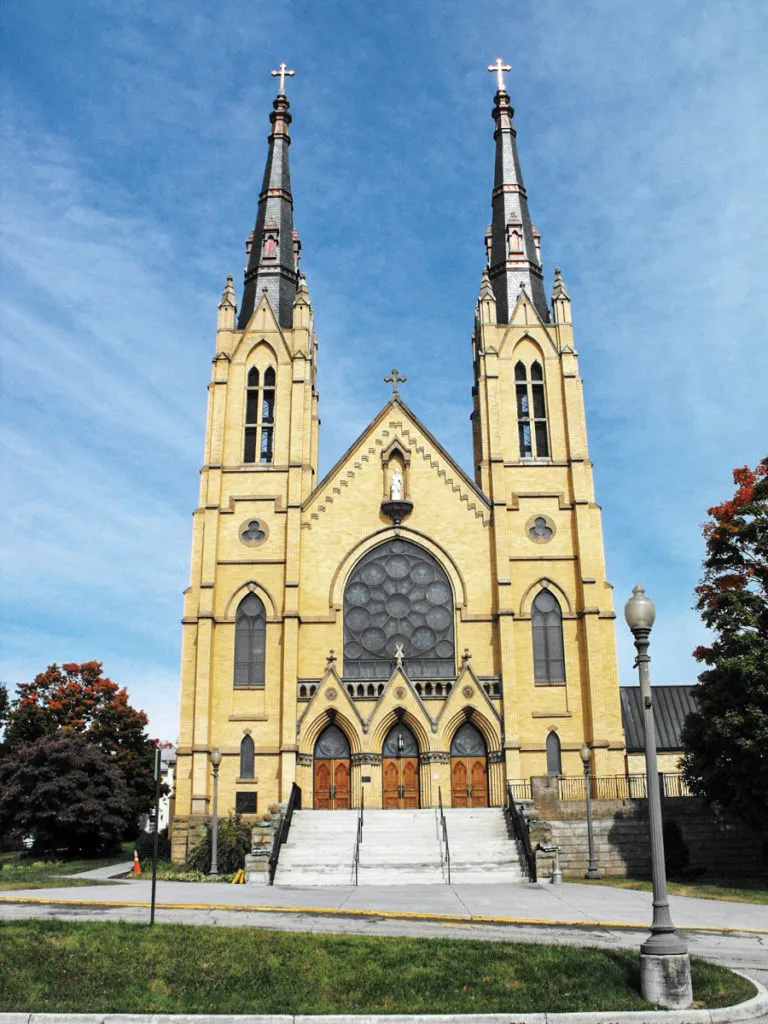
Basilica of St. Andrew, Roanoke, Virginia, USA

Introduction
The Basilica of St. Andrew, also known as St. Andrew’s Catholic Church, is a historic Roman Catholic Church and rectory in Roanoke, Virginia, United States. It was built in 1900-1902, and is a buff brick church on a stone foundation in the High Victorian Gothic style. It has a cruciform plan and features two tall Gothic towers which flank the main entrance and are square in plan.
Due to restrictions on Roman Catholic worship in Virginia in the early days of European settlement, it took some time to establish the church in the state. Most of the early Catholic population settled and built churches in the western part of the state, including in Roanoke.
This Gothic cathedral was built in 1902, replacing a small earlier church building. . The church is also listed on the National Register of Historic Places. The church is a rare example in Virginia of yellow brick High Victorian Gothic. The large stained glass windows were imported from Germany and the altar marble from Italy. The exterior is brick and sandstone. The last major restoration was done in 2014.
The official announcement of the basilica title came from the Diocese of Richmond, following the approval by the Vatican’s Dicastery for Divine Worship and the Discipline of the Sacraments. Father Kevin Segerblom, the leader of St. Andrew’s, describes the basilica as “living art,” a place where people can come and have their hearts and minds lifted up to the divine.
The basilica’s beauty and magnetism are undeniable. Its architecture and art are truly impressive, drawing in newcomers and leaving them awestruck. People often find themselves standing in the parking lot, simply gazing at the church’s magnificence. And once they step inside, they are overwhelmed by its grandeur.
But it’s not just the physical beauty that keeps people coming back. The parishioners play a crucial role in creating a welcoming and inclusive community. Their warmth and kindness make visitors feel at home and encourage them to explore their faith further. The parishioners of St. Andrew’s are the heart and soul of this basilica.
Southwest Virginia is not known for its large Catholic population, making the basilica designation even more significant. It serves as a symbol of the vitality of Catholicism in this predominantly non-Catholic region. For more than a hundred years, the church has stood as a testament to the enduring presence of Catholicism here.
History of St. Andrew’s Catholic Church

According to research for the Virginia Historical Society, It is well established that the first Europeans to set foot on Virginia soil were Spanish Catholic missionaries in the Sixteenth Century. A band of Jesuits settled near the York River opposite Jamestown in 1570 and spent two years trying to Christianize the Indians before they were massacred by the Chiskiacs.
On the 22nd day of September in the year 1879, the Bishop of the Diocese of Richmond, Rt. Rev. John J. Keane, assigned to the church at Lexington and the adjacent counties of Rockbridge, Alleghany, Bath, Botetourt, Craig and Roanoke, the young newly-ordained priest, Father John W. Lynch. The Catholic population was sparse and scattered and the faithful discharge of his duties was arduous indeed, for horseback was his only means of contact.
The one Catholic in the village of Big Lick was joined by others with the coming of the Shenandoah Valley Railroad and its joining with the new Norfolk & Western. On November 19, 1882, in Passenger Coach No. 6, Father Lynch said the first Mass celebrated in the then thriving town of Roanoke. Later, old Rorer Hall, located at 3rd Street and Campbell, alternated as a place of worship.
Realizing the necessity of a church, for the growing Catholic population the land developer. J. B. Austin offered as a gift to Father Lynch, any unselected site in his company’s holdings. He chose two lots atop what is now St. Andrew’s hill, and in just one year, Mass was celebrated in a new small brick church. Adjoining lots were purchased.
With a sizable debt and a congregation that filled only eight pews, Father Lynch was inspired to establish a plan of financing widely in use to this day – the contributions of small amounts on a monthly basis. This worked so well that in three years he had increased the land to 12.85 acres.
Soon the congregation began clamouring for a resident pastor, and legend has it that the bishop said, “Build me a house and I will give you a priest.” Little did he realize the swiftness with which this would be accomplished? Father Lynch, who had been sleeping in the sacristy on his visits, salvaged materials from an old mill which had burned down at the foot of Mill Mountain, and the rectory was completed in 1887.
So hard pressed was the bishop to provide for the faithful in the remaining counties, his appointment as pastor did not come for two years, November 19, 1889, seven years to the day after the first Mass in Roanoke.
The Parish flourished in many ways; a Sunday school was established and a class of twenty-five was confirmed. A hall was next provided for Sunday school and meetings. St. Vincent’s Home for boys was opened on March 1, 1893 and staffed by the Sisters of Charity of Nazareth, Kentucky. The building provided school rooms on the ground floor and quarters for the boys and the sisters on the upper two floors. A few years later, a school building including an auditorium was added, a gift of Mrs. Thomas Fortune Ryan, wife of the well-known financier.
With the advent of Father Lynch as resident pastor, there came an impetus which carried plans forward. One hundred and four acres were purchased for a cemetery. Even though some of the original debt remained, within eight years of Father Lynch’s residency, the parish was debt free.
The church originally began as a small brick building built in 1879. In 1897, the small church was outgrown by the size of the congregation, and the construction of the current building began. A contract was let for the present St. Andrew’s at a total cost of about $108,000, all but 20% of which was paid by the dedication date in 1902.
St. Andrew’s was approved by the Vatican’s Dicastery for Divine Worship and the Discipline of Sacraments on September 6, 2023 to become a minor basilica. It is now known as The Basilica of St. Andrew.
Architecture of Basilica of St. Andrew

William P. Ginter of Akron, Ohio, was the architect of the twin-spired Gothic structure which occupies one of the highest knolls within the City of Roanoke and which has been likened by many to the cathedrals of Rouen and Chartres in France. The exterior is buff brick and Ohio sandstone with slate roof and copper finishing. White marble for the altars and altar railings was imported from Italy. In the beginning, the interior of the church was painted cream and gold. In 1947, artists from Yonkers, NY, came to fresco the church and do the stenciling design of the Vine and Branches theme. The present stations were not placed in the church until February 25, 1906.
The church has a characteristically French facade composed of twin front towers flanking three deeply recessed portals beneath a rose window. Above the rose window is a niche with a statue of St. Andrew. Tall spires, buttresses, corbeling, roof cresting, and a flèche at the crossing of the nave and transept add excitement to the church’s bold silhouette. Steps lead up to the three gabled portals that open to the narthex and stairways to the balcony above it. Rib vaults terminating in pendants cover the nave. The Franz Mayer Company of Munich, Germany, created some of the stained glass windows. There are around 15 glass windows in the basilica.
The symbols of the basilica include the ombrellino (umbrella), the tintinnabulum (bell), and the papal cross keys. The ombrellino is a distinctive symbol used in basilicas throughout the world and is designed with stripes of yellow and red; traditional papal colors. The silk canopy is a symbol of a basilica’s special connection with the Holy Father, while the crossed keys are a sign of papal authority. In recent years, the basilica has undergone a complete restoration of its interior and exterior.
The church has had two major renovations since its completion. The first renovations took place after the Second Vatican Council authorized certain liturgical alterations. A freestanding altar was installed so that Mass could be celebrated versus populum, the priest facing the people. The ornate high altar was left in place and intact.
Later, the original freestanding altar was replaced with a more ornate, marble one that remains in use to this day. At the same time the interior was radically modified to remove two side altars, a long altar rail, and a select portion of iconography. The lighting of the church was also renovated to allow a brighter hue.
From 2010 to 2014, St. Andrew’s saw its most expensive long-term renovation. The large pipe organ, being an object of much effort to maintain, was replaced with an electric organ. The pipes, however, were retained for decoration. In 2014, the steeples, originals from the construction of the church, were removed and renovated.
Relics at the Basilica of St. Andrew

The Basilica of St. Andrew is the guardian of 17 first class relics. The relics are in reliquaries, which are kept under lock and key within relic cabinets mounted on the side walls of the All Saints Chapel in the parish centre. They are housed in a chapel where they can be reverenced by the faithful whenever the church is open. All of the relics have their documents of authentication.
The relics that are in the care of The Basilica of St. Andrew are listed as follows:
- Relic of Wood of the True Cross of our Lord Jesus Christ
- First class relic of Saint Andrew, Apostle
- First class relic of Saint James the Great, Apostle
- First class relic of Saint Matthew, Apostle and Evangelist
- First class relic of Saint Mark, Evangelist
- First class relic of Saint Simon, Apostle
- First class relic of Saint Jude Thaddeus, Apostle
- First class relic of Saint Nicodemus
- First class relic of Saint Maximus of Rome
- First class relics of Saints Cosmas and Damian
- First class relic of Saint Helena, Empress
- First class relic of Saint Monica
- First class relic of Saint Basil the Great
- First class relic of Saint Gregory Nazianzus
- First class relic of Saint John Chrysostom
- First class relic of Saint John of Damascus
- First class relic of Pope Saint Pius X
On the Feast of the Exaltation of the Holy Cross, the relic of the Wood of the True Cross, in its reliquary, is placed on a small table in front of the altar. At the end of Mass, all the faithful are blessed, in silence, with the relic.
On the Solemnity of All Saints, all the saints’ relics, in their reliquaries, are placed on a table just outside the sanctuary of the church. They are incensed at the beginning of Mass, and the faithful are invited to pray before them after Mass.
On each of the saints’ individual feast days, the saint’s relic, in its reliquary, is placed on a table just outside the sanctuary. When Mass is finished, the presiding priests withdraws to the sacristy to remove his chasuble and don a cope. He then returns and blesses each of the faithful individually with the relic and in the name of the Father, and of the Son, and of the Holy Spirit as he or she comes forward in procession to the front of the altar.
Annual Feast Day
Feast Day – 30th November
The annual feast day of St. Andrew’s Catholic Church, Roanoke is celebrated on 30th November each year
Mass Timing
Weekdays
- Monday to Friday – 12:00 PM
Weekend days
- Saturday – 5:30 PM
- Sunday -7:30 AM, 9:00 AM (live streamed), 11:30 AM.
Contact Info
Basilica of St. Andrew
631 North Jefferson Street
Roanoke, Virginia 24016
Phone No.
Phone: 540-344-9814
Fax: (540) 344-7879
Accommodations
How to reach the Sanctuary
Airways
The nearest Airport to the Basilica of St. Andrew, Roanoke is Roanoke-Blacksburg Regional Airport which is 4.7 miles away from the basilica.
Railways
The nearest Railway station to the Basilica of St. Andrew, Roanoke is Roanoke Railway station which is 0.7 miles away from the basilica.
