


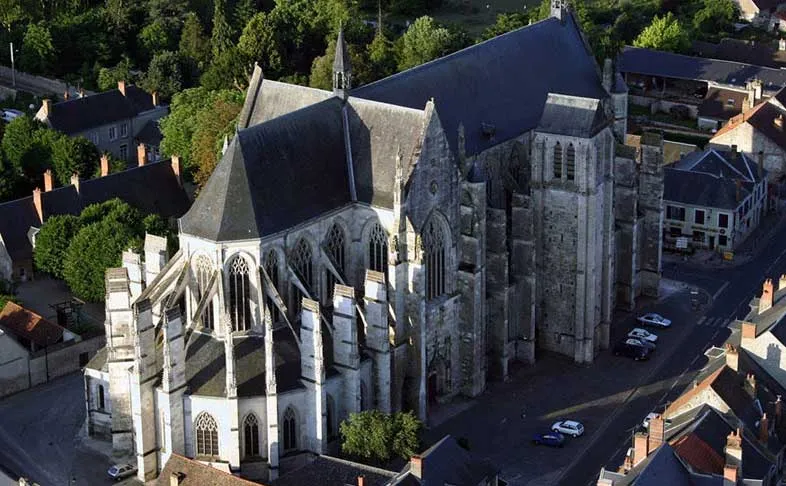
Basilica of Our Lady of Cléry-Saint-André

Introduction
The Notre-Dame de Cléry-Saint-André basilica (Basilica of Our Lady of Cléry-Saint-André, France) is a French religious building located in Cléry-Saint-André in the Loiret department (Centre-Val-de-Loire region). Today the parish church of the Catholic community of Cléry, it is both collegiate, royal chapel and Marian basilica because of the devotion to Notre-Dame which developed there.
The building was popularized by the nursery rhyme Le Carillon de Vendôme. It is classified as a historic monument by the list of 1840 and located within the perimeter of the Loire Valley, listed as a UNESCO World Heritage Site.
Notre-Dame Basilica is located in the city center of the commune of Cléry-Saint-André, in the canton of Cléry-Saint-André, the arrondissement of Orléans, the department of Loiret, the Center region and the region nature of the Loire Valley, 3 km from the left bank of the Loire. It depends on the ecclesiastical province of Tours, in the diocese of Orléans and the pastoral area of Val de Loire and Sologne.
The building is located about 95 m above sea level, 15 km south-west of Orléans, 5.5 km east of Meung-sur-Loire and 132 km south of Paris; it is surrounded by departmental roads 18 (rue Louis XI), 951 (rue du maréchal Foch), rue du cloître and passages Dunois and Cachon.
The church is 6 km from the Meung-sur-Loire SNCF train station, 8 km from exit 15 of the A10 motor way and located on line 8 of the Ulys departmental coach network.
History of Basilica of Our Lady of Cléry-Saint-André

The origin of the church would come from the discovery of a statue of the Blessed Virgin on the site, to which are attributed miraculous virtues at the origin of a pilgrimage. In order to welcome pilgrims, Philippe IV le Bel decided to build a collegiate church there around 1300.
The church was destroyed in 1428 during the Hundred Years War by English troops, only the square bell tower remains on the north side. During a battle against the English, in Dieppe, Louis XI, then Dauphin of France, made a vow to rebuild a church in Cléry if he triumphed; the project will be implemented in 1443 by Charles VII and Jean de Dunois who founded the new church.
The reconstruction of the new building by Louis XI, following his victory at Dieppe in 1443, took place from 1449 to 1485 and was carried out under the direction of Pierre Chauvin and Pierre Le Page.
On this occasion, the king donated the Holy Thorn and a relic of Saint Andrew; in 1483, the Saint-Jean chapel was built by the architect Simon Duval for Jean de Dunois and his family who are buried there. In the 16th century, two chapels were added: around 1515, Gilles de Pontbriant, dean of the chapter of Cléry and his brother, François de Pontbriant, an architect then working on the construction site next to the Château de Chambord, built the Saint-Jacques chapel on the pilgrimage route to Saint-Jacques-de-Compostelle; a hexagonal chapel signed Jean des Roches.

Middle Ages
We can follow the future of Notre-Dame de Cléry through the letters patent issued by Louis XI during his reign (1461-1483): from Tours, in October 1461: “Letters patent which confirm the exemptions, the rights, the bonds etc residents of the town of Clairy”; from Tours, in December 1461: “Freedom of several taxes in favor of the town of Cléry”; December 21, 1467, from Le Mans, the collegiate church also becomes a royal chapel: “General tax relief and various other concessions for the church of Notre-Dame de Cléry”; from Mehun-sur-Loire, October 24, 1471.
“Gift made by the King to the Chapter of the collegiate church of Cléry of four thousand pounds tournament income to add to the solemnity of the divine service”; from Plessis-du-Parc-lèz-Tours, in February 1478, “Letters relating to the assignment of four thousand pounds of income, made to the chapter of Notre-Dame de Cléry, on the Lands and Lordships designated there in”; in January 1479, from Les Forges-lèz-Chinon, two letters were issued, “Creation of dignities in the chapter of Notre-Dame de Cléry” and “Exemption from seal duties for the dean, the chapter, the vicars and regulars of the Church of Our Lady of Cléry;
One in February 1479, from Les Forges-lèz-Chinon: “Ratification, with declaration, for a donation of four thousand pounds tournament income made to the church of Notre-Dame de Cléry” 18 and one in March 1479 from Tours: ” Letters concerning donations made to the Church of Notre-Dame de Cléry”. In November 1479, from Plessis-du-Parc-lèz-Tours, “Donation of salt to the church of Cléry”.
Finally, the king grants the barony of Cléry to the collegiate church of Notre-Dame de Cléry, by his letters patent. The Parliament of Paris registers them on July 7, 1480.
September 7, 1483, Louis XI, and Charlotte of Savoy, his wife, around December 1483, are buried in the basilica. A tomb (originally a mausoleum in bronze and a statue of the king in enameled gilded copper represented as a praying hunter) was then made by the goldsmith Conrad of Cologne and the gunner Laurent Wrine, molded after a sculpture by Colin of Amiens.

Modern Era
April 2, 1562, during the Wars of Religion, the king’s tomb and the statue of the Virgin were destroyed by Protestants following the capture of the city of Orléans by the armies of the Prince of Condé. The lead from the coffins is cut into strips to be melted down.
During the reign of King Henry III, processions to Notre-Dame de Cléry by the Royal Chapel were frequently carried out, notably during the Annunciation.
In 1622, Louis XIII had a new, more modest marble burial built which would in turn be destroyed during the French Revolution (only the modern statue of the king and the four angels would be preserved by Alexandre Lenoir in Paris in his Museum of French Monuments), as well as a new statue of the Virgin in white marble signed Michel Bourdin d’Orléans, painter and architect in Paris.

Contemporary Period
In the 19th century, the architect François-Narcisse Pagot and the sculptor Romagnési reconstructed a new mausoleum after the prefect Maxime de Choiseul d’Aillecourt repatriated the sculptures from the Musée des monuments français in 1818. The monument was dismantled in 1868 then replaced in 1896 on a monument designed by Alexandre Lenoir and adapted by the sculptor Libersac, a monument which now appears in the nave of the church.
Only the base of a sawed off skull and a jaw, attributed to Charlotte of Savoy, a sawed off cranial vault, a jaw and a fragment of the nasal part attributed to Louis XI, remain at Cléry, in the vault of the crypt of the basilica whose location was found in 1889 by Abbé Saget, then parish priest of Cléry, the rest of the bones having disappeared in 1792 after the passage of the revolutionaries.

Architecture
In the 19th century, the building was restored by, among others, the French architect Eugène Viollet-le-Duc. The church is classified as a historical monument on the list of 1840. In 1873, Count Georges de Balby de Vernon, a member of the Archaeological and Historical Society of Orleans, taking advantage of the restorations to carry out excavations of the soil, discovered the heart of King Charles VIII.
In 1891, the Saint-Jean chapel was restored thanks to the patronage of the Marquise de Poterat. The royal chapel becomes a basilica under the pontificate of Pope Leo XIII, the February 2, 1894.
In 2002, the electricity, gas and tele communications networks located in the vicinity of the basilica were buried and the building benefited from a new lighting of its facades. The same year, archaeological work on the contents of the tombs of the basilica was carried out by Dr. Gorbenko, a Ukrainian scientist. Their publication will arouse violent polemics.
From March to December 2009, € 690,000 provided by the Ministry for Recovery as part of the implementation of the recovery plan enabled the restoration of the sculpted decorations on the south facade of the chapels.
In 2018 the rector of the Basilica of Notre-Dame de Cléry, Olivier de Scitivaux, was dismissed from his post by Bishop Jacques Blaquart after accusations of pedophilia. In 2021, after having recognized the attacks before a canonical judge, Olivier de Scitivaux was excluded from the clerical state by decision of the Congregation for the Doctrine of the Faith.
The general plan of the building is of the Latin cross type. The vault of the basilica is of Gothic style, the roof with long sides is covered with slates.

The Discovery of A Statue of the Virgin
The history of the Basilica dates back to the 13th century, when laborers discovered a statue of the Virgin in a field in Cléry-Saint-André. Very quickly, the rumor spread and many pilgrims flocked from all over to pay homage to him and gather in front of Mary, invested with miraculous powers. It was then decided to build a chapel to welcome these passing visitors.
Faced with the scale of the phenomenon, King Philippe Le Bel decided to undertake a more ambitious construction of a church, the first stone of which was laid in 1339. But the Hundred Years War plunged the region into turmoil. The English will have no pity for Notre-Dame de Cléry and will leave, as only witness, the bell tower.

The Royal Chapel
The rebuilding of the church was initiated in 1444 by the Lord of Beaugency, Jean de Dunois, the famous bastard of Orléans and comrade-in-arms of Joan of Arc. He even chooses to order a funeral chapel in which he will be buried alongside his wife.
Let’s not forget that the destiny of the Basilica is inseparable from that of King Louis XI. Multiplying donations and very devoted to Notre-Dame, he proclaimed it “Royal Chapel” and chose it as his burial place in 1467. He has been resting there since 1483. He will be the only king of the Valois dynasty not to be buried, with his predecessors, at the basilica of Saint-Denis, north of Paris.

The Rebirth of the Basilica
The life of a church is not a long calm river. Its embellishment continued at the beginning of the 16th century before being ransacked again, once during the Wars of Religion and again during the French Revolution. A restoration campaign will be undertaken throughout the 19th century, affirming its architectural and heritage interest. Classified as a “Historic Monument” in 1840, it obtained from Pope Leo XIII the honorary title of Basilica in 1894.
Located on the way to Santiago de Compostela, the beautiful Lady still welcomes many pilgrims, more than 500 years later.

Feast Day – 11th July
Annual Feast Day of Our Lady of Clery celebrated on 11th July.
Church Visiting Time
Contact Info
Basilica of Our Lady of Cléry,
Rue Louis XI, 45370,
Cléry-Saint-André, France.
Phone No.
Tel : +33 2 38 45 70 05
Accommodations
How to reach the Basilica
Aéroport Orléans Loire-Valley in Saint-Denis-de-l’Hôtel, France is the nearby Airport to the Basilica.
Gare de Meung-sur-Loire Train Station in Meung-sur-Loire, France is the nearby Train Station to the Basilica.