


Basilica of St. Mary, Igualada, Spain
Introduction
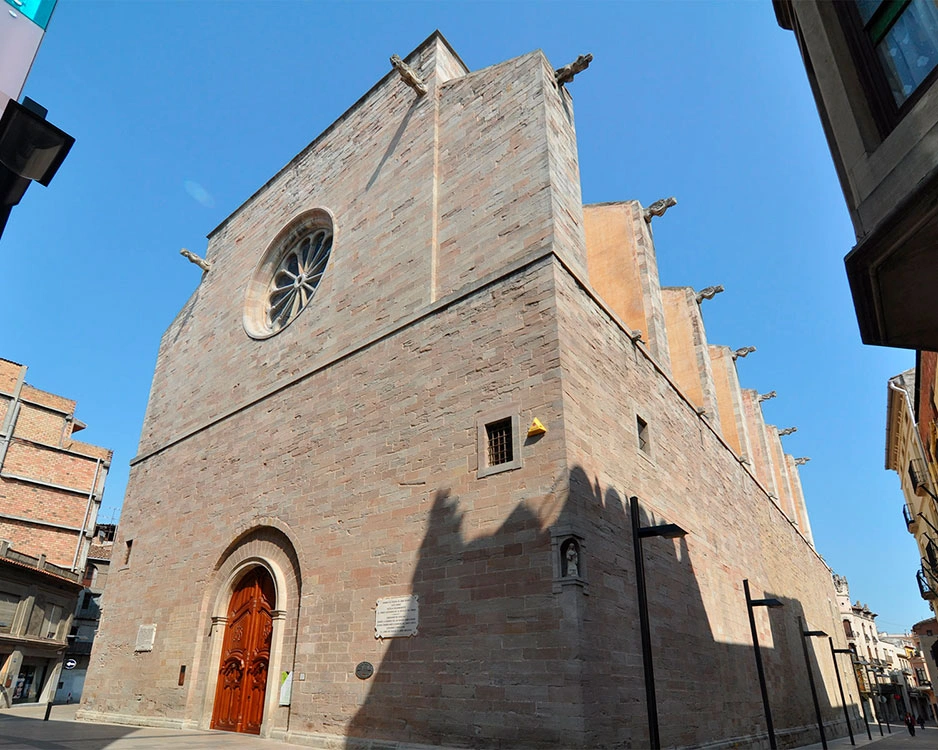
The Basilica of Santa María de Igualada, also known locally as the Great Church, stands as the most significant historical and architectural landmark in Igualada, the capital of the Anoia (Noya) region in Catalonia, Spain. Strategically located at a historic crossroads connecting Barcelona with Aragon, and New Catalonia with Old Catalonia, the site has served as a focal point of settlement and spiritual life since the early medieval period. The origins of the Church of Santa María can be traced back to the 11th century, when the first inhabitants of Igualada established their community around this location.
While the church’s foundations are rooted in the Romanesque period, the current basilica structure primarily dates from the 17th century, reflecting the architectural tastes and religious aspirations of the time. Over the centuries, Santa María has undergone numerous transformations. During the Spanish Civil War, it was repurposed as a marketplace, a role it temporarily fulfilled before being restored under the guidance of renowned Catalan architect César Martinell. In 1949, the church was elevated to the status of minor basilica by Pope Pius XII, in recognition of its historical and spiritual importance. The basilica’s most recent restoration took place during the 1980s, culminating in a grand reopening in 1990. As a result of its long and complex history, the building showcases a unique blend of architectural styles, each reflecting the era in which it was added. Today, the Basilica of Santa María remains not only the main religious temple of Igualada but also a vital symbol of the city’s cultural and artistic heritage.
History of the Basilica of St. Mary, Igualada, Spain
The Church of Santa María, popularly known as the “Església Gran” (the Great Church), holds the distinction of being the most important historical and architectural landmark in the city of Igualada, the capital of the Anoia comarca in Catalonia, Spain. The origins of both the church and the city are closely intertwined, with the first recorded settlement in the area dating back to around the year 1000. This early settlement grew around a strategic crossroads that linked Barcelona with Aragon, and connected the northern and southern regions of Catalonia—making it a vital hub for trade, travel, and cultural exchange. The initial church structure was established in the 11th century, marking the beginning of Santa María’s religious presence in the area. Over the centuries, the building underwent multiple phases of construction and expansion. The majority of the current structure, however, reflects the architectural style and construction efforts of the 17th century, when the church was largely rebuilt and took on the monumental form seen today.
During the Spanish Civil War (1936–1939), the church faced a dramatic transformation: it was converted into a market, reflecting the turbulent period and the shifting functions of religious buildings during times of conflict. After the war, efforts were made to restore the church to its former religious and architectural significance. The restoration was carried out under the direction of the notable Catalan architect Cèsar Martinell, a disciple of Antoni Gaudí and an important figure in the architectural renovation of Catalan heritage. In 1949, the church received a major honor when Pope Pius XII conferred upon it the title of Minor Basilica, a recognition of its historical, artistic, and spiritual value. The most recent restoration project took place during the 1980s, aimed at preserving and revitalizing the basilica’s architectural integrity. This extensive rehabilitation was completed and inaugurated in 1990. As a result of the various construction phases over the centuries, the Basilica of Santa María today is characterized by a rich blend of architectural styles and artistic influences, making it not only a place of worship but also a testament to the historical evolution of Igualada.
Architecture of Basilica of St. Mary, Igualada, Spain
Architect : Pere Blai
Architectural style : Gothic architecture
Central Body of the Church
The Basilica of Santa María features a single-nave floor plan, which is emblematic of the Catalan Renaissance style—noted for its formal austerity and structural simplicity. This restrained aesthetic is clearly visible on the church’s façade, where decoration is minimal, focusing attention primarily on a large rose window. The side walls maintain this sobriety, interrupted only by regularly spaced windows and buttresses that are topped with intricately carved gargoyles depicting both animal and human forms, serving both decorative and functional roles in channeling rainwater. The roof of the nave employs a Gothic vaulting system known as the transept vault. This design features a network of ribbed arches that intersect and converge on sculpted keystones, each adorned with figures of saints. These arches rest upon Italianate-style pillars, which support a narrow triforium arcade gallery and an ornamental cornice. At the eastern end, a quadrangular apse encloses the nave, covered by a star-shaped vault with keystones symbolizing the Virgin Mary in the center and the four Evangelists at the sides, highlighting the church’s religious symbolism.
Side Chapels
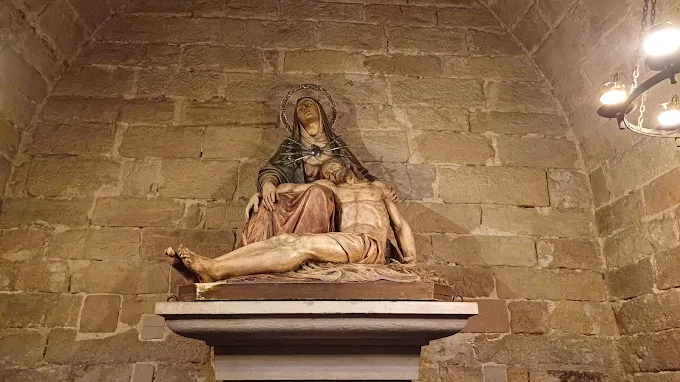
Flanking the central nave are twelve chapels, each reflecting a rich blend of history and artistic styles. While the chapels exhibit a primarily Baroque architectural style, many of their decorative elements are post-Civil War additions, funded by donations from Igualada’s local trade guilds (gremis). These chapels are dedicated to various patron saints relevant to the city’s trades and crafts, including Saint Anthony the Abbot (patron of muleteers), Saint Isidore the Laborer (patron of farmers), Saint Anthony of Padua (patron of tanners), Saint Christopher (patron of motorists), and Saint Anthony Mary Claret (patron of weavers). Notably, beneath the bell tower, within a pointed Gothic arch, lies the altar of Our Lady of Sorrows, which is considered one of the oldest parts of the basilica. This section likely represents a 14th-century extension of the original Romanesque chapel, preserving a direct link to the church’s medieval origins.
Chapel of the Holy Christ (Sant Crist)
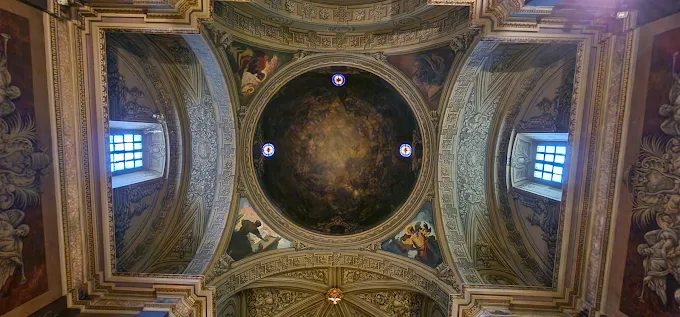
One of the basilica’s most distinctive features is the Chapel of the Holy Christ, constructed in the early 18th century in the Baroque style. Located as an annex on the left side of the nave near the bell tower, the chapel has a Latin cross floor plan and is capped by a hemispherical dome supported by four pairs of pilasters. The interior is adorned with a striking fresco by Francesc Tremulles depicting the Holy Trinity alongside the Virgin Mary. The dome’s pendentives are further embellished with paintings of the four Evangelists by Miquel Llacuna. The chapel’s exterior dome is octagonal in shape, adding architectural prominence. At the chapel’s apse stands an altarpiece housing a replica of the 14th-century Gothic image of the Holy Christ of Igualada, lost during the Spanish Civil War. Flanking the altar, two murals by Camps Dalmases depict the miraculous event of the bloody sweating of the Holy Christ, a legendary occurrence dated to 1590 that is central to local religious tradition.
Main Altarpiece
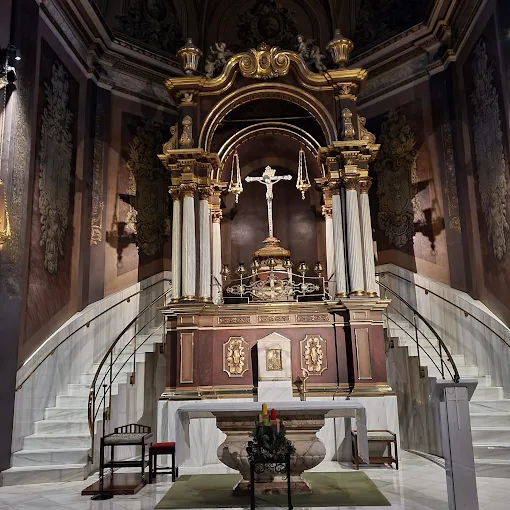
The main altarpiece of Santa María stands as one of the most significant artistic and religious elements of the basilica. Construction began in the early 18th century, but the War of the Spanish Succession delayed its completion until the century’s end. This interruption caused the initial Baroque design to be tempered by classical elements evident in the altarpiece’s final form. Created by artists Jacint Morató and Josep Sunyer, the altarpiece was partially destroyed during the Spanish Civil War but later rebuilt under the supervision of architect Cèsar Martinell. The restoration of the 1980s included a thorough cleaning and conservation of this masterpiece.
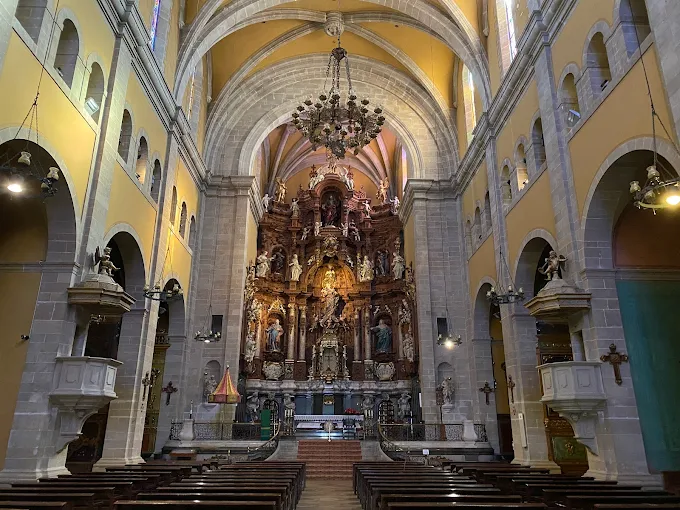
The altarpiece’s design is organized into three distinct levels:
The central level is dominated by the Immaculate Conception, depicted within a niche and carried aloft by angels. Flanking her are statues of her parents, Saint Joachim and Saint Anne, below which are two medallions illustrating scenes from Mary’s life: her Marriage and her Presentation in the Temple. Above the Virgin, a dove symbolizing the Holy Spirit is topped by a medallion representing the Eternal Father. The second level features statues of Saint Faustus and Saint Roch, saints closely associated with Igualada’s devotional practices. These figures are accompanied by four angelic musicians, typical of Baroque iconography. Of special note is the angel playing the guitar, a rare motif in religious art of the period. The upper level culminates with the figure of Saint Bartholomew, patron saint of Igualada, symbolizing the sun and the gates of Jerusalem.
The entire structure is supported by four marble atlantes, symbolic of the four seasons, which ground the celestial themes of the altarpiece in the natural world. On either side of the altar, two sculptural panels depict the Epiphany and the Adoration of the Shepherds, each crowned by the coat of arms of Igualada, reinforcing the church’s connection to the city and its spiritual heritage.
Organ
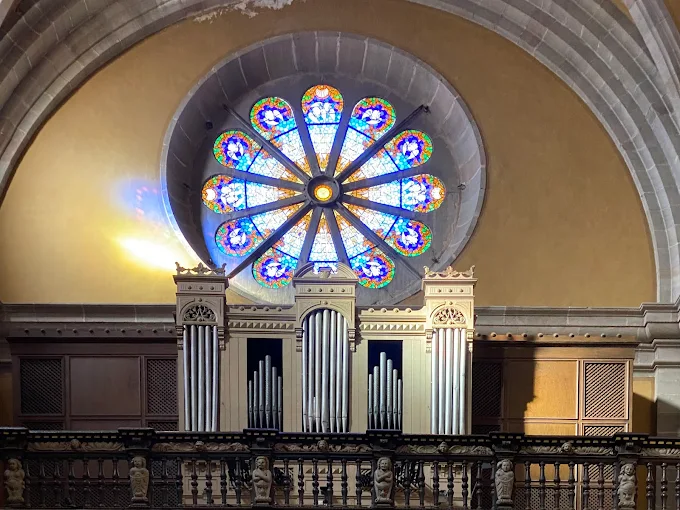
The organ of the Basilica of Santa María is situated in the church choir, directly beneath the rose window on the façade. Constructed in the mid-18th century by the skilled organ builder Antoni Boscà, this instrument is renowned for its historical and musical significance. During the Spanish Civil War, the organ was carefully relocated to the Escolàpies convent, which served as a concert hall during the conflict, ensuring its preservation. In 1980, the organ underwent a meticulous restoration led by master organ builder Gerhard Grenzing, who revitalized its original sound and mechanical functions. Today, it is considered one of the most notable organs in Catalonia, and the basilica honors this legacy by hosting an annual International Organ Festival, attracting performers and enthusiasts from around the world.
Bell Tower
The bell tower of Santa María dates back to the 16th century, built during the Gothic period of the church’s construction. It features a quadrangular plan with a simple yet elegant design marked by its austere style. The tower is adorned with large windows in the upper section, allowing light and air inside, alongside smaller arched windows that add decorative interest without overwhelming the structure’s sobriety. The roof is pitched on all four sides, maintaining a classic Gothic silhouette. The bell tower houses seven bells, six of which were recently installed and crafted in Germany, enriching the soundscape of the basilica and its surroundings.
Other Architectural and Artistic Elements
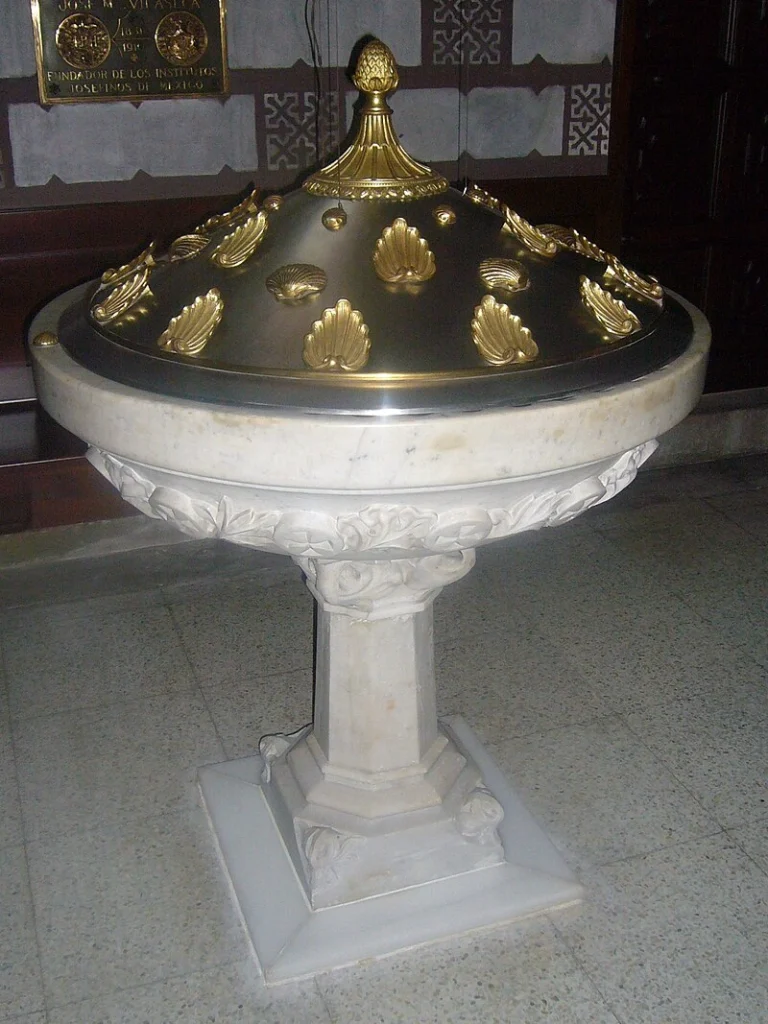
Between the marble atlantes supporting the main altar’s altarpiece are two entrances leading to the sacristies, each proudly bearing the coat of arms of Igualada, symbolizing the church’s strong ties to the city. To the right, in the first side chapel, visitors can admire an allegorical painting by Segimon Ribó depicting the miraculous sweating of blood of the Holy Christ of Igualada, an event believed to have occurred in 1590 and deeply rooted in local tradition. The baptistery, designed by Ignasi Colomer, stands to the left of the church entrance and is a remarkable example of Art Nouveau architecture, contrasting with the otherwise historic styles present in the basilica. Below the presbytery lies the crypt, built after the Spanish Civil War from a design by architect Cèsar Martinell, adding a contemplative space beneath the main altar. On the exterior of the main façade, two plaques commemorate the participation of the Igualada Somatén (local militia) in the historic Battle of El Bruc, highlighting the church’s role as a silent witness to the city’s rich history.
Feast Day
Feast Day : 20 April
The Basilica of Santa María de Igualada celebrates its annual feast day on Easter Tuesday, commemorating the miraculous event known as the “Sweating of the Holy Christ of Igualada.” This event is said to have occurred on April 20, 1590, when the statue of Christ reportedly emitted drops of blood. The feast is marked by a liturgical service attended by the Bishop of Vic and a traditional religious procession through the streets of Igualada.
Church Mass Timing
Monday to Saturday : 9:00 am
Sunday : 12:00 pm, 8:00 pm
Church Opening Time:
Monday to Friday : 8:30 am – 12:30 pm, 5:30 pm – 7:30 pm
Saturday : 8:30 am – 12:30 pm, 6:00 pm – 8:00 pm
Sunday : 10:30 am – 1:00 pm., 7:00 pm – 9:00 pm
Contact Info
Address : Basilica of St. Mary
Plaça el Bruc, 08700 Igualada, Barcelona, Spain.
Phone : +34 933 80 00 40
Accommodations
Connectivities
Airway
Basilica of St. Mary, Igualada, Spain, to Igualada-Ódena Airport, distance 11 min (4.6 km) via BV-1106.
Railway
Basilica of St. Mary, Igualada, Spain, to Igualada Station, distance between 6 min (1.4 km) via Carrer de Sant Josep.