


Basilica of Our Lady of the Culture, Parabita, Italy
Introduction
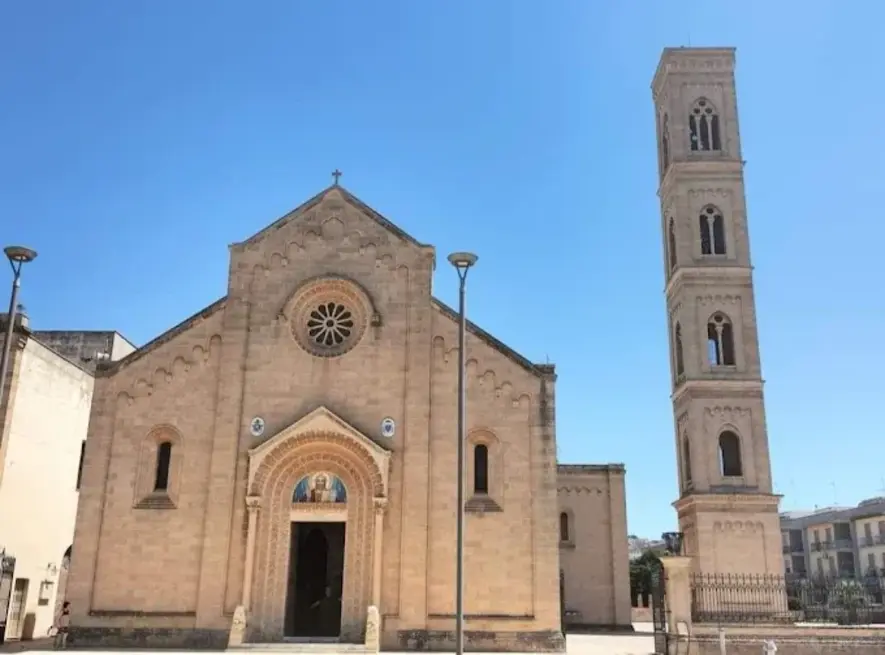
The Basilica Sanctuary of Madonna della Coltura is a Roman Catholic church located in Parabita, a town in the province of Lecce, in the Apulia region of southern Italy. This important church serves as the parish church for the Diocese of Nardò-Gallipoli and holds the title of a minor basilica. The basilica was constructed at the beginning of the 20th century, replacing a previous 17th-century church. The architectural design of the new basilica features a mixed historicist style, blending elements of different historical architectural periods. The church is dedicated to the Madonna della Coltura, a revered image of the Virgin Mary, and stands as a significant religious and cultural landmark in the region.
History of the Basilica of Our Lady of the Culture, Parabita, Italy
The Basilica Sanctuary of Madonna della Coltura has a rich and fascinating history that spans several centuries and architectural transformations. The church as it stands today was rebuilt between 1913 and 1942, based on the design of the architect Napoleone Pagliarulo. It replaced a 17th-century church, which in turn had been constructed on the site of an earlier 14th-century chapel. The original chapel, dedicated to the Virgin Mary, was documented as early as 1452 during a pastoral visit by Monsignor Ludovico De Pennis, the bishop of Nardò. Inside the church, visitors can admire a Byzantine fresco from the 11th-12th century, which depicts the Virgin and Child. This image is significant not only for its historical value but also because it has been reproduced in various frescoes throughout the region, dated between 1435 and 1445, suggesting that the image of the Madonna was widely known and venerated in the early part of the century.
The initial chapel was quite modest, but over time, it adapted to changing architectural trends. During the 17th century, it was expanded with arches and pillars, and the image of the Madonna was covered by a carparo ogive, effectively hiding it from view for three and a half centuries. The chapel’s modest portal was later reproduced in the 19th century, based on its original design. Despite the care and devotion given to the chapel, it fell into disrepair due to significant degradation. In April 1912, the chapel was demolished because it had become unsafe, and during this demolition, the Virgin and Child monolith was rediscovered in its entirety. This discovery sparked renewed devotion among the people of Parabita and laid the groundwork for the construction of a new church.
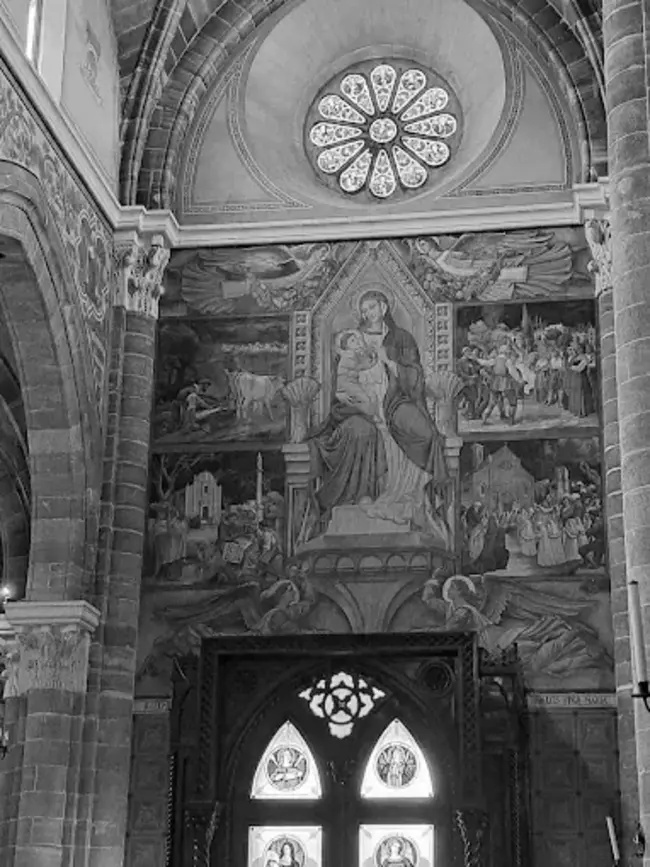
The new sanctuary was built a short distance from the old chapel and was inaugurated on December 21, 1922, after just over nine and a half years of construction. The church was built with a more ambitious design, and frescoes by painter Mario Prayer adorn the side aisles, illustrating the life of the Madonna. In the 1970s, further expansions were made, including the addition of side arms for the chapels of the Holy Sacrament and the Sacred Heart, as well as the construction of a bell tower. In recognition of its importance as a religious site, the sanctuary was elevated to the status of a minor basilica on September 1, 1999, by Pope John Paul II. This distinction highlights the church’s significant spiritual role in the region of Apulia and its deep connection to the community of Parabita.
Architecture of Basilica of Our Lady of the Culture, Parabita, Italy
Architect: Napoleon Pagliarulo
Architectural style: Gothic Revival architecture.
External Features
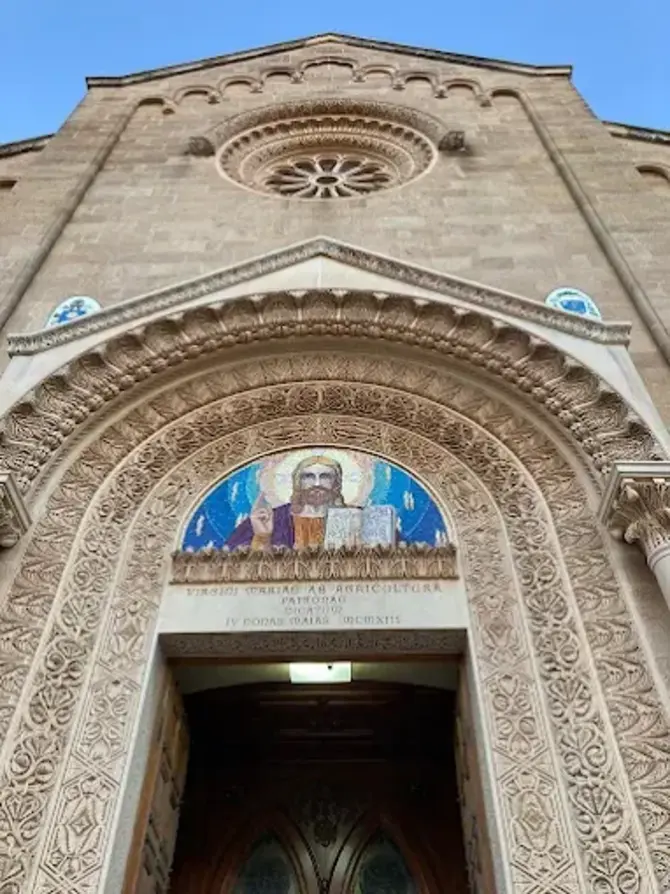
The architectural style of the Basilica Sanctuary of Madonna della Coltura blends elements of Romanesque-Byzantine, Apulian Romanesque, and Gothic design. The façade is primarily Romanesque in style, with a finely carved porch that frames a central portal. Above the portal is a lunette containing a mosaic that depicts Christ the King, adding both spiritual significance and artistic value to the entrance. The artistic rose window at the top of the façade is a striking feature, adorned with stained glass windows that portray Christ at the center and the twelve apostles in the surrounding segments. A towering bell tower rises beside the sanctuary, adding to its monumental presence. Completed in 1976, the bell tower was commissioned by the Dominicans, who have historically been the custodians of the sanctuary. The bell tower’s construction further enhances the architectural grandeur of the basilica.
Internal Features
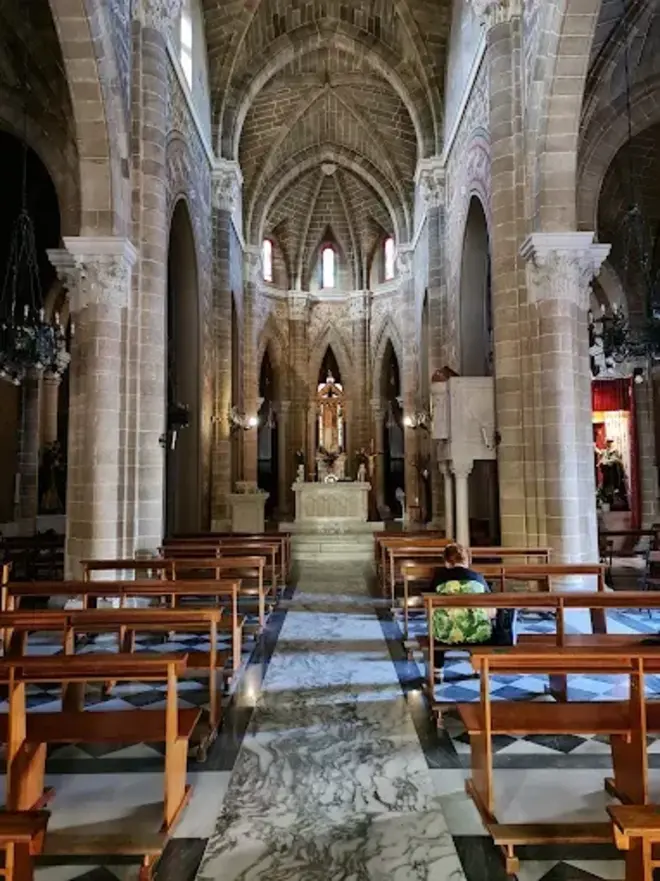
The interior of the basilica is designed with three naves, divided by pointed arches. These arches create a sense of openness, and they are accompanied by lunettes containing historiated windows, which narrate biblical stories and add to the decorative appeal of the space. The central apse houses the precious monolith frescoed with the Madonna and Child, an iconic image of the sanctuary. This apse is separated from the choir by five decorated pointed arches, contributing to the harmonious flow of the interior design. Inside the church, eighteen frescoes painted by Mario Prayer in 1942 enhance the sanctuary’s walls. These frescoes primarily depict the life of the Virgin Mary, illustrated across the two internal walls of the main façade. The artwork begins with the promise of redemption in the earthly paradise and culminates in the glorification of the Virgin. The side chapels, completed in 1980, also attract attention. The right-side chapel is embellished with a marble canopy, while the left-side chapel houses an altar with a statue of Christ sculpted by Tomagnini, adding to the spiritual and artistic richness of the church.
Dominican Convent
Over the centuries, the sanctuary has seen a succession of religious orders taking charge of its management. The Dominicans (Preaching Friars) played a central role in overseeing the sanctuary for a significant period. However, in 1809, the convent was suppressed by Gioacchino Murat, leading to the abandonment of the convent by the Dominicans. In the 20th century, the local population of Parabita dedicated itself to rebuilding the convent with the hope of restoring a permanent religious presence. Between 1928 and 1954, the Consolata Missionaries took charge of the sanctuary, followed by the Missionaries of the Sacred Heart of Jesus. Finally, in 1955, the Dominicans returned and continue to reside in the convent to this day, maintaining their spiritual oversight of the sanctuary.
Origin of the Name “Madonna della Coltura”
The name “Madonna della Coltura” is a shortened form of “Madonna dell’Agricoltura” or “Our Lady of Agriculture”, and its origin is intertwined with both legend and etymology, offering a rich cultural history. One popular legend tells of a farmer ploughing his field with oxen who unearthed a frescoed monolith of the Madonna and Child. Upon discovering the sacred image, the people of Parabita held a procession to the town church, but the stone mysteriously disappeared overnight, only to be found again outside the town walls near the fields. This led the community to decide to build a sanctuary at the discovery site. This tale is believed to be associated with the original 14th-century chapel, although no physical evidence of this chapel remains today. Another interpretation of the name links it to the dialectical term “Cutura”, which is derived from “Cullura”, a word for bread, specifically “Cuddura”, a traditional Easter bread decorated with egg. In this view, the Madonna della Coltura is seen as the protector of the fields and bread, symbolizing her role as a guardian of agricultural prosperity and the well-being of the people of the region. These two origins—the legendary and the etymological—add layers of depth to the sanctuary’s significance as a sacred site, both historically and culturally, for the people of Parabita and the surrounding area.
Feast Day
Feast Day : 15 August
The feast day of the Basilica of Our Lady of the Culture (Basilica della Madonna della Coltura) in Parabita, Italy, is celebrated on August 15th, which is also the Feast of the Assumption of the Virgin Mary. This feast day honors the Virgin Mary’s ascent to heaven and is a significant day for the sanctuary, as it celebrates the patronage of the Madonna della Coltura, who is venerated as a protector of the agricultural community and the people of Parabita.
Church Mass Timing
Monday to Saturday : 07:30 AM, 7:00 PM.
Sunday and Holidays : 8:00 AM , 10:30 AM , 5:30 PM , 7:00 PM
Church Opening Time:
Monday to Friday : 6:30 am – 12:00 pm., 4:30 pm – 7:30 pm.
Saturday and Sunday : 6:00 am – 12:00 pm., 4:30 pm – 7:30 pm.
Contact Info
Address:
Basilica of Our Lady of the Culture, Parabita, Italy
Piazza Regina Del Cielo, 1, 73052 Parabita LE, Italy
Phone : +39 0833 593217
Envelope
Dribbble
Facebook
Instagram
Youtube
X-twitter
Accommodations
Connectivities
Airway
Basilica of Our Lady of the Culture, Parabita, Italy, to Aviosuperficie Masseria Macrì, distance between 19 min (15.9 km) via SP361.
Railway
Basilica of Our Lady of the Culture, Parabita, Italy, to Parabita Railway Station, distance between 1 min (400.0 m) via Via Coltura and Via Vittorio Emanuele III.