


Cathedral of San Cerbone in Massa Marittima, Italy
Introduction
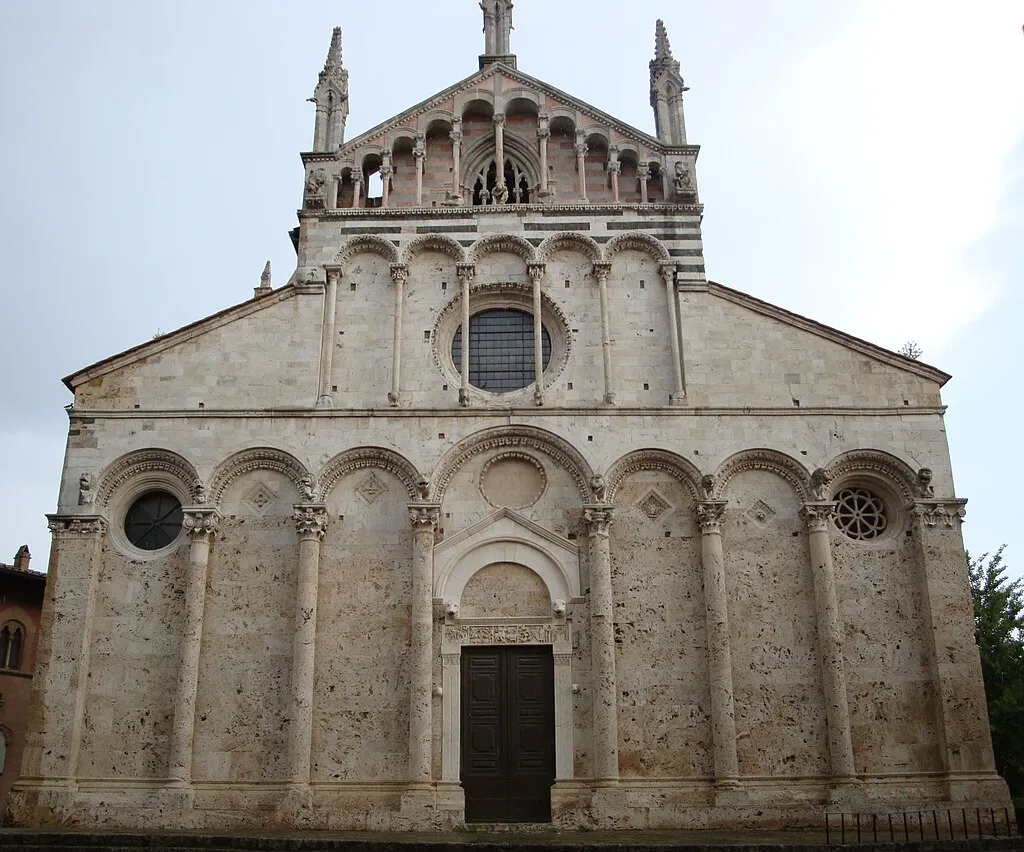
The Cathedral of San Cerbone (Italian: Duomo di Massa Marittima), located in Massa Marittima, Tuscany, is the most important Catholic place of worship in the town. Dedicated to Saint Cerbonius, the cathedral originally served as the episcopal see of the Diocese of Massa Marittima, which later merged into the Diocese of Massa Marittima-Piombino. In July 1975, Pope Paul VI elevated the cathedral to the dignity of minor basilica, recognizing its religious and historical significance. Additionally, the cathedral holds the distinction of being an Italian national monument, further emphasizing its cultural importance in the region.
History of Cathedral of San Cerbone in Massa Marittima, Italy
The Cathedral of San Cerbone was originally constructed starting in the 11th century in the Romanesque style. Its construction spanned several centuries, continuing throughout the 12th and 13th centuries, as each phase brought new architectural developments. By the end of the 13th century, the cathedral underwent significant modifications under the direction of renowned sculptor and architect Giovanni Pisano. He altered the third and highest order of the cathedral’s façade, giving it the form we recognize today. Additionally, Pisano extended the apse, shaping it into its present structure, which contributed to the cathedral’s majestic appearance.
In the 15th century, further changes were made to the interior, particularly to the roof of the central nave. The original wooden truss roof was replaced with cross vaults, which remain in place today, providing both structural stability and a distinctive aesthetic. This architectural evolution marked a shift from the traditional wooden truss design to the more robust and enduring cross vault system.
The 17th century brought additional modifications, this time to the lateral naves of the cathedral. The cross vaults, already established in the central nave, were extended to the side naves, further unifying the interior’s design and enhancing its architectural harmony. These changes over the centuries transformed the cathedral into a blend of Romanesque, Gothic, and Renaissance elements, reflecting the evolving artistic and architectural trends of the time.
As a result, the Cathedral of San Cerbone stands today as a testament to centuries of architectural innovation, combining the styles of multiple periods into one harmonious structure.
Architecture of Cathedral of San Cerbone in Massa Marittima, Italy
The Facade
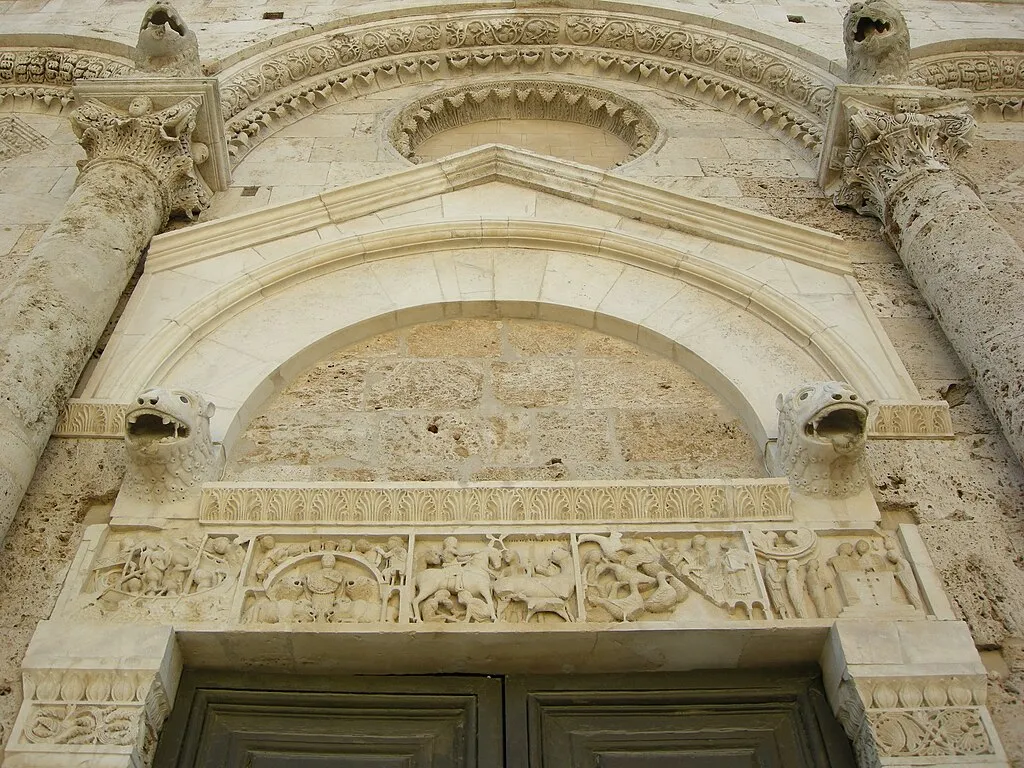
The facade of the cathedral reflects the cultural influences that shaped Massa Marittima over the centuries. The lower part of the façade features blind arches decorated with circular and diamond-shaped openings, revealing Pisan Romanesque influences. The central loggia and the overlying tympanum crown also trace back to Pisan Romanesque design. In contrast, the large ogival quadrifora and three spires suggest Sienese influence. The central portal is framed by a lintel, flanked by two lion heads, and depicts the Stories of San Cerbone in five panels, dating from the early 13th century. The tympanum’s three central columns rest on figures—a bearded man, a griffin, and a horse. The sides of the façade, with their series of blind arches, show a Pisan character, as indicated by the two-tone decoration on the right side.
The bell tower maintains its original design in the lower section, up to the three-light window, while the upper part was rebuilt in 1929-1930. The polygonal dome, however, was inspired by 15th-century design.
The Interior
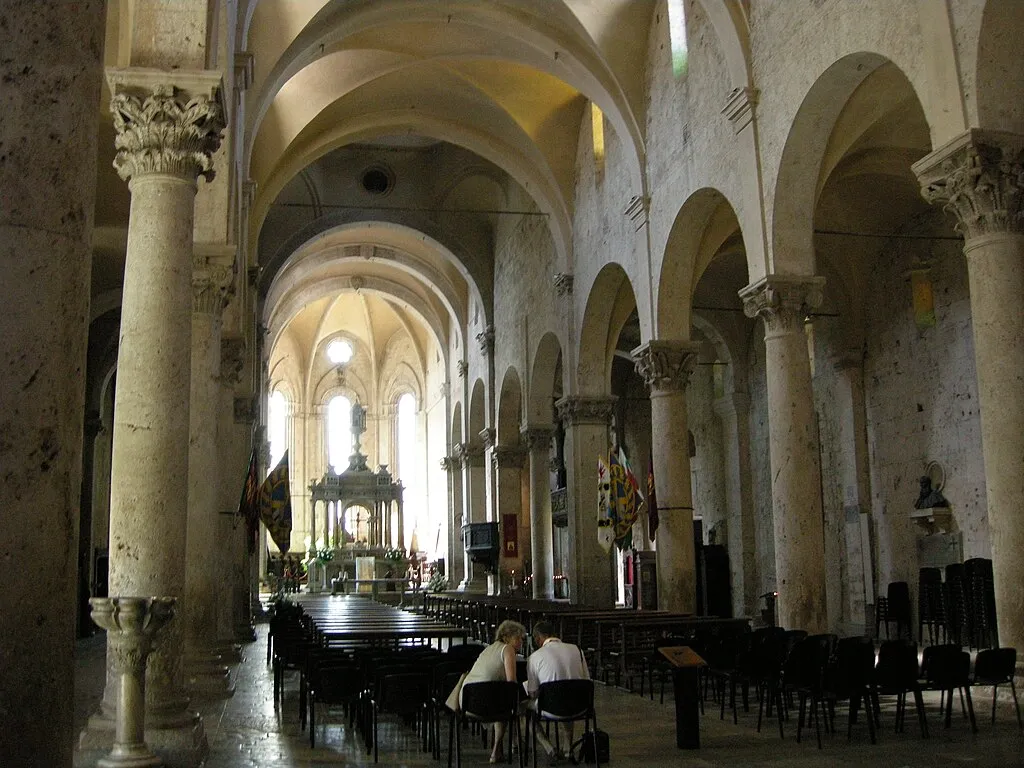
The interior of the cathedral follows a basilica plan with three naves, supported by cylindrical columns and cruciform pillars, each capped with complex composite capitals. The ribbed vaults of the central nave were added in the 15th century, while the cross vaults of the lateral naves were completed in the 17th century. The apse, featuring large ogival windows, bears Sienese characteristics and reflects an expansion of the pre-existing church, possibly attributed to Giovanni Pisano. The three figures on the third order of the façade, mentioned earlier, are also attributed to him.
To the left of the entrance on the counter-façade is a 14th-century frescoed triptych with the Madonna and Child and saints. Beneath it, a Roman sarcophagus from the 3rd century is displayed. On the right side of the counter-façade, a series of sculpted stone panels, possibly from the early Middle Ages, are accompanied by two frescoes depicting the Crucifixion (14th century) and a Story of San Giuliano (15th century).
Baptismal Font and Chapel
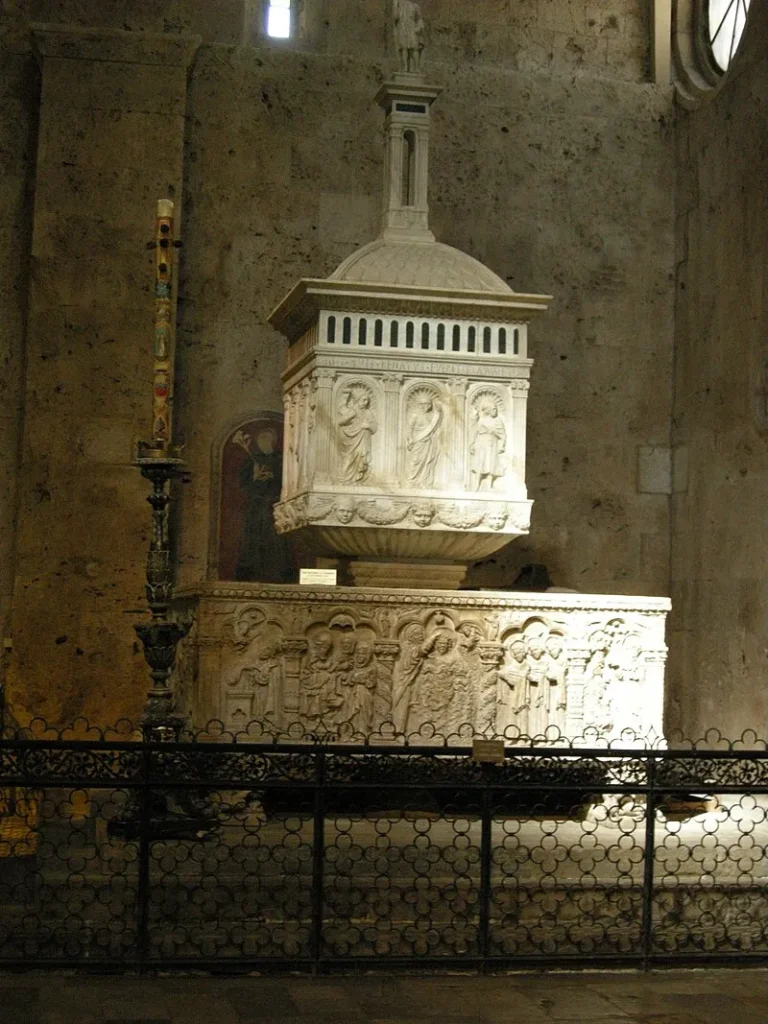
In the center of the counter-façade is a 13th-century baptismal font with a 15th-century temple. The baptismal font consists of two parts: a quadrangular basin with scenes depicting the Deesis and Stories of San Cerbone and San Regolo, made from a single piece of travertine. It rests on four lionesses and measures 2.73 meters by 0.98 meters. This portion of the font was created by Giroldo da Arogno in 1267. The second part, the elevation, shaped like a small temple, dates from 1447. A statue of Saint John the Baptist stands on a small quadrangular column.
Artworks and Altars
On the right nave, notable works include a Madonna in Glory with Saints Joseph, Bernardino, and two monks, attributed to Antonio Nasini (late 17th century), and a Nativity of the Virgin by Rutilio Manetti. In the chapel at the end of the right nave hangs a painted Crucifix by Segna di Bonaventura (early 14th century). A 17th-century wooden pulpit and a wooden cross holder in ecclesiastical dress are also present. In the same chapel are the Immaculate Conception and the Eternal Father, both works by Rutilio Manetti.
The high altar, created by Flaminio Del Turco in 1626, is made of marble and features a polychrome wooden crucifix from the same period, replacing a previous crucifix by Giovanni Pisano now housed in the Museum of Sacred Art. At the altar’s upper corners are wooden angels attributed to Domenico di Niccolò dei Cori from the 15th century. Behind the altar, the Ark of San Cerbone by Goro di Gregorio (1324) is placed, featuring scenes of the saint and medallions depicting the Virgin, San Cerbone, and other saints.
The Maesta and Other Paintings
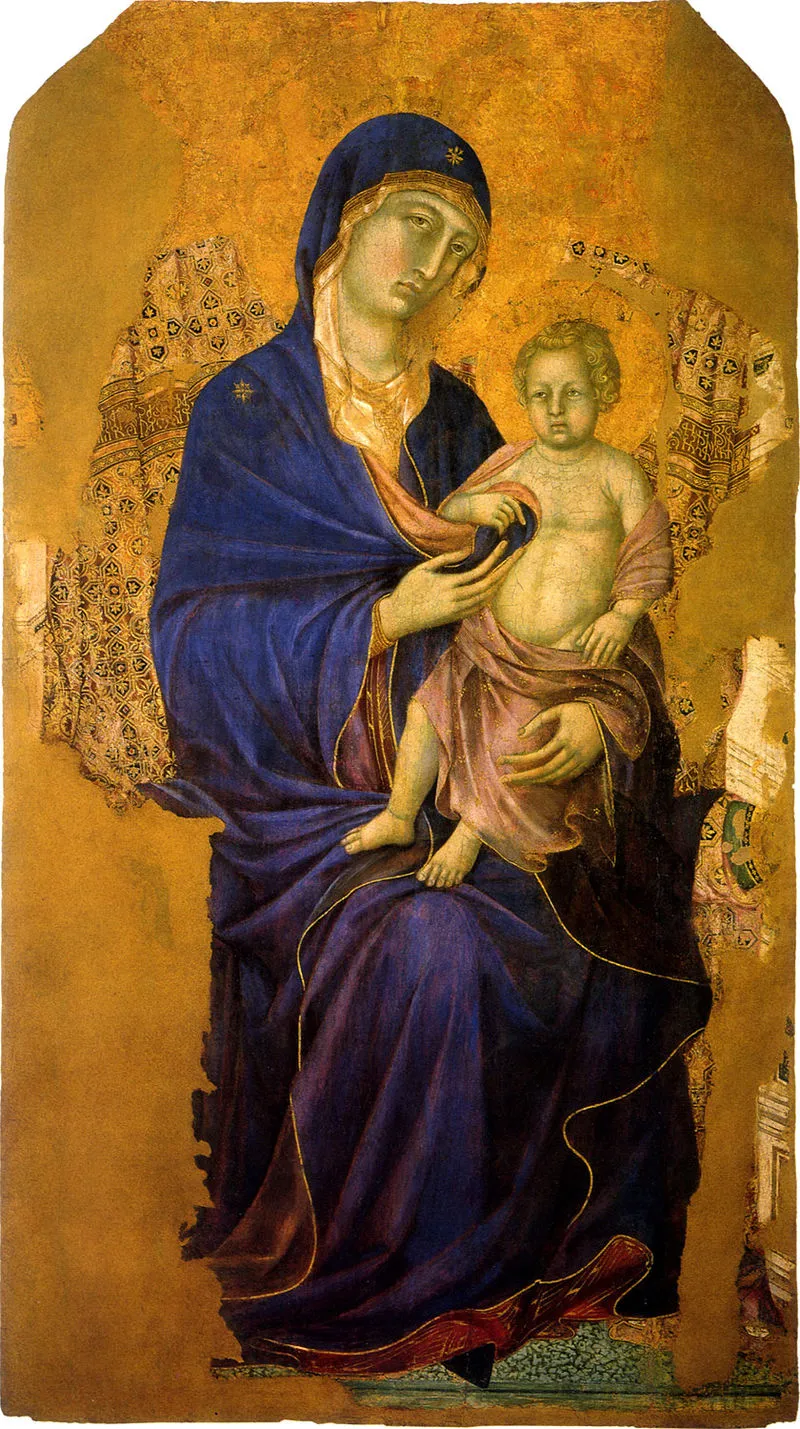
The Maesta attributed to Duccio di Buoninsegna (1316) is located in the terminal chapel on the left. The chapel also features a Crucifixion and Stories of the Passion. The left wall of the chapel contains a fragmentary altarpiece by Sano di Pietro, showing the Presentation at the Temple.
The Annunciation by Raffaello Vanni (17th century) decorates the left wall of the nave, along with a funerary monument for Bishop Giuseppe Traversi (died in 1872), designed by Tito Sarrocchi. Several fragmentary frescoes from the 14th-15th centuries, including an Annunciation, are also present.
The Pipe Organ and Crypt
The cathedral’s pipe organ, built in 1905 by Filippo Tronci, reused the case and choir of a 16th-century instrument.
Below the presbytery, reorganized in 2004 with modern furnishings, lies the crypt. Inside, eleven statuettes of Prophets and Saints, created by a Sienese sculptor in the mid-14th century, are displayed. A 15th-century fresco depicting the Crucifixion and Mourners with San Cerbone and San Bernardino da Siena can also be found. In the sacristy, there are three 14th-century reliquaries, including one containing the finger of San Cerbone.
Restorations
The Cathedral of San Cerbone underwent extensive restoration work between 1990 and 2000 under the direction of architect Antonio Cappelli. During this time, the dome and the west wall of the cathedral were consolidated. The restoration of the main façade (1995-1997) used innovative techniques, including cleaning sculptural parts with a pulsed laser. For the Jubilee of 2000, a new lighting system was installed, enhancing the architectural features and artworks of the cathedral, thanks to the contribution of Enel.
Feast Day
Feast Day : 10th October
Saint Cerbonius, also known as Cerbone, is venerated as the patron saint of Massa Marittima and Populonia in Tuscany, Italy. His feast day is celebrated annually on October 10.
Church Mass Timing
Monday : 9:00 AM
Tuesday : 9:00 AM
Wednesday : 9:00 AM
Thursday : 9:00 AM
Friday : 9:00 AM
Saturday : 9:00 AM
Sunday : 11:00 AM and 6:00 PM
Church Opening Time:
Monday : 8:00 am – 5:00 pm
Tuesday : 8:00 am – 5:00 pm
Wednesday : 8:00 am – 5:00 pm
Thursday : 8:00 am – 5:00 pm
Friday : 8:00 am – 5:00 pm
Saturday : 8:00 am – 5:00 pm
Sunday : 8:00 am – 5:00 pm
Contact Info
Cathedral of San Cerbone in Massa Marittima
Piazza Giuseppe Garibaldi, 58024 Massa Marittima GR, Italy.Diocese of Massa Marittima–Piombino.
Phone : +390566902039
Accommodations
Connectivities
Airway
Grosseto Airport to Cathedral of San Cerbone in Massa Marittima, Italy distance between 43 min (47.8 km) via E80.
Railway
Follonica Railway Station to Cathedral of San Cerbone in Massa Marittima, Italy distance between 21 min (20.5 km) via SS439.