


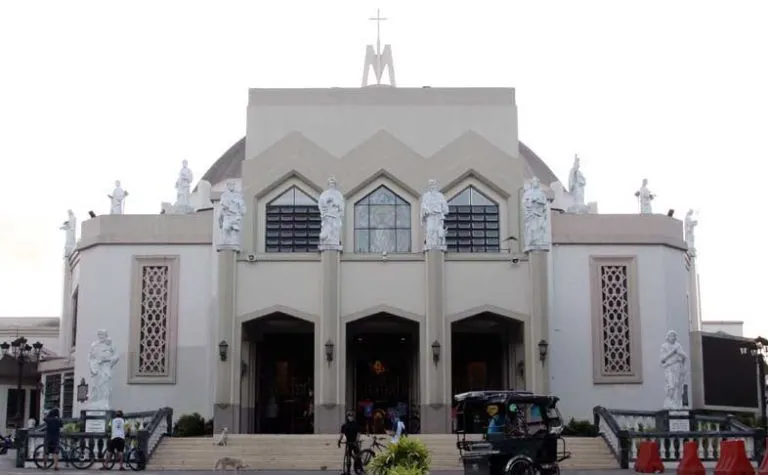
Antipolo Cathedral, Philippines


Introduction
The Antipolo Cathedral, Philippines is a Roman Catholic cathedral located in Antipolo City, Rizal in the Philippines. It is also the Immaculate Conception Parish and formally known as the National Shrine of Our Lady of Peace and Good Voyage referred by locals as “Simbahan ng Antipolo”.
It enshrines the Marian image of Our Lady of Peace and Good Voyage (Spanish: Nuestra Señora de la Paz y Buen Viaje), and is the seat of the Bishop of Antipolo.
The Antipolo Cathedral, Philippines attracts millions of pilgrims annually, especially during the Pilgrimage Season which commences with the Alay Lakad from the Quiapo Church on April 30 and lasts throughout the month of May.
The first missionaries in Antipolo were the Franciscans, who arrived in the vicinity in 1578. The Jesuits then followed and administered the church from 1591 until May 1768, when the decree expelling the Jesuits from Spanish lands reached Manila.
The Antipolo Cathedral, Philippines was greatly damaged during the Chinese uprising of 1639, the 1645 Luzon earthquake, and the earthquakes of 1824 and 1883. Notable Filipino historians such as Pedro Chirino and Pedro Murillo Velarde (also a prominent cartographer) ministered at the church.
The Diocese of Antipolo was created on 24 January 1983 and was canonically erected on 25 June 1983 at the diocese’s new see, which bears the formal title of “National Shrine of Our Lady of Peace and Good Voyage-Immaculate Conception Parish”.
History of Antipolo Cathedral, Philippines


The First Missionaries Of Antipolo Were The Franciscans
The Antipolo Cathedral, Philippines – the first church in what is now Antipolo City was built by the Society of Jesus under Rev. Juan de Salazar. The Jesuits administered the Church from 1591 to 1768. Built by Reverend Juan de Salazar, S.J., the church was ready for the image of Nuestra Senora dela Paz y Buen Viaje in 1632. However, the church structure was greatly damaged during the Chinese uprising in 1639 and the earthquakes of 1645, 1824 and 1863.
The church, meant to house the image of Our Lady of Peace and Good Voyage brought by then-Governor General Juan Niño de Tabora, was supposed to be built on a different plot of land. The church’s present location was the site of the tipolo (Artocarpus blancoi), top which the image was found after mysteriously vanishing several times.
The Church Was Completed In 1632
But it suffered severe damage in 1639 when the Sangley (Chinese) set fire to the church in a revolt. It was restored afterwards though it was damaged by the 1645 Luzon earthquake, and other earthquakes in 1824 and 1863.
Nevertheless, the church became a popular pilgrimage site as many devotees paid reverence to Our Lady of Peace and Good Voyage, including Philippine national hero and polymath José Rizal, who visited the shrine as a boy with his father, Francisco Mercado, on 6 June 1868. The pair went on pilgrimage to fulfill a vow Rizal’s mother, Teodora Alonso, had made when she and the boy survived his delivery.


Towards The End Of The Second World War In 1945
In 1944, the Japanese Imperial Army invaded the town and turned it into a garrison, with the shrine being used as an arsenal. To save the image, the church’s head sacristan, Procopio Ángeles, wrapped it in a thick woollen blanket and placed it in an empty petrol drum, which he then buried in a nearby kitchen.
Fighting between Imperial Japanese troops and the combined American and Filipino forces drove Ángeles and other devotees to exhume the image and move it to Sitio Colaique on the border with Angono. From there, it was spirited away to the lowland Barangay Santolan in Pasig, and then to the town center of Pasig itself. The statue was then kept by Rosario Alejandro (née Ocampo), daughter of Pablo Ocampo, at the Ocampo-Santiago family residence on Hidalgo Street, Quiapo, Manila, before it was enshrined inside Quiapo Church for the remainder of the Second World War.
On 15 October 1945, the statue was translated back to its church in Antipolo, where it remains today.
On January 14, 1954
The Antipolo Cathedral, Philippines – the church was destroyed by Allied bombardment meant to liberate the area from the Japanese imperial control. After the war, a campaign was organized to build a new church, with the fundraising committee headed by former First Lady Aurora Quezon and Antipolo parish priest, Francisco Avendano. Architect José L. de Ocampo was commissioned to design the new shrine, which was completed in 1954.
The Catholic Bishops Conference of the Philippines declared the new Antipolo Church as declared the National Shrine to Our Lady of Peace and Good Voyage. The church was elevated to the status of cathedral on 25 June 1983, upon the canonical erection of the Diocese of Antipolo.


Pilgrimage Season
The pilgrimage season for the Cathedral is initiated yearly by the “Pagdalaw ng Ina sa Anak” (Visit of the Mother to her Son), a motorcade bearing the image of Our Lady of Peace and Good Voyage from Antipolo Cathedral to Quiapo Church where the Black Nazarene is enshrined. A Welcome Mass is held in Quiapo Church at 9:00 in the morning.
At 6:00 p.m., the farewell mass is officiated and after which the Penitential Walk from Quiapo Church to Antipolo Cathedral commences, distance is close to 33 kilometers.
On the 1st of May of each year, the arrival of the Image of Our Lady of Peace and Good Voyage at the Cathedral is celebrated by a mass at 5:00 in the morning. Every 1st Tuesday of May, a procession of the Statue of Our Lady of Peace and Good Voyage starts at 7:00 a.m. from the Cathedral to Pinagmisahan Hill where at the end, a mass is held there.
It was here on May 3, 1947, the Feast of the Holy Cross, that a wooden cross was blessed and erected. Since 1947 to the present, a commemorative thanksgiving mass is said very First Tuesday of May, the start of the Pilgrimage Season ending on the First Tuesday of July.
Pilgrimages to the image’s shrine begin and peak in May, which in Catholicism is dedicated to the Virgin Mary. On 30 April—the eve of May Day—thousands of devotees from Metro Manila customarily perform the Alay Lakad (literally, “Walk Offering”), where pilgrims spend the night travelling on foot to the shrine, where they hear Mass at dawn.
The farthest official starting point of the modern pilgrimage is Quiapo Church; the custom of visiting the shrine in May, however, was already recorded by the 19th century. On 6 June 1868, a young José Rizal and his father Don Francisco Mercado, visited the shrine in thanksgiving after the boy and his mother, Teodora Alonso, survived his delivery in 1861.
Our Lady of Antipolo (Our Lady of Peace and Good Voyage)


Our Lady of Peace and Good is also known as Our Lady of Antipolo and the Virgin of Antipolo, is a 17th-century Roman Catholic wooden image of the Blessed Virgin Mary venerated in the Philippines. This Black Madonna is enshrined in Antipolo Cathedral in the Sierra Madre mountains east of Metro Manila.
The image was brought to the country by Governor-General Juan Niño de Tabora from Mexico via the galleon El Almirante in 1626. His safe voyage across the Pacific Ocean was attributed to the image, which was given the title of “Our Lady of Peace and Good Voyage”. It was substantiated later by six other successful voyages of the Manila-Acapulco Galleons with the image aboard as its patroness.
The statue is one of the most celebrated images of the Blessed Virgin Mary in the Philippines, gaining devotees since the mid-19th century, having been mentioned by José Rizal in his writings.
From May to July each year, the image attracts millions of pilgrims from all over the country and abroad. In 1904, the image was taken down for the Novena anniversary of the dogma of the Immaculate Conception. Pope Pius XI granted her the Pontifical decree of canonical coronation on 18 June 1925, which was carried out on 28 November 1926.
On 25 March 1626, the galleon trading ship El Almirante left Acapulco, Mexico, carrying the newly appointed Governor-General of the Spanish East Indies, Don Juan Niño de Tabora, who brought with him the statue.
He arrived in Manila on 18 July 1626, and the statue was brought to San Ignacio Church of the Jesuits in Intramuros. When Governor Tabora died in 1632, the statue was given to the Jesuits for enshrinement in the church of Antipolo, which was then being built in the present-day barangay Santa Cruz.


Pontifical Coronation
The statue was granted a Pontifical decree of coronation granted via Cardinal Merry del Val to the Archbishop of Manila Michael James O’Doherty on 18 June 1925, both signed and notarized by Monsignor Vincent Bianchi Cagliesi and Chancellor Guardian of the Vatican Chapter, Monsignor Giuseppe Cascioli.
The image was canonically crowned by the Archbishop of Manila, Michael James O’Doherty, on 28 November 1926 in Luneta (present-day Rizal Park), Manila.
Claims of Miracles


During construction of the Antipolo church in the 1630s, the image would mysteriously vanish several times from its shrine, only to reappear atop a tipolo (breadfruit tree; Artocarpus incisa) A plant that’s native to Southeast Asia and had spread to Latin America. This was taken as a celestial sign, and the church was relocated to where the tipolo tree stood. The image’s pedestal is supposedly made from the trunk of that same tipolo tree,[4] which also gave its name to Antipolo itself.
In 1639 the Chinese rose in revolt, burning the town and the church. Fearing for the statue’s safety, Governor Sebastián Hurtado de Corcuera ordered its transfer to Cavite, where it was temporarily enshrined. Governor Hurtado later ordered the statue removed from its Cavite shrine in 1648, and it was shipped back to Mexico aboard the galleon San Luis. At the time, the statue of a saint onboard served as a ship’s patron saint or protector of the Acapulco trade.
The statue crossed the Pacific six times aboard the following Manila-Acapulco galleons:
- San Luis — (1648–1649)
- Encarnación — (1650)
- San Diego — (1651–1653)
- San Francisco Javier — (1659–1662)
- Nuestra Señora del Pilar — (1663)
- San José — (1746–1748)
A royal decree by Queen Isabella II on 19 May 1864 ordered that the parishes of Saint Nicholas of Tolentino be turned over to the Jesuits in exchange for the parishes of Antipolo, Taytay and Morong, which were given to the Augustinian Recollects. The latter order thus came into possession of the image.


Television
In December 2011, the Eternal Word Television Network programme Mary: Mother of the Philippines ran an episode showcasing the statue as the “most traveled Marian icon in the Philippines”.
Feast Day – 1st Tuesday of May
First Tuesday of May is celebrated as the annual feast day of Our Lady of Antipolo each year.


Mass Time
Weekdays
Saturdays
Sundays
Church Visiting Time
Contact Info
Antipolo Cathedral,
Dela Paz Street, Antipolo,
1870 Rizal, Philippines
Phone No.
Tel : +63 2 8571 7347
Envelope
Dribbble
Twitter
Facebook
Instagram
Accommodations
How to reach the Cathedral
Ninoy Aquino International Airport, formerly known as Manila International Airport (MNL, which is 17.5 km away and Clark International Airport (CRK) (87.8 km) are the nearby airports to the Cathedral.
Antipolo Tram Stop is the nearby Light Rail Station to the Cathedral.
