


Basilica of San Vitale, Ravenna, Italy
Introduction
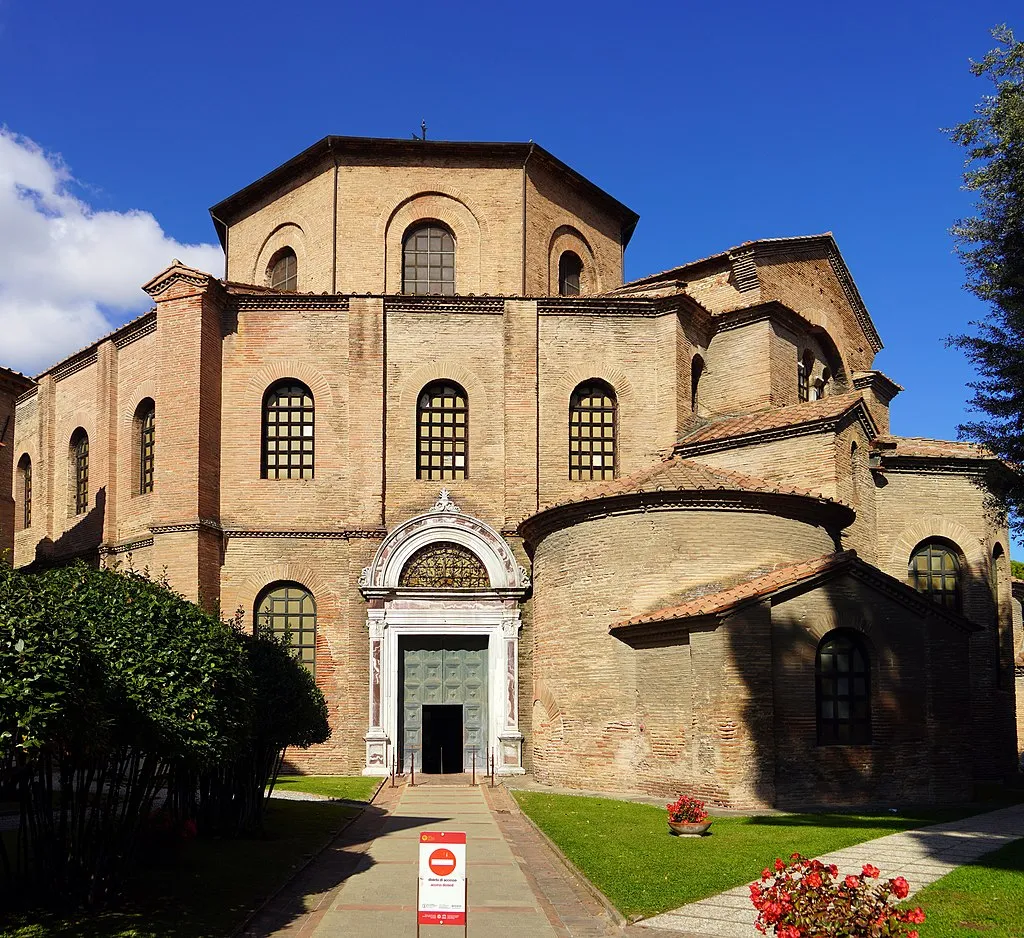
The Basilica of San Vitale is a 6th-century church located in Ravenna, Italy, and is a significant example of early Byzantine art and architecture. Its mosaics are particularly renowned and among the most studied works in Byzantine art. The church is one of eight sites in Ravenna listed as UNESCO World Heritage sites. Although it is referred to as a basilica in its founding inscription, its centrally planned design deviates from the traditional basilica layout. Within the Roman Catholic Church, it holds the honorary title of basilica due to its historical and ecclesiastical significance.
History of Basilica of San Vitale, Ravenna, Italy
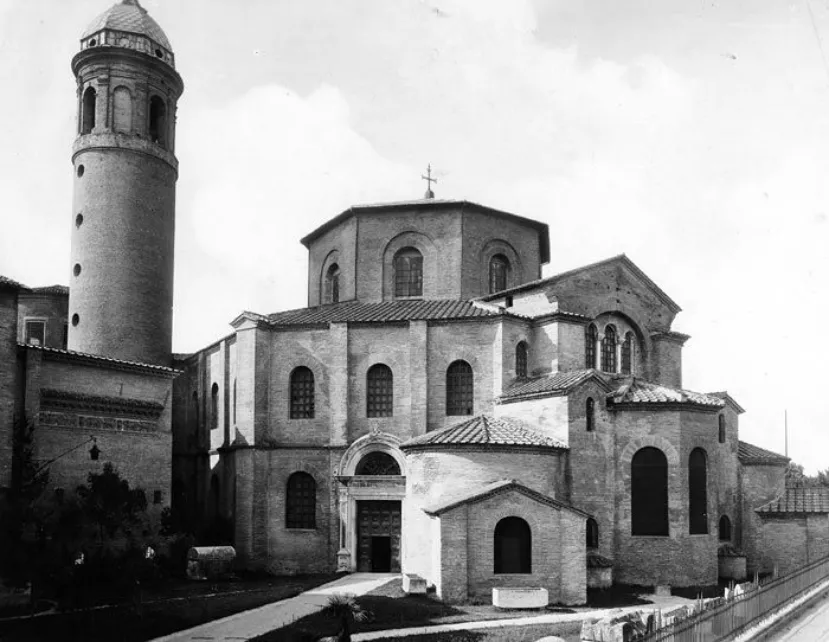
The construction of the Basilica of San Vitale began in 526 under the orders of Bishop Ecclesius of Ravenna, during a period when the city was under Ostrogothic rule. The project was later completed in 547 under the leadership of Bishop Maximian, just before the establishment of the Exarchate of Ravenna by the Byzantine Emperor Justinian I. This occurred after Justinian’s successful reconquest of parts of the Western Roman Empire, marking a significant shift in the region’s political and religious landscape.
The funding for the basilica was provided by Julius Argentarius, a local banker and architect about whom little historical information is available. He also financed the construction of the nearby Basilica of Sant’Apollinare in Classe around the same period. Some scholars suggest that a portrait of Julius Argentarius may be included among the courtiers depicted in the famous mosaic of Emperor Justinian within the basilica. The total cost of the church’s construction is recorded as 26,000 solidi, an amount equivalent to approximately 16.38 kilograms (36.11 pounds) of gold. Given the substantial financial contribution, it has been speculated that Julius Argentarius may have originated from the eastern regions of the Byzantine Empire, where traditions of public benefaction were well established.
Architecturally, the basilica incorporates both Western and Eastern building techniques. The central vault was constructed using an innovative method that involved hollow terra-cotta tubes fitted into one another, rather than traditional brickwork. This technique is considered the earliest recorded example of structural terra-cotta forms, which eventually influenced the development of modern structural clay tiles. Additionally, the ambulatory and upper gallery were not originally vaulted but were later modified in the Middle Ages to include vaulted ceilings.
In the late 18th century, the church’s interior underwent significant artistic embellishment. Between 1778 and 1782, the dome was decorated with elaborate Baroque frescoes, painted by artists S. Barozzi, Ubaldo Gandolfi, and Jacopo Guarana. These frescoes introduced a new artistic layer to the basilica, blending Baroque influences with the church’s earlier Byzantine aesthetic.
Architecture of Basilica of San Vitale, Ravenna, Italy
Exterior Architecture
The main structure of the Basilica of San Vitale is laid out octagonally, a design that incorporates both Roman and Byzantine elements. The building’s dome, doorways, and stepped towers reflect Roman architectural styles, while the polygonal apse, narrow bricks, capitals, and early examples of flying buttresses are characteristic of the Byzantine approach. The church is particularly renowned for its collection of Byzantine mosaics, which are the largest and best-preserved outside of Istanbul. San Vitale stands out as one of the few surviving structures from the period of Emperor Justinian I, retaining much of its original form. Like the Church of Saints Sergios and Bacchos in Constantinople, the church’s overall design features a “double-shelled octagon” structure.
The church also has a bell tower with four bells, the oldest of which dates back to the 16th century. Legends suggest that the church was constructed on the site of the martyrdom of Saint Vitalis. However, there is some confusion as to whether this refers to the Saint Vitalis of Milan or another Saint Vitale, whose remains were discovered in Bologna by Saint Ambrose in 393.
Interior Design and Mosaics
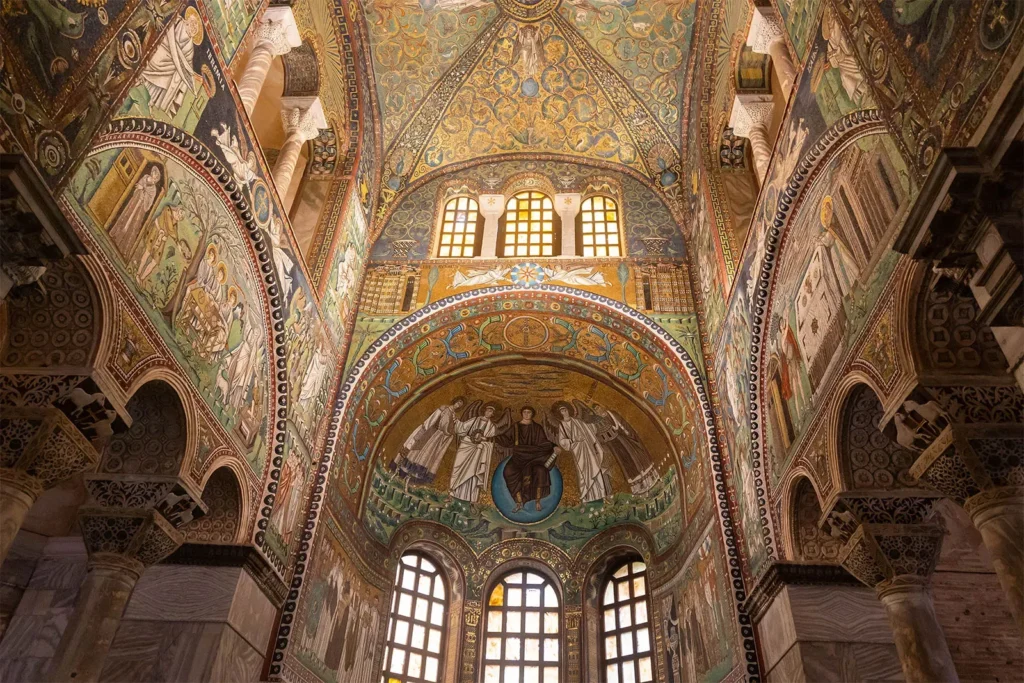
Inside the church, the central section is surrounded by two superposed ambulatories. The upper ambulatory, known as the matrimoneum, was possibly reserved for married women. Above the triforia, a series of mosaics depict Old Testament stories, including the Hospitality of Abraham, the Sacrifice of Isaac, Moses and the Burning Bush, as well as the stories of Jeremiah and Isaiah. The mosaics also include representations of the Twelve Tribes of Israel and the story of Abel and Cain. Each lunette is crowned by a pair of angels holding a medallion with a cross.
On the side walls, next to the mullioned windows, there are mosaics depicting the Four Evangelists, each shown with their symbolic animals: the angel (Matthew), the lion (Mark), the ox (Luke), and the eagle (John). These figures are presented in white robes, and the depiction of the lion is particularly remarkable for its ferocity.
The presbytery’s cross-ribbed vault is adorned with intricate mosaics featuring festoons of leaves, fruit, and flowers that converge on a crown encircling the Lamb of God. The crown is supported by four angels, and the entire surface is filled with a profusion of flowers, stars, birds, and animals, including many peacocks. Above the arch, two angels hold a disc, flanking depictions of the cities of Jerusalem and Bethlehem, representing the Jews and the Gentiles, respectively.
The mosaics are executed in the Hellenistic-Roman tradition, characterized by vibrant colors, imaginative depictions, and a certain use of perspective. The style, often referred to as the “jeweled style,” features a preference for geometric patterns over representation, common in Late Antiquity. These mosaics were completed while Ravenna was still under Gothic rule. The apse is flanked by two chapels— the prothesis and the diaconicon, which are typical elements of Byzantine architecture.
Triumphal Arch and Apse Mosaics
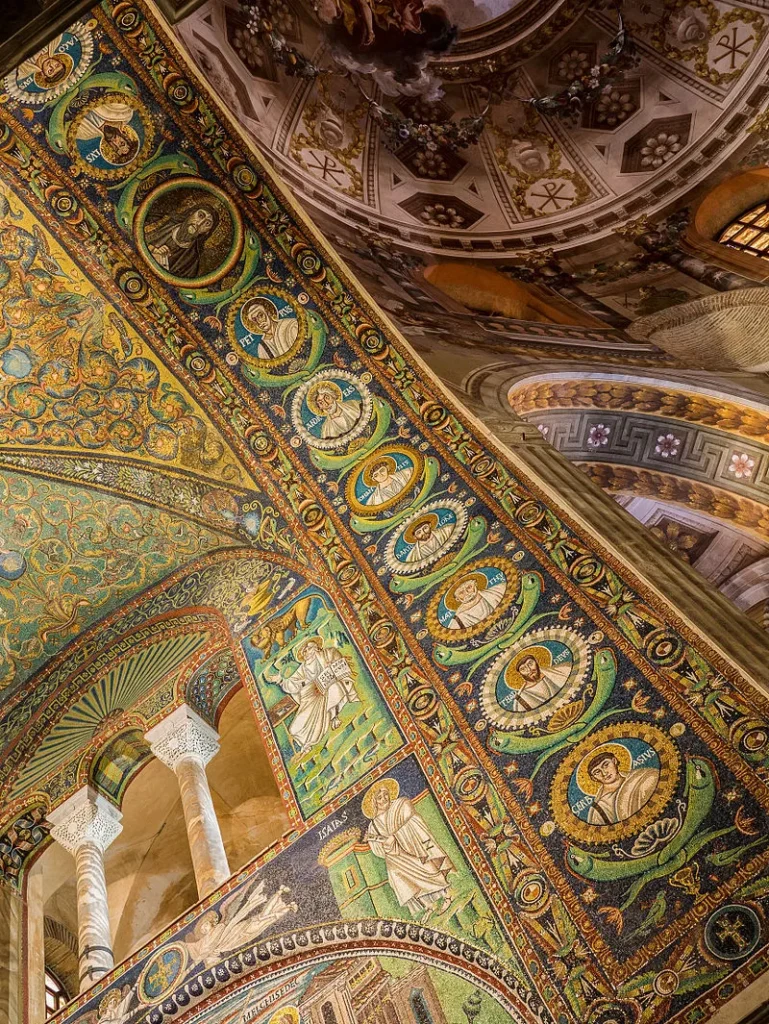
The great triumphal arch of San Vitale is decorated with fifteen mosaic medallions depicting Jesus Christ, the Twelve Apostles, and Saints Gervasius and Protasius, the sons of Saint Vitale. The mosaics were initiated in 525 under Bishop Ecclesius, and feature a gold fascia adorned with twining flowers, birds, and horns of plenty.
The apse mosaic centers around a youthful depiction of Jesus Christ seated on a blue globe, robed in purple. He is flanked by angels, and with his right hand, he offers the martyr’s crown to Saint Vitale, while on his left, Bishop Ecclesius offers a model of the church, symbolizing his role as the donor.
Justinian and Theodora Panels
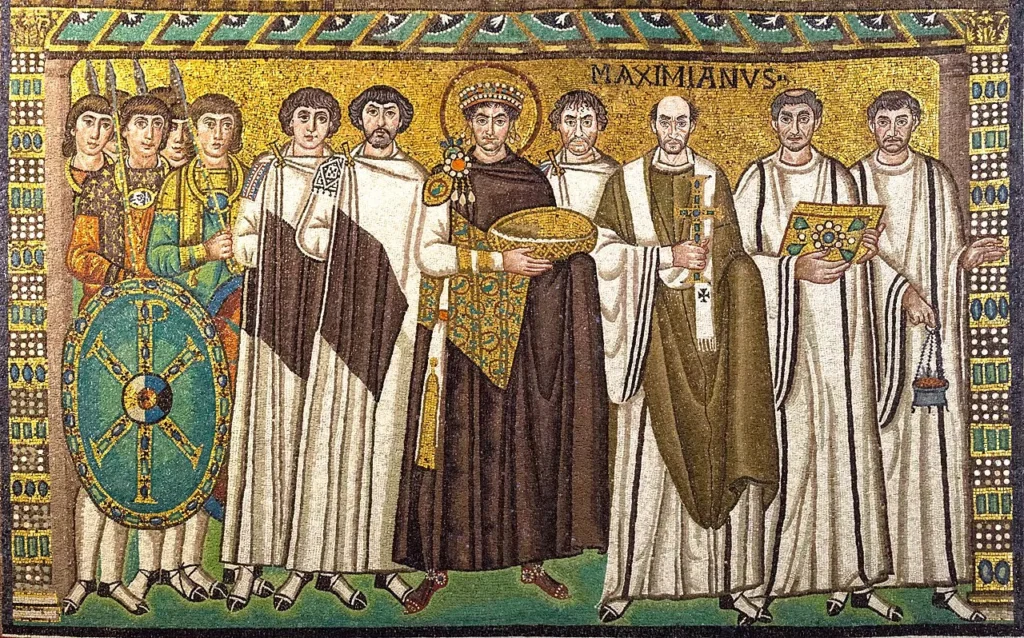
At the foot of the apse’s side walls are two famous mosaics completed in 547. On the left (but from the perspective of Christ in the apse, the right side) is the mosaic of Emperor Justinian I. He is depicted wearing Tyrian purple with a golden halo, standing in the company of court officials, generals Belisarius and Narses, and Bishop Maximian. The emperor stands in the center, flanked by soldiers and clergy, emphasizing his dual role as both the leader of the church and the state. The gold background of the mosaic suggests that Justinian and his entourage are inside the church, and the V-shaped arrangement of figures shows his importance, with lesser individuals placed behind him.
On the opposite wall, the mosaic of Empress Theodora presents her in a more elaborate setting. She is depicted with a golden halo, crown, and jewels, holding the Eucharistic vessel for the Precious Blood. Her background is more complex than Justinian’s, featuring a fountain, cupola, and lavish hangings, indicative of the wealth and luxury of her position. The intricately patterned textiles adorning the figures are possibly silks imported from the Sassanian Persian Empire. Some scholars have proposed that Theodora’s depiction may have been completed after her death in 548, but evidence suggests that the mosaics were finished by 547 when the church was consecrated. This is the only known image of Empress Theodora, contrasting with her portrayal in political rhetoric of the time.
Feast Day
Feast Day : 28th April
The Feast Day of the Basilica of San Vitale in Ravenna, Italy, is celebrated on April 28. This day honors Saint Vitale, the martyr to whom the basilica is dedicated. Saint Vitale was an early Christian martyr, and his feast day is observed in various Christian liturgical calendars, particularly in the Catholic and Orthodox traditions. The Basilica of San Vitale in Ravenna is one of the most important churches dedicated to him and stands as a significant monument to Byzantine art and architecture.
Church Mass Timing
Sunday : 9:30 PM
Church Opening Time:
Monday : 10:00 am – 4:30 pm
Tuesday : 10:00 am – 4:30 pm
Wednesday : 10:00 am – 4:30 pm
Thursday : 10:00 am – 4:30 pm
Friday : 10:00 am – 4:30 pm
Saturday : 10:00 am – 4:30 pm
Sunday : 10:00 am – 4:30 pm
Contact Info
Address:
Via San Vitale, 17, 48121 Ravenna RA, Italy.
Phone : +390544541688
Accommodations
Connectivities
Airway
Rimini Airport (RMI) to Basilica of San Vitale, Ravenna, Italy distance between 1 hr (69.9 km) via A14 and SS3bis.
Railway
Ravenna Railway Station to Basilica of San Vitale, Ravenna, Italy distance between 5 min (1.3 km) via Via Paolo Costa.