


Cathedral Basilica of St. Sabinus, Bari, Italy
Introduction
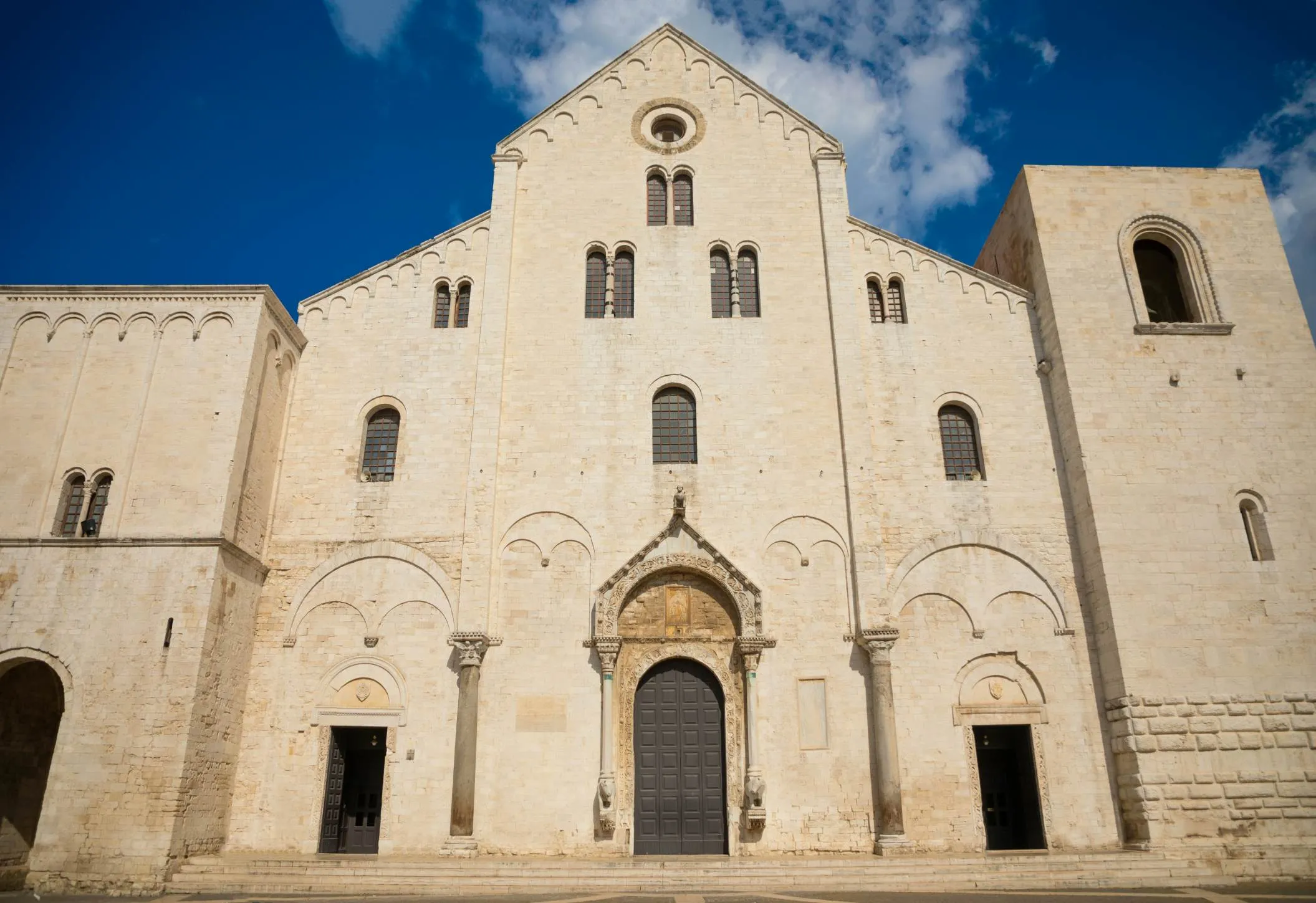
Bari Cathedral, or the Cathedral of Saint Sabinus (Italian: Duomo di Bari or Cattedrale di San Sabino), is the cathedral of Bari, located in the Apulia region of southern Italy. It serves as the seat of the Archbishop of Bari-Bitonto and was historically the seat of the bishops of Bari. The cathedral is dedicated to Saint Sabinus, a bishop of Canosa, whose relics were brought to Bari in the 9th century.
The current structure was built between the late 12th and late 13th centuries, with most of the work completed in the final thirty years of the 12th century. It was constructed on the site of the Imperial Byzantine cathedral, which was destroyed in 1156 by William I of Sicily, known as William the Wicked (il Malo). Traces of the original Byzantine pavement can still be seen to the right of the transept, extending beneath the nave.
Although less famous than the Basilica of Saint Nicholas in Bari, the Cathedral of Saint Sabinus is an important religious and historical site. Between 2006 and 2021, it was part of the “Romanesque Cathedrals of Puglia” serial asset, a tentative nomination for UNESCO World Heritage status, though it was removed from this list in 2021.
History of Cathedral Basilica of St. Sabinus, Bari, Italy
Early History and Construction
The documented presence of a bishop in Bari dates back to Gervasius, who attended the Council of Sardica in 347, and his successor Concordius, who participated in the Synod of Rome in 465. The names of earlier bishops are preserved by tradition, starting with Saint Maurus in the 1st century. The bishopric was elevated to an archbishopric in the 6th century, and evidence of a cathedral in Bari dates from the same period. Beneath the current nave, traces of an earlier church with an apse from before the first millennium have been uncovered. This church featured three aisles, square pilasters, and foundations slightly misaligned with the present cathedral. A mosaic pavement bearing the name of Bishop Andrea (758–761) suggests these remains belong to the first cathedral, which was destroyed in the 9th or 10th century.
Reconstruction in the 12th and 13th Centuries
In the first half of the 11th century, Archbishop (1025–1035) ordered the construction of a new episcopal church, which was completed under his successors, Nicola I (1035–1061) and Andrea II (1061–1068). This church was destroyed in 1156 by William I of Sicily, known as William the Wicked, along with most of the city. Only the Basilica of St. Nicholas was spared. At the end of the 12th century, Archbishop Rainaldo began the reconstruction of the cathedral, reusing materials from the earlier church and other demolished buildings. The new cathedral was consecrated on October 4, 1292, and was built in the style of the Basilica of St. Nicholas, which had temporarily served as the episcopal seat.
Baroque Refurbishments and Modern Restorations
In the 18th century, the façade, nave, aisles, Trulla (the ancient 12th-century baptistery, later converted into a sacristy), and crypt were refurbished in Baroque style under Archbishop Muzio Gaeta, based on designs by Domenico Antonio Vaccaro. Over the years, the cathedral underwent a series of refurbishments, demolitions, and extensions. In the 1950s, the original Romanesque appearance of the interior was restored. The most recent restorations occurred in the late 20th and early 21st centuries, which further clarified the Romanesque structures and refurbished the interior.
Architecture of Cathedral Basilica of St. Sabinus, Bari, Italy
Architectural Style and Facade
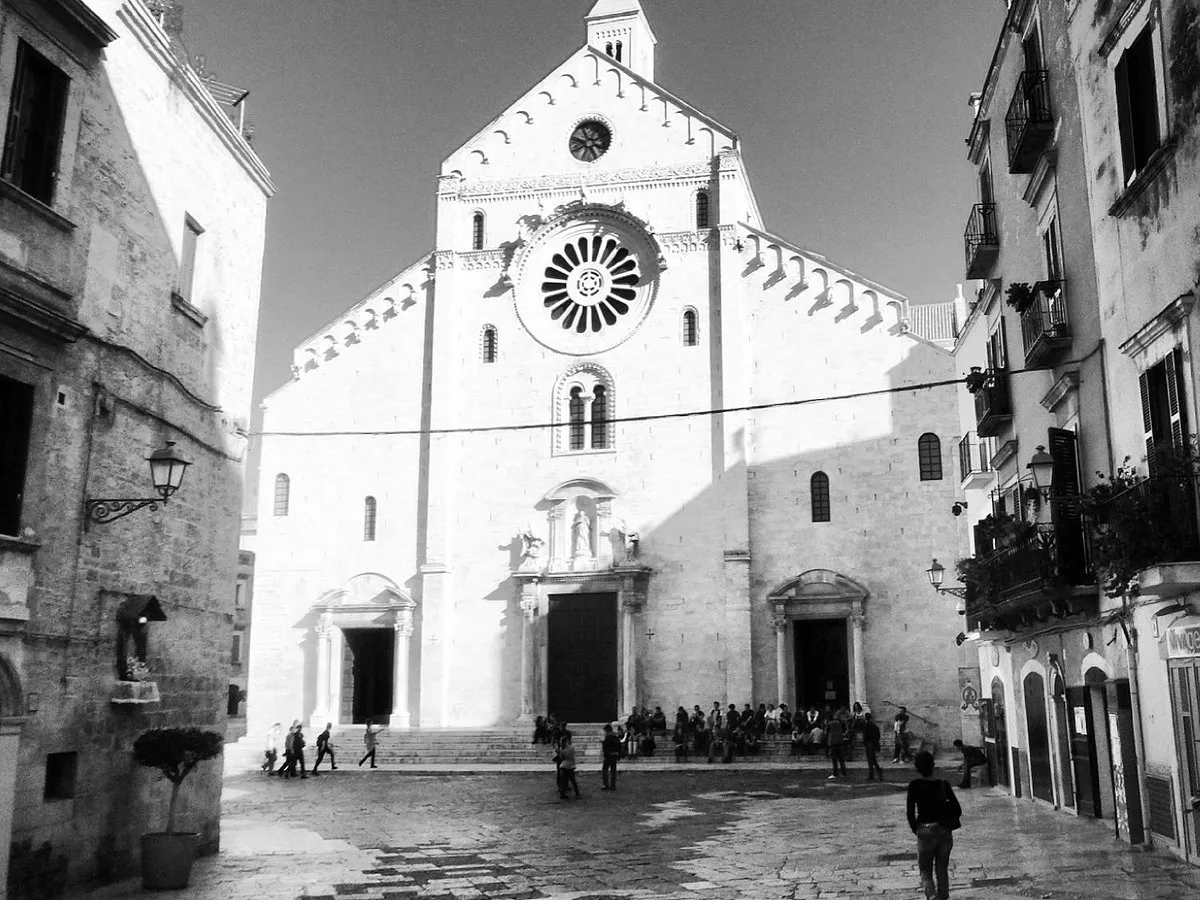
Bari Cathedral is a significant example of Apulian Romanesque architecture. The simple yet striking facade features three portals from the 11th century beneath a rose window, with a lintel intricately carved with monsters and fantastic beasts. The campanile was rebuilt in the modern era from stone similar to the original and includes an elaborate lantern tower. Beneath the tower, the dome of the cupola displays clear Moorish influences.
Interior Layout and Restoration
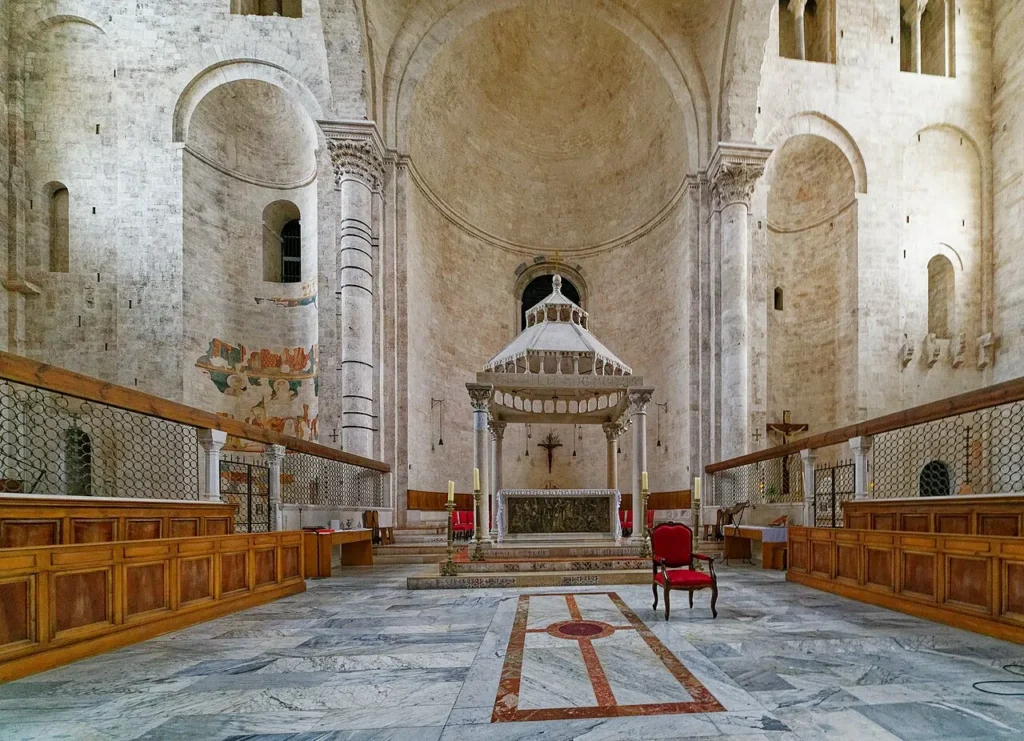
Internally, the cathedral is divided into three aisles, supported by sixteen columns with arcades. Originally overwhelmed by Baroque additions, the church has been carefully restored to reveal the uncluttered beauty of its original Apulian Romanesque style, particularly visible in the transept, false matroneum, and the magnificent pulpit, which has been rebuilt using the same material as the original. The nave features three naves separated by two rows of slender columns, likely from the earlier Byzantine church. Above the arches, false female galleries with large windows are framed by relieving arches. The stucco capitals and the ceiling with exposed beams have been reconstructed to match the original design. The ciborium of the main altar, dating back to 1233, was also rebuilt from the remains of the original.
The Crypt and Relics
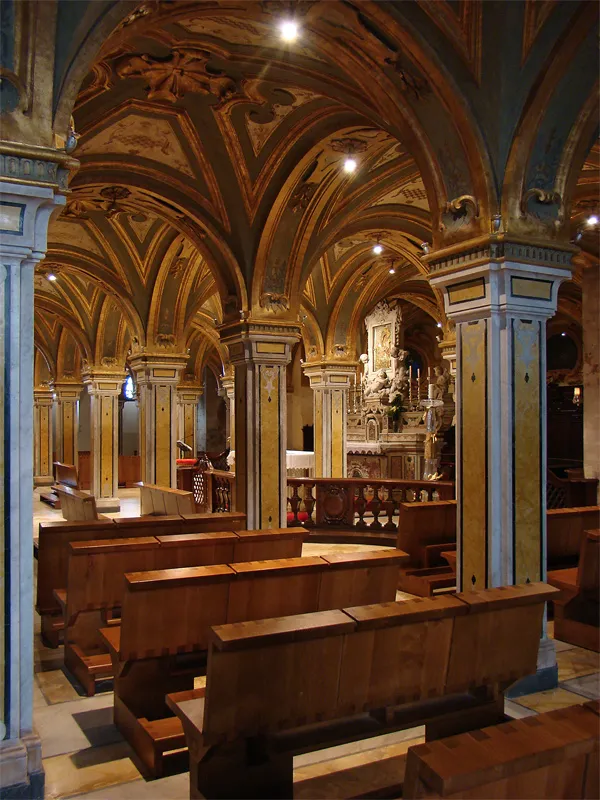
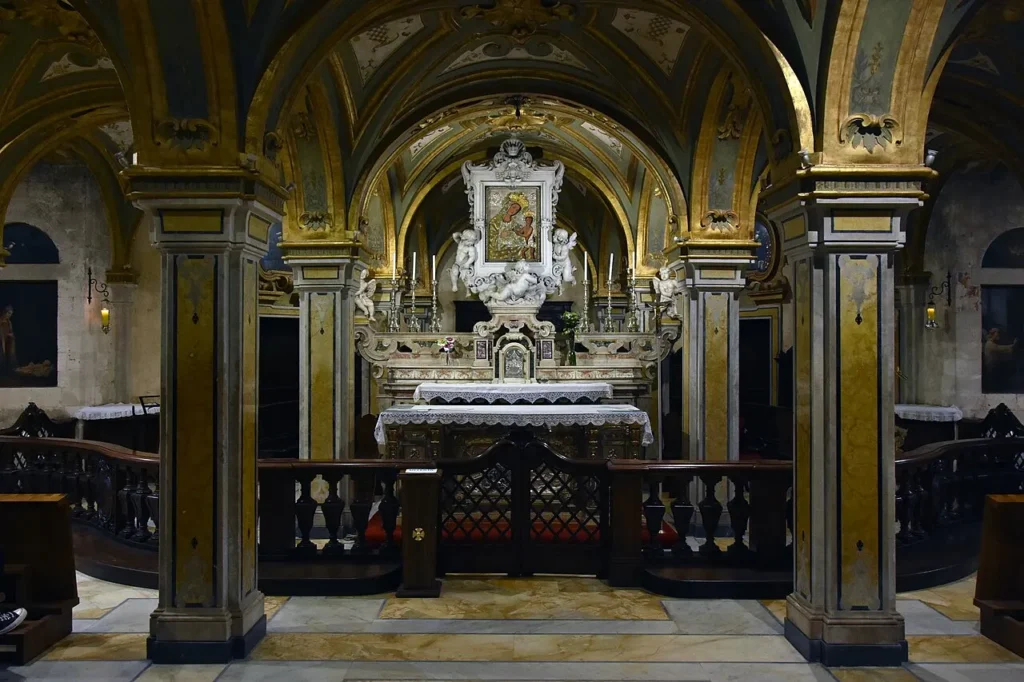
In the crypt, the relics of Saint Sabinus, Bishop of Canosa, are preserved on the main altar. These relics were brought to Bari in 844 by Saint Angelarius, who rescued them from the ruins of Canosa after the city was destroyed by the Saracens. The silver bust of Saint Sabinus was once housed here but was later moved to the capitular archive. Currently, the icon of the Madonna Odegitria, traditionally believed to have been brought from Constantinople in the 8th century, is venerated in the crypt, although it is actually a later addition, but still an object of great antiquity.
In smaller apses of the crypt are two sarcophagi. One holds the relics of Saint Columba, which has been restored, while the other contains various other relics. In the sacristy to the right of the cathedral is an altar with a painting, likely depicting Saint Maurus, who is traditionally recognized as the first bishop of Bari in the 1st century.
Floor and Decorative Features
On the floor of the nave, remnants of 14th-century polychrome marble and a mosaic rose window are visible, reproducing the design of the façade’s rose window. During the summer solstices, the sunlight passing through the rose window of the façade casts a shadow on the floor, with the 18 petals of the mosaic rose window aligning perfectly with the design of the rose window on the façade.
The Ambo and Romanesque Lions
To the right of the nave stands the reconstructed ambo, a lectern featuring the symbolic Frederickian eagle holding the lectern with its head. On either side of the staircase leading to the presbytery are two Romanesque lions, further adding to the cathedral’s medieval charm. The transept is raised and bordered by 13th-century plinths adorned with patterns that imitate oriental fabrics.
The Diocesan Museum and Byzantine Remains
Adjacent to the cathedral, in the Curia Palace, is the Diocesan Museum, which displays the Exultet, a precious manuscript of Byzantine origin, finely illuminated. Interestingly, the images in the manuscript are inverted, allowing the faithful to view the sacred drawings as the celebrant chants the hymn during the Easter Vigil.
Beneath the cathedral, visitors can explore the archaeological remains of the earlier Byzantine cathedral and the surrounding streets. Excavations have revealed polychrome mosaics that once decorated the floor, featuring figures such as fish and an octopus, along with funerary rooms, the remains of a Roman road, and traces of two small Byzantine churches, including some of their frescoes.
Feast Day
Feast Day : 11th February
The feast day of Saint Sabinus, the patron saint of Bari, is celebrated on February 11. This day honors Saint Sabinus, the bishop of Canosa, whose relics are kept in the Cathedral Basilica of San Sabino in Bari. It is a significant day for the city and the faithful who revere his memory and his contributions to the early Christian church.
Church Mass Timing
Monday : 8:30 AM , 7:00 PM
Tuesday : 8:30 AM , 7:00 PM
Wednesday : 8:30 AM , 7:00 PM
Thursday : 8:30 AM , 7:00 PM
Friday : 8:30 AM , 7:00 PM
Saturday : 8:30 AM , 7:00 PM
Sunday : 8:00 AM , 10:00 AM , 11:15 AM, 7:00 PM
Church Opening Time:
Monday : 8:30 am – 7:00 pm
Tuesday : 8:30 am – 7:00 pm
Wednesday : 8:30 am – 7:00 pm
Thursday : 8:30 am – 7:00 pm
Friday : 8:30 am – 7:00 pm
Saturday : 8:30 am – 7:00 pm
Sunday : 8:00 am – 10:00 am, 11:15 am – 7:00 pm
Contact Info
Address :
Piazza dell’Odegitria, 70122 Bari BA, Italy.
Phone : +390805210605
Accommodations
Connectivities
Airway
Bari Airport (BRI) to Cathedral Basilica of San Sabino Bari distance between 27 min (15.3 km) via SS16.
Railway
Bari Centrale to Cathedral Basilica of San Sabino Bari distance between 9 min (2.7 km) via Lungomare Imperatore Augusto.