


Santissima Annunziata, Florence, Italy

Introduction
The Basilica della Santissima Annunziata (Basilica of the Most Holy Annunciation) is a Renaissance-style, Catholic minor basilica in Florence, region of Tuscany, Italy. This is considered the mother church of the Servite Order. It is located at the northeastern side of the Piazza Santissima Annunziata near the city center. Santissima Annunziata – Florence. One of the most highly venerated Marian shrines in Florence, the church was founded in 1250 as the Oratory of Cafaggio, by the Seven Holy Founders of the Servite Order.
History of Santissima Annunziata, Florence, Italy

The church was founded in 1250 by the seven original members of the Servite Order. In 1252, a painting of the Annunciation had been begun by a friar Bartolomeo, commissioned by the Servite monks. It is said he despaired about being able to paint a virgin with a beautiful enough face, and fell asleep, only to find the painting completed.
This miracle he attributed to an angel. The painting now housed in the church, acquired increasing veneration, such that in 1444 the Gonzaga family from Mantua financed a special tribune. Initially Michelozzo, who was the brother of the Servite prior, was commissioned to build it, but since Ludovico III Gonzaga had a special admiration for Leon Battista Alberti, this latter architect was given the commission in 1469. Alberti’s designs were constricted by the pre-existing foundations. Construction was completed in 1481, after Alberti’s death. Though the structure was refurbished in Baroque-style in the seventeenth century, the basic scheme of a domed circular space flanked by altar niches is still evident.
The facade of the church was added in 1601 by the architect Giovanni Battista Caccini, imitating the Renaissance-style of Brunelleschi’s facade of the Foundling Hospital, which defines the eastern side of the piazza. The building across from the Foundling Hospital, designed by Sangallo the Elder, was also given a Brunelleschian facade in the 1520s.
Architecture of Santissima Annunziata, Florence, Italy
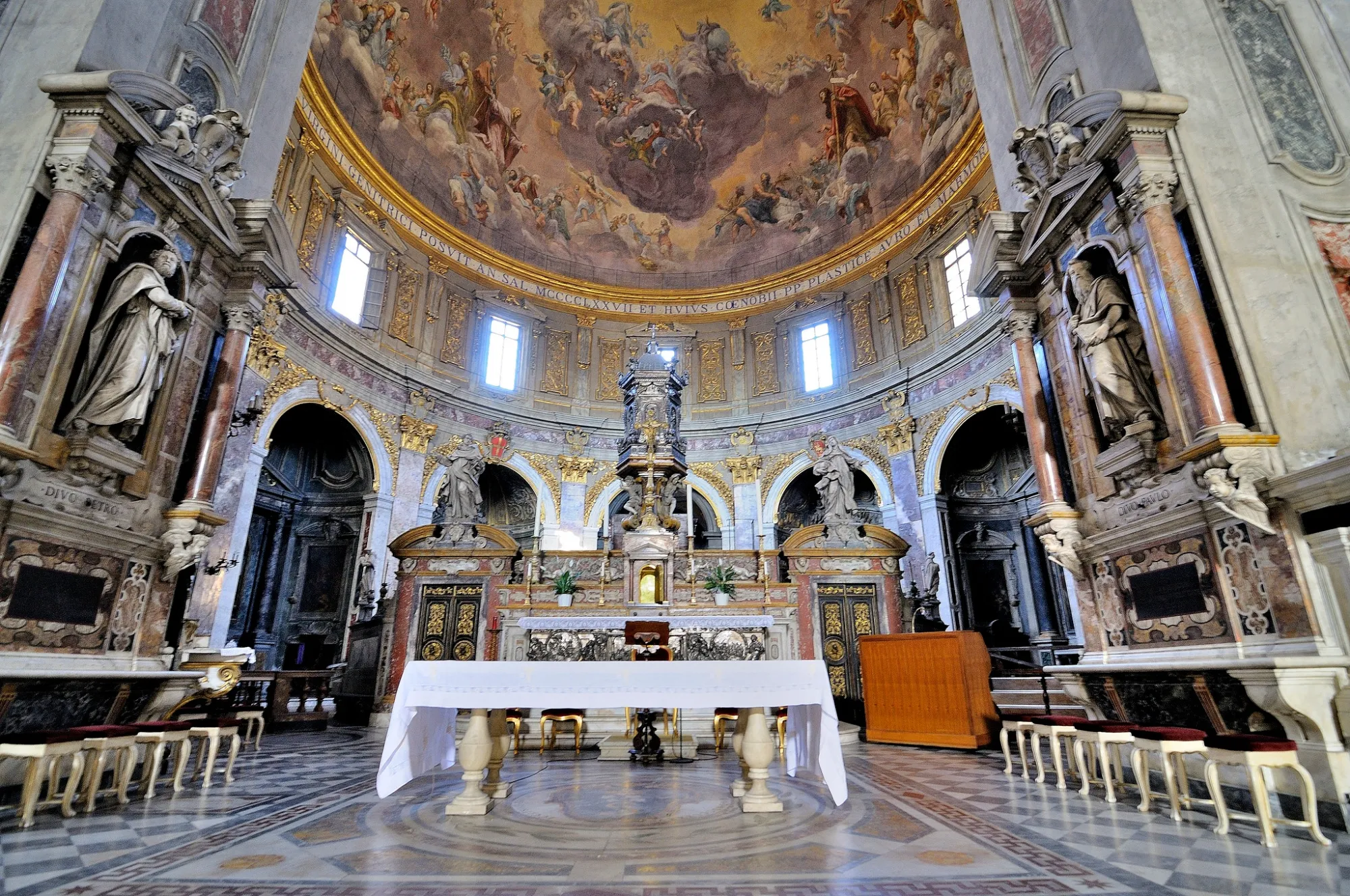
This church is entered from the Chiostrino dei Voti. The Baroque decoration of the church interior was begun in 1644, when Pietro Giambelli frescoed the ceiling with an Assumption as a centerpiece based on designs by Baldassare Franceschini. The 1st chapel to right contains a Madonna in Glory by Jacopo da Empoli, with walls frescoed by Matteo Rosselli. The 5th chapel on the right contains a Monument to Orlando de’ Medici (1456) by Bernardo Rossellino. The right transept has a small side chapel has a Pietà (1559) by Baccio Bandinelli and graces his tomb.
The chapel-surrounded tribune or choir, known as the Rotonda, was designed in turn by Michelozzo and Alberti between 1444 and 1476. Notable among the chapels is the fifth (aligned to nave axis), which has a crucifix (1594–8) by Giambologna for his tomb, with statues of the “Active and Contemplative Lives” by his pupil Francavilla, saints and angels by Pietro Tacca, and murals by Bernardino Poccetti. The next chapel has a Resurrection (1548–52) by Bronzino with a statue of St Roch attributed to Veit Stoss. The next chapel has a Madonna with Saints by a follower of Perugino.
In the sixth chapel to the left of the nave is a SS Ignatius, Erasmus and Blaise by Raffaellino del Garbo; the next chapel has one of the panels of Annunziata Altarpiece (1507) by Perugino, once at the high altar of the church (the Deposition, begun by Filippino Lippi, is now at the Gallerie dell’Accademia, while other panels are divided between other collections in the world). The altarpiece of the next chapel has a Trinity with Saint Jerome and two saints by Andrea del Castagno, who also painted the mural of The Vision of St. Julian in the next chapel, called the Feroni chapel. This chapel was elaborately decorated in a baroque fashion by Gianbattista Foggini in 1692. The first chapel just to the left of the entrance has a tabernacle of the Annunciation (1448–52) by Michelozzo and the sculptor Pagno di Lapo Portigiani .
The organ built by Domenico Di Lorenzo da Lucca in 1509–1521 is the oldest in Florence and the third oldest in Italy. Today the titular organist of the church is Simone Stella. The church contains the tomb of the Italian writer Maria Valtorta. A memorial was erected in the church to the painter Giovanna Tacconi Messini by her husband after her death.
The Church Cloister

The Chiostrino dei Voti was designed by Michelozzo. The center of this small cloister in front of the basilica facade is now sheltered by a glass roof. Baldovinetti painted the first lunette in the chiostro in c. 1460. In about 1476, Rosselli began its decoration with a lunette dedicated to the then blessed Filippo Benizzi, fifth Prior General of the Servites. Further lunettes were added (1509–1510) by Andrea del Sarto.
The large cloister, known as the Chiostro Grande or dei Morti, flanking the northwest of the church, contains the famous frescoed lunette depictiong the Madonna del Sacco (1525) by del Sarto.
The Capella di San Luca, which opens off it, has belonged to the artists confraternity or the Accademia delle Arti del Disegno since 1565. Many artists are buried in its vault, including Benvenuto Cellini, Pontormo, Franciabigio, Giovanni Angelo Montorsoli and Lorenzo Bartolini. Inside is Pontormo’s Holy Family painted for church of St. Ruffillo and murals by Alessandro Allori: Trinity; Vasari: St. Luke paints Madonna; and Santi di Tito: Solomon directs the construction of the temple of Jerusalem. The ten large stucco figures were sculpted by Vincenzo Danti, Montorsoli and others.
Most part of the Cloister of SS. Annunziata is today the seat of Istituto Geografico Militare (IGM). In 2007, in the west part of the cloister occupied by the Istituto, the group found a monumental stair by Michelozzo, previously hidden, an Annunciation attributed to Paolo Uccello[citation needed], and some ‘Grottesche’ frescoes by Morto da Feltre.
The Atrium of the Church

Pontormo’s Visitation (see right) for which he was paid the meagre, for Vasari, sum of 16 scudi, is the highlight of the now-covered entrance atrium (see far right) known as the Ciostrino dei Voti as it was filled with wax votive offerings, it is something of an argument for Mannerism’s ability to impress, although it is still very Raphael-inspired. The scene in the arch above is The Sacrifice of Isaac. Pontormo was buried under his fresco, but his body was moved to the chapel devoted to artists by Fra Giovan Angelo Montorsoli in 1562, under the Trinity painted by Bronzino, his pupil, and Allori. The decoration of the cloister had begun with works by Baldovinetti and Rosselli. Fifty years later Rosselli’s work was continued with five frescoes by Andrea del Sarto (Pontormo and Rosso’s master) from the life of Saint Filippo Benizzi, his first public commissions from 1509-10 and opposite his two scenes from the life of the virgin, The Journey of the Magi and the Nativity of the Virgin, painted later, from 1513.
The latter is the better of the two, looking to have been very influenced by Ghirlandaio’s Tornabuoni Chapel frescos in Santa Maria Novella. The Journey of the Magi, Pontormo’s Visitation and the Assumption of the Virgin by Rosso were all removed and restored and grouped in the marvellous first room of the 2014 Pontormo and Rosso exhibition at the Strozzi. Also here is Franciabigio’s Marriage of the Virgin which was painted in 1513. Vasari tells us that Franciabigio was so angry with the Servite brothers for uncovering the fresco before it was finished that he attacked some of the heads, including the Virgin’s, with a mason’s hammer. Franciabigio was ordered to repair the fresco but this was apparently ignored, as the damage is still clearly visible. The recent restoration of the frescoes in the atrium was completed in 2017.
Leonardo connections
Leonardo da Vinci stayed her for a while on his return to Florence in 1500. He was commissioned to paint the high altarpiece here, but the job went to Filippino Lippi when Leonardo was called away to work for Cesare Borgia as a military engineer in the summer of 1502. His father Ser Piero, a notary, and the del Giacondo brothers established their professional and personal links through their involvement with this church, and it is this which led to Leonardo’s commission to paint Lisa del Giacondo.
Veneration

Pilgrims who came to the church to venerate the miraculous painting often left wax votive offerings, many of them life-size models of the donor (sometimes complete with horses). In 1516, a special atrium was built to house these figures, the Chiostrino dei Voti. By the late 18th century there were some six hundred of these images and they had become one of the city’s great tourist attractions. In 1786, however, they were all melted down to make candles. Pope Alexander VI, in appreciation for the survival of Rome after French occupation, paid homage and gifted a silver effigy to the church. The Florentine brides traditionally visit the shrine to leave their bouquets
Santissima Annunziata Festivals
The Festival of the Annunziata, also known as the Feast of the Annunciation, is a significant religious and cultural event celebrated in Florence, Italy. The feast commemorates the announcement by the Archangel Gabriel to the Virgin Mary that she would conceive and become the mother of Jesus Christ.
The festival typically takes place on March 25th, exactly nine months before Christmas, the day traditionally believed to be the date of Christ’s conception. In Florence, the celebration involves various religious ceremonies, processions, and cultural events.
One of the central elements of the Festival of the Annunziata in Florence is the religious procession. During the procession, a statue of the Virgin Mary is carried through the streets of the city, often accompanied by clergy, musicians, and worshippers. The procession usually starts from the Basilica della Santissima Annunziata, a church dedicated to the Annunciation, and makes its way through the historic center of Florence.
The Basilica della Santissima Annunziata itself is a focal point of the celebrations. It is one of the most important Renaissance churches in Florence, known for its stunning architecture and rich artistic heritage. Pilgrims and visitors flock to the basilica during the festival to pay homage to the Virgin Mary and participate in special Masses and prayers
In addition to the religious aspects, the Festival of the Annunziata often includes cultural events such as music concerts, art exhibitions, and traditional food festivals. These events showcase the vibrant cultural heritage of Florence and provide opportunities for locals and tourists alike to come together in celebration.
Overall, the Festival of the Annunziata is a cherished tradition in Florence, blending religious devotion with cultural festivities, and attracting people from near and far to join in the commemoration of the Annunciation.
Feast Day
Feast day : 25th March
Mass Timing
Monday to Saturday : 7am, 8am, 9am, 10am, 11am, 12pm and 6pm
Sundays: 7am, 8:30am, 10am, 11:30am, 1pm, 6pm and 9pm
Church Opening Time:
Monday to Saturday : 07.30 AM to 12.30 PM and 04.00 PM to 06.30 PM
Sunday : 08.45 PM to 09.45 PM
Contact Info
Address:
Piazza della Santissima
Annunziata – 50121 Florence,
Italy.
Tel: +39 055 266181.
Dribbble
Envelope
Facebook
Instagram
Youtube
Accommodations
Connectivities
Airway
Amerigo Vespucci Airport to Santissima Annunziata, Florence, Italy Distance 34 min (12.1 km) via SS67.
Railway
Firenze Santa Maria Novella Train Station to Santissima Annunziata, Florence, Italy Distance 7 min (1.4 km) via Via Guelfa.