


Saint Bavo’s Cathedral, Ghent, Belgium
Introduction
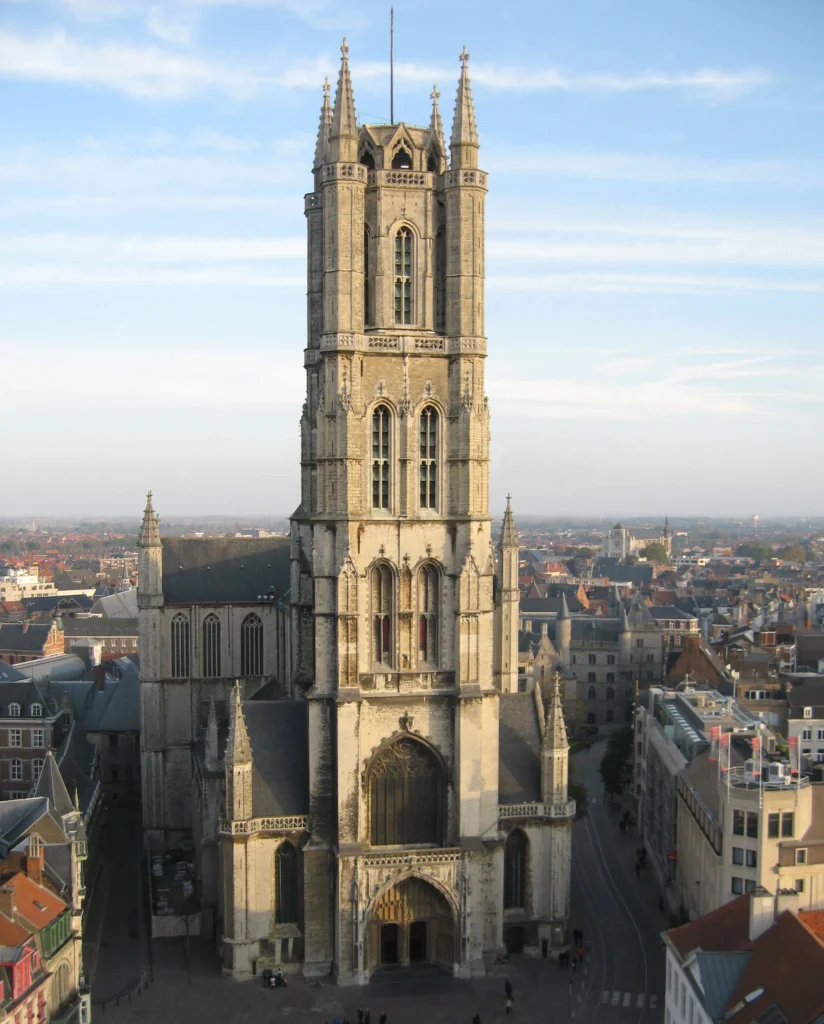
Bavo’s Cathedral in Ghent, Belgium, is a place of pilgrimage for both religious people and those interested in cultural history. Among other things, the abbey houses one of the most important works of European art history – the «Adoration of the Mystic Lamb», attributed to the van Eyck brothers. Saint Bavo’s Cathedral, also known as Sint-Baafs Cathedral (Dutch: Sint Baafskathedraal), is a cathedral of the Catholic Church in Ghent, Belgium. The 89-meter-tall Gothic building is the seat of the Diocese of Ghent and is named for Saint Bavo of Ghent. It contains the well-known Ghent Altarpiece.
History of Saint Bavo’s Cathedral, Ghent, Belgium
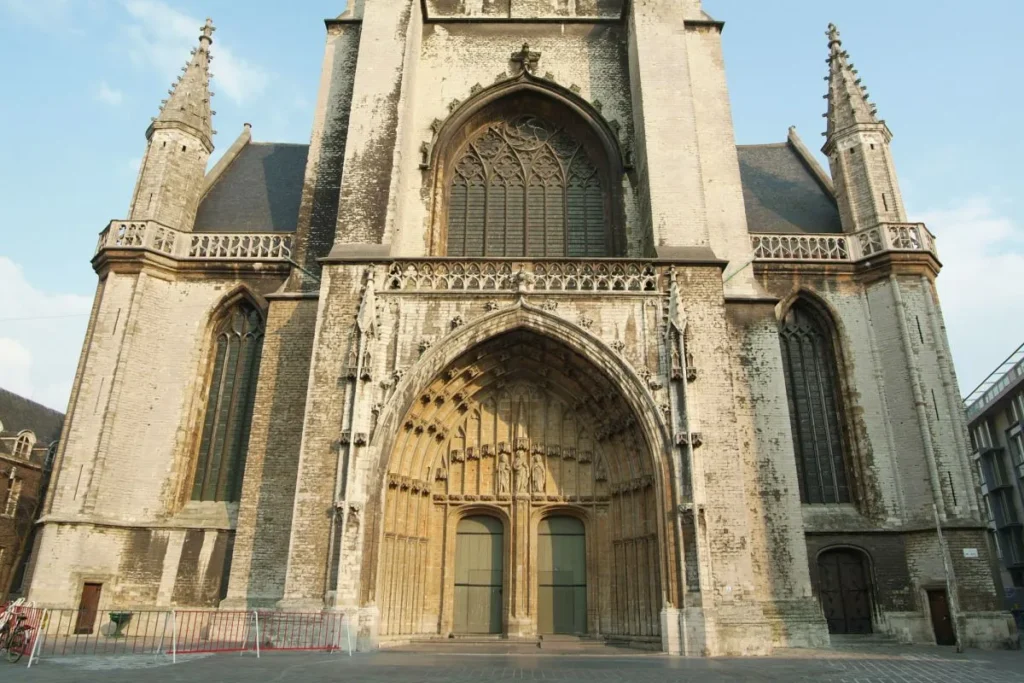
Transmarus, bishop of Tournai and Noyon, is said to have consecrated a church on this site in 942 to Saint John the Baptist. This was followed in the mid 12th century by a romanesque church, traces of which visitors can still find in the the crypt decorated with murals. In the Middle Ages, Ghent flourished into a powerlful city, allowing churches to be build larger and more lavishly. Saint John’s Church was converted to the Gothic style during the 15th and 16th centuriess, and gradually took on its current form.
In 1536, on orders of Emperor Charles V, the centuries-old Saint Baafs Abbey was dissolved. Most of the abbey was demolished after the Ghent uprising in 1540 and converted into military barracks. The abbot and monks were secularized and given the title of canon. Their chapter transferred to Saint John’s Chruch, which from then on was called Saint Baafs Church. In 1559, the diocese of Ghent was established by which the church became Saint Bavo’s Cathedral. In the long line of pastors of the diocese of Ghent, seventh bishop, Antonius Triest, must certainly be mentioned. The rich, baroque interior of the cathedral as we see it today bears his powerful imprint.
The diocese of Ghent was founded in 1559 and the church became St Bavo’s Cathedral. Among the long line of shepherds of the diocese of Ghent, the figure of the seventh bishop, Antonius Triest, should certainly be mentioned. The cathedral’s rich, baroque interior as we see it today bears his powerful stamp.
In the summer of 1566, bands of Calvinist iconoclasts visited Catholic churches in the Netherlands, shattering stained-glass windows, smashing statues, and destroying paintings and other artworks they perceived as idolatrous. However, the altarpiece by the Van Eycks was saved.
About Saint Bavo’s
Saint Bavo, also known as Saint Baaf or Saint Bavon, a saint in the Christian tradition lived during the 7th century in Belgium. Bavo was originally a nobleman named Allowin van Haspengouw, who lived a life of luxury and excess. Legend has it that after the death of his wife, Bavo experienced a profound spiritual transformation. He renounced his wealth and devoted himself to a life of prayer, penance, and service to the poor. Eventually, he became known for his piety and asceticism. He was venerated as a saint after his death. He is particularly revered in the region of Flanders, where his relics are housed in this St. Bavo’s Cathedral in Ghent, Belgium.
Saint Bavo is often depicted in religious art and iconography, symbolizing repentance, conversion, and the transformative power of faith. His feast day is celebrated on October 1st in the Roman Catholic Church.
Architecture of Saint Bavo’s Cathedral, Ghent, Belgium
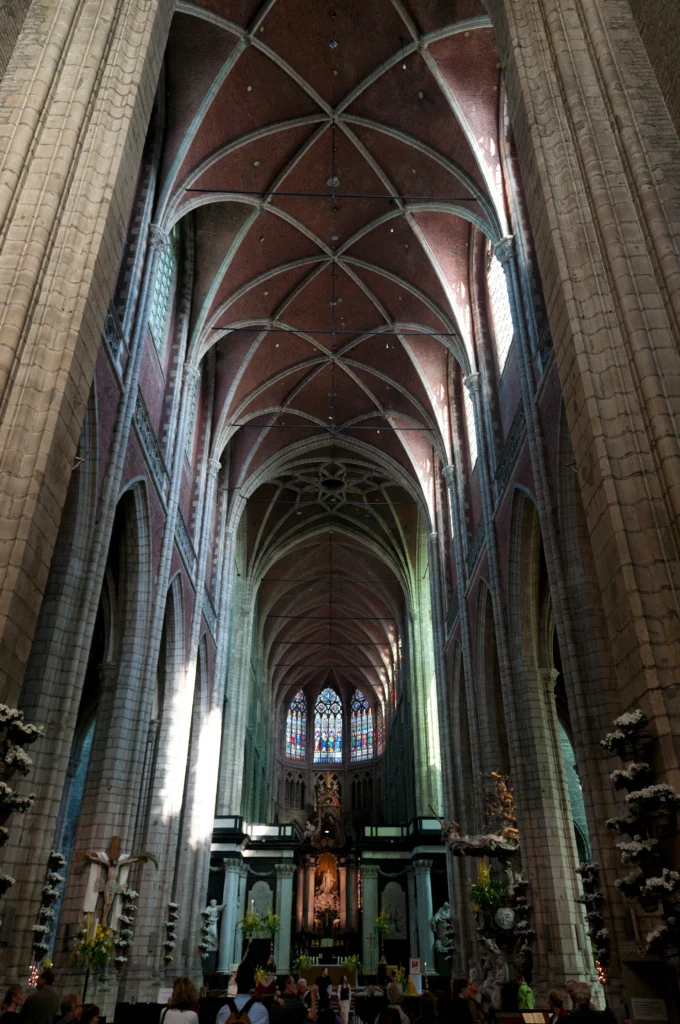
Construction of the Gothic church began around 1274. In the subsequent period from the 14th through 16th centuries, nearly continuous expansion projects in the Gothic style were executed on the structure. A new choir, radiating chapels, expansions of the transepts, a chapter house, nave aisles and a single-tower western section were all added. In 1539, as a result of the rebellion against Charles V, who was baptized in the church, the old Abbey of St. Bavo was dissolved. Its abbot and monks went on to become canons in a Chapter that was attached to what then became the Church of Saint Bavo. When the Diocese of Ghent was founded in 1559, the church became its cathedral. Construction was considered complete on 7 June 1569.
In the summer of 1566, bands of Calvinist iconoclasts visited Catholic churches in the Netherlands, shattering stained-glass windows, smashing statues, and destroying paintings and other artworks they perceived as idolatrous. However, the altarpiece by the Van Eycks was saved. In 2012, extensive restoration treatment was required. Carried out in the Museum of Fine Arts in Ghent by the Royal Institute for Cultural Heritage and with financial support from the Flemish Government and the Baillet-Latour Fund, the old hardened varnish layers and overpaintings were meticulously removed.
Interior
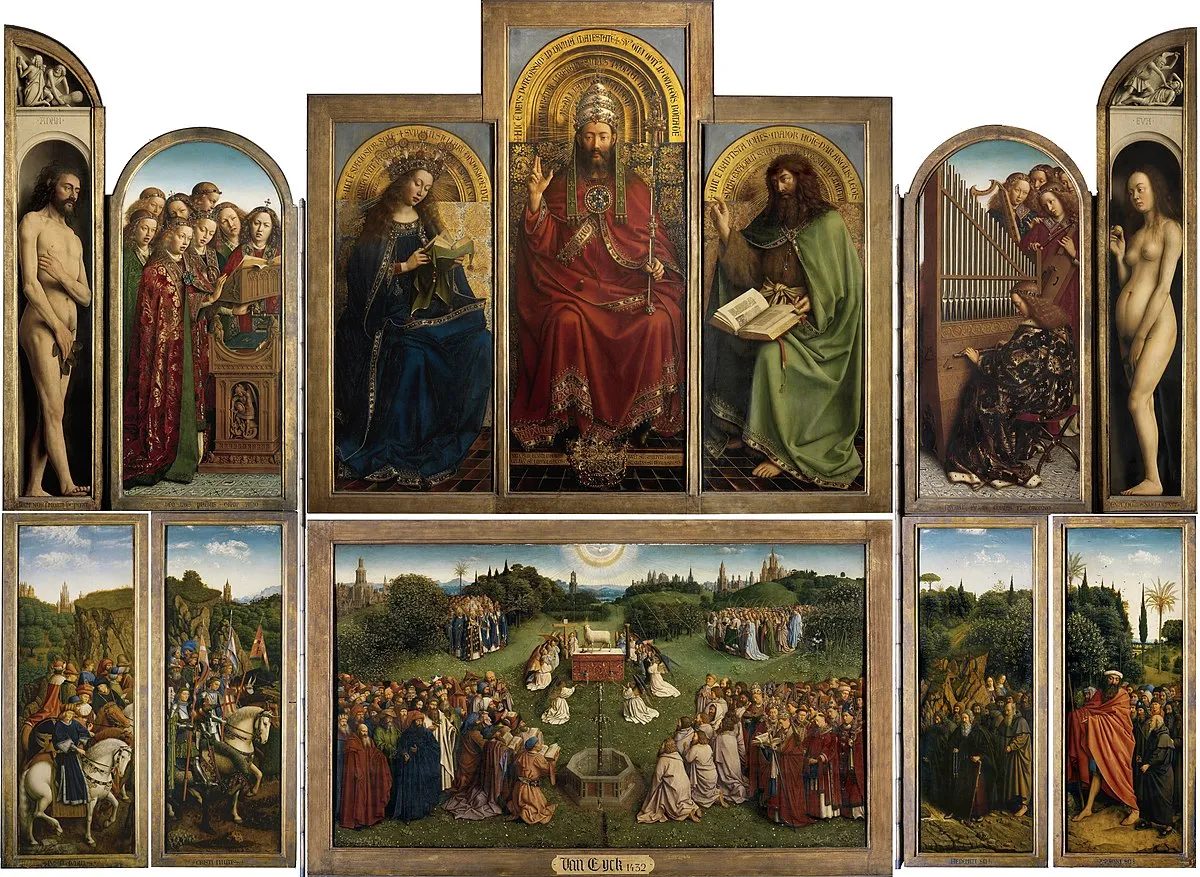
The cathedral is noted for the Ghent Altarpiece, originally in the Joost Vijd Chapel. It is formally known as the Adoration of the Mystic Lamb after its lower centre panel by Hubert and Jan van Eyck. This work is considered Van Eyck’s masterpiece and one of the most important works of the early Northern Renaissance, as well as one of the greatest artistic masterpieces of Belgium. Part of the painting, the lowermost left panel known as The Just Judges, was stolen in 1934 and has not been recovered. It has since been replaced with a facsimile by Jef Van der Veken.
The cathedral has four organs for use at liturgical celebrations. Most famous is the main organ in the Upper church, the biggest organ in the Benelux. In 1935 Mgr Coppieters commanded that the Klais organ from the world exhibition would be put inside the cathedral. The organ case dates from the 18th century and the complete organ has more than 6000 pipes inside. It has 5 manuals.
Choir
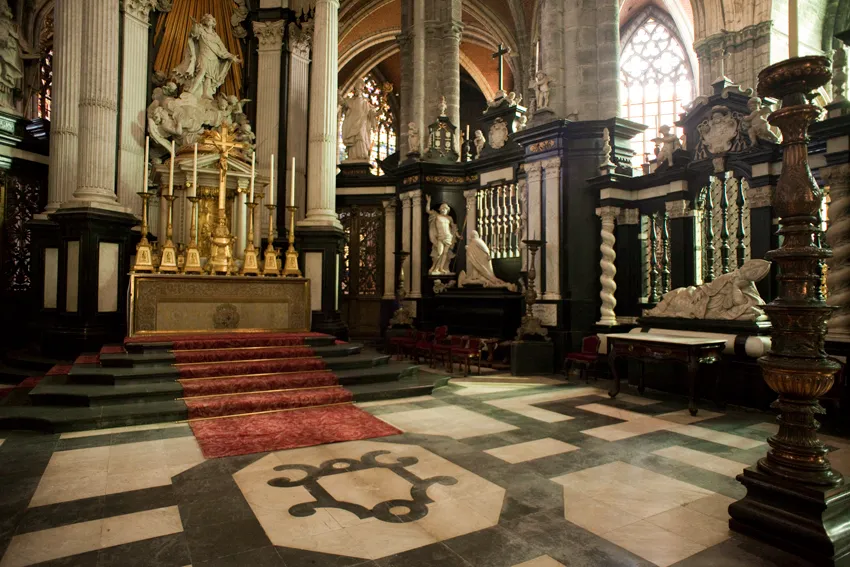
The most impressive part is the high choir with stalls for the members of the Chapter of Saint-Bavon. The episcopal throne is located on the right side with the episcopal arms visible. Highlights of the interior decoration of the choir include the Baroque high altar (1702–1782), in white, black, and red flamed marble, and the tomb monuments of Ghent bishops, including that of Antonius Triest, in white and black marble (1652–1654), a major work of Jerôme Duquesnoy (II). On the right side is the gallery with painted crests of the members of the Order of the Golden Fleece.
In the choir is the 1559 painting The Queen of Sheba visits King Solomon by the Flemish artist Lucas de Heere. This allegorical work depicts King Solomon as Philip II of Spain, recognizable by his facial features, receiving gifts from the Queen of Sheba, an allegory of the Low Countries, representing that country donating its riches to the Spanish king in thanks for his prudent government.
Nave
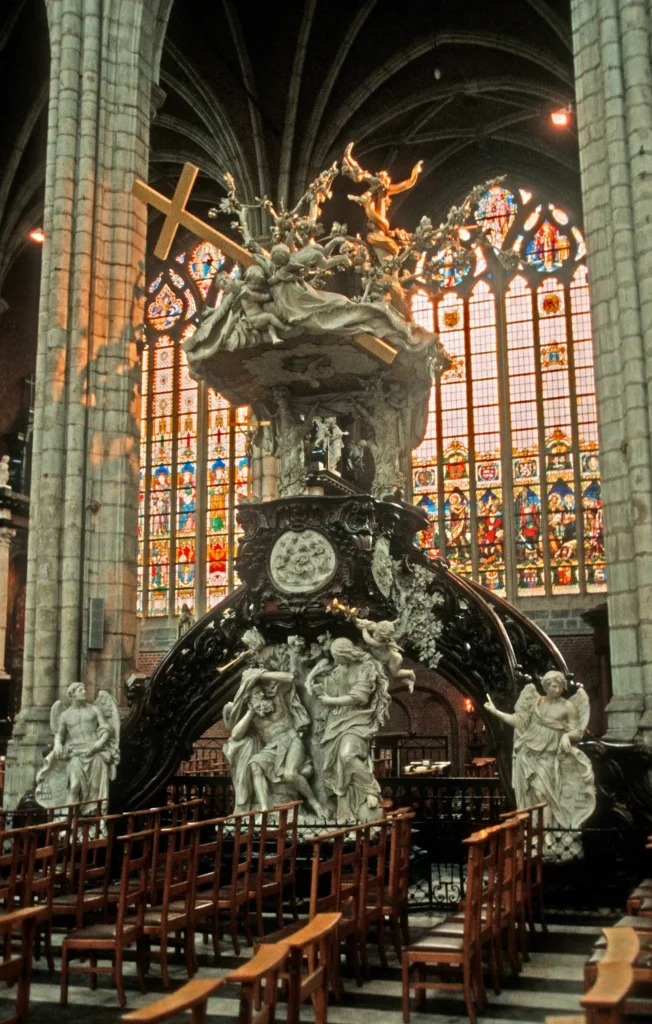
In the nave we find an impressive rococo pulpit (1741–1745), made in oak, gilded wood and white and black marble by Laurent Delvaux, with wrought-iron railings by J. Arens. There are also chairs designed by the contemporary designer Maarten Van Severen. The main altar is placed between the nave and the choir.
Treasury and crypt
In the Chapel of the Holiest an important Calvary Triptych is on display. This 15th-century work is attributed to Justus van Gent. Finally, there is a valuable collection of important liturgical plates, reliquaries, and liturgical vessels dating from the 15th century onward. Among the important reliquaries are the head of Saint John the Baptist and of Saint Macarius. The important collection of hand-embroidered and brocaded liturgical ornaments is widely known as one of the most important of the country, some of which are put on display.
The Ghent Altarpiece is not the only masterpiece that is housed within the old walls of the Ghent cathedral. From the in 1536 abolished Saint Bavo’s Abbey, the monks transferred various objects to the former Saint Bavo’s Church. One of the most special is Livinus’ manuscript which contains the four Gospels. It is one of the oldest preserved books in Belgium, since it dates from the 9th century.
Feast Day
Saint Bavo’s feast day is celebrated on October 1st in the Roman Catholic Church.
Church Opening Time
Cathedral:
Mon – Sat: 8:30 am – 5.30 pm
Sun: 1 pm – 5.30 pm
Mass Timing
Monday, Tuesday & Thursday: 5.00 PM
Friday: 8:15 AM
Saturday: 8:15 AM & 5 PM (Vigil)
Sunday: 7 AM, 9 AM & 11 AM
Contact Info
Address
Sint-Baafsplein 1, 9000 Gent, Belgium
15,520 people checked in here
Phone : +32 9 269 20 45
Dribbble
Youtube
Facebook
Instagram
Accommodations
Connectivities
Airway
Brussels Airport (BRU) to Saint Bavo’s Cathedral, Ghent Distance 56 min (66.4 km) via E40
Railway
Gent-Sint-Pieters train Station to Saint Bavo’s Cathedral, Ghent 10 min (2.8 km) via Kortrijksesteenweg/N414